How to Buy Chiliz (CHZ): A Guide for 2026
Learn how to buy CHZ on Bitunix in 2026, what Chiliz is, why it still matters, and how to buy CHZ with USDT step by step.

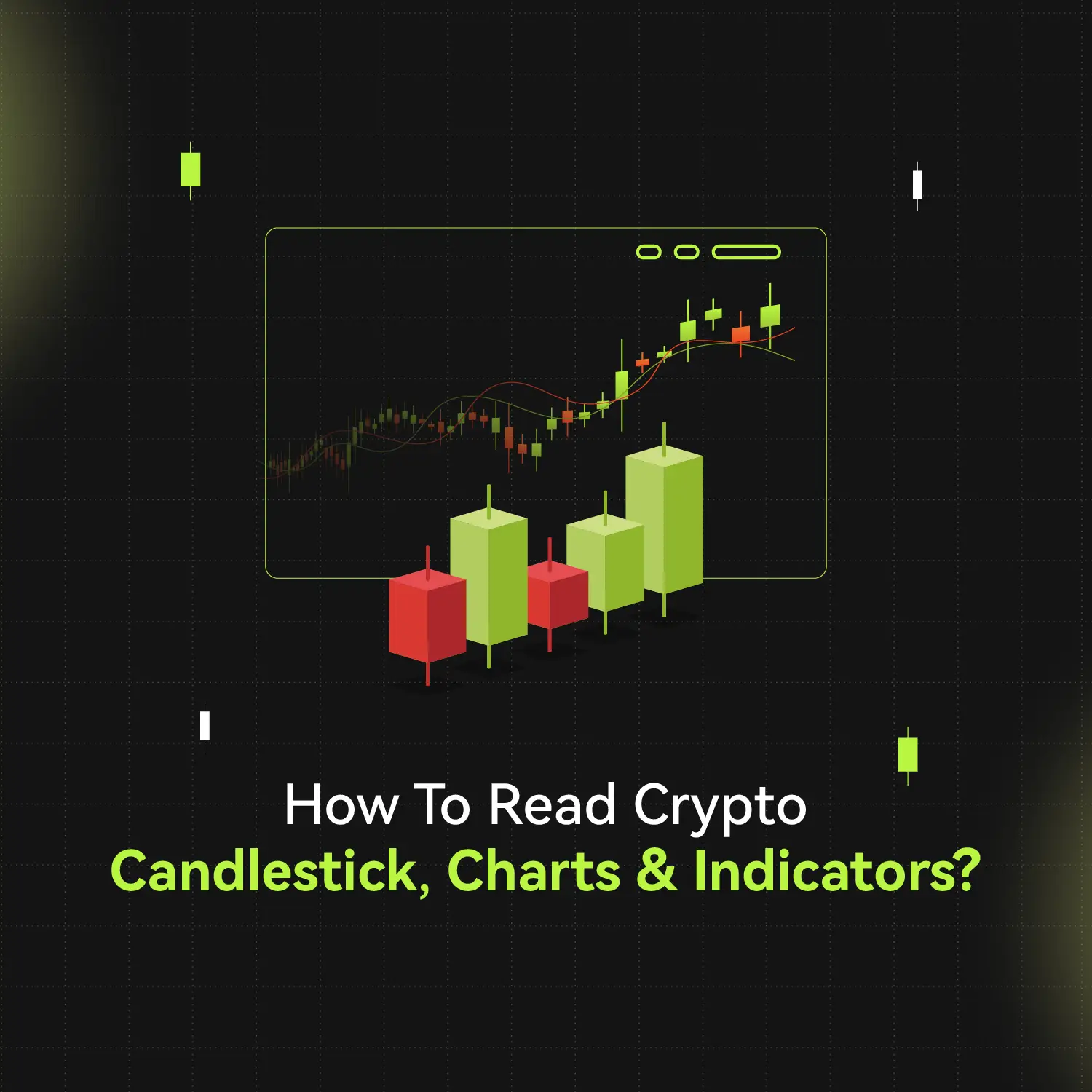
A crypto candlestick chart visually represents the trading activity of a digital asset over a selected period. It provides crucial information such as the asset’s opening price, closing price, highest point, and lowest point.
An asset’s candlestick chart showcases the real time price performance, including the trading price and the trading volume. Whether you’re a day trader or a long-term investor, understanding these charts can offer an edge in navigating the volatile nature of the crypto market.
Technical indicators play a vital role in crypto trading because they provide data-driven insights into market behavior, helping traders make better decisions in the volatile cryptocurrency markets. Given the unpredictable nature of crypto assets, these indicators are essential tools to understand trends, momentum, and potential price reversals.
Following are the key reasons why technical indicators are crucial for crypto traders
Identify Trends and Market Direction: Crypto markets experience frequent and often dramatic price fluctuations. Trend indicators, such as Moving Averages (MA) or Moving Average Convergence Divergence (MACD), help traders identify the direction of the market—whether an asset is in an uptrend, downtrend, or moving sideways. Knowing the market’s direction allows traders to align their trades with the prevailing trend, increasing the probability of success.
Detect Entry and Exit Points: Technical indicators help pinpoint the best moments to enter or exit a trade. For example: RSI (Relative Strength Index) can reveal if an asset is overbought or oversold, signaling a good opportunity to buy or sell.
Bollinger Bands highlight when prices are at extremes, helping traders decide when to enter or exit during volatile periods. These insights allow traders to time their trades more effectively and maximize profits while reducing losses.
Confirm Market Movements and Trends: Indicators like the On Balance Volume (OBV) or MACD confirm whether the price movements are supported by trading volume and momentum. For example,
if a price increase is accompanied by rising volume (as indicated by OBV), it confirms the strength of the trend. Conversely, low volume during price rises may warn that the trend is weakening, alerting traders to a potential reversal.
Adapt to Volatile Market Conditions: Given the crypto market’s 24/7 trading cycle and frequent price swings, it’s important for traders to adapt quickly. Indicators like the Exponential Moving Average (EMA) are particularly useful because they react faster to recent price changes, allowing traders to adjust their strategies in real-time.
Each candlestick on the chart represents a specific time period, such as five minutes, one hour, or a day. The body of the candlestick, often called the real body, shows the difference between the opening and closing prices during that interval.
For example, if a candlestick covers the period from 9:00 am to 10:00 am, and the asset’s price opened at $100 and closed at $110, the difference of $10 would be reflected in the body’s length.
The color of each candlestick provides essential information about the price movement:
Also called the tail, the wick extends above and below the real body and represents the highest and lowest prices reached during the period. For example, if the asset opened at $100, peaked at $150, and dropped to a low of $80 before closing at $120, the wick will display that price range, giving a clearer picture of the trading activity.
Now that we know how candlesticks are formed, let’s understand some of the most crucial indicators that you must know to place your trades more effectively. Following are the indicators that you can combine with your larger trading strategy.
The RSI measures the speed and magnitude of price changes, helping traders determine whether an asset is overbought or oversold. It helps you determine whether an asset is overbought (above 70) or oversold (below 30), signaling a potential reversal.
Moving Averages (MA) smooth out price fluctuations, helping traders identify trends more easily. Two common types used in crypto trading are:
Moving averages help traders spot trends and trend reversals, reducing noise from random price movements.
Bollinger Bands consist of a moving average with two standard deviation lines above and below it. When the price moves outside the bands, it indicates:
This indicator helps traders anticipate price breakouts and identify periods of market volatility.
The MACD is an indicator that compares two moving averages—typically a 12-day EMA and a 26-day EMA. The difference between these averages is plotted as a line, helping traders identify momentum changes.
When the MACD crosses above the signal line, it may indicate a buy signal. Conversely, a downward cross can signal a sell opportunity.
OBV measures the volume flow to determine whether volume supports the current trend. If the price rises with high volume, it confirms the trend’s strength. Conversely, if volume decreases during a price rise, it may signal that the trend is weakening. OBV helps traders spot early trend reversals and confirm breakouts.
To use technical indicators, simply select the trade pair you wish to trade in. Let’s take BTC/USDT for example. Now, select the indicators icon (see image below)
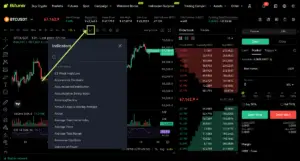
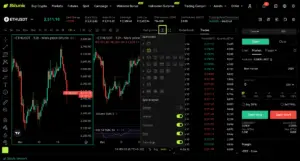
From the list of indicators, you can choose the indicator you wish to track. In the image above, we have selected RSI and SMA for BTC/USDT for the last 12 hours. You can use the multi chart window to track multiple indicators of the trade pair. Simply head over to the square icon and choose the layout you want to apply. (See image below)
Mastering crypto candlestick charts and indicators is essential for anyone looking to succeed in the volatile world of cryptocurrency trading. These charts offer valuable insights into an asset’s price trends, volatility, and market sentiment, helping traders reduce risks and make more informed decisions.
By combining candlestick patterns with key indicators like RSI, MACD, Bollinger Bands, and OBV, traders can refine their strategies and improve their ability to predict market movements. Whether you are a short-term trader or a long-term investor, understanding these tools will give you a critical edge in the ever-evolving crypto market.