How to Buy Chiliz (CHZ): A Guide for 2026
Learn how to buy CHZ on Bitunix in 2026, what Chiliz is, why it still matters, and how to buy CHZ with USDT step by step.


The security and sustainability of blockchain networks depend on their consensus mechanisms. Bitcoin and Ethereum, the two largest cryptocurrencies, have taken different paths. Bitcoin remains committed to Proof of Work (PoW), while Ethereum transitioned to Proof of Stake (PoS) in 2022 with “The Merge.”
Understanding the differences between Proof of Work and Proof of Stake is crucial for traders and investors who rely on these networks. This article explains why Bitcoin chose Proof of Work, why Ethereum adopted Proof of Stake, and what this means for the future of crypto.
[ez-toc]

Proof of Work is the original blockchain consensus mechanism, first introduced by Bitcoin in 2009. In this model, miners compete to solve cryptographic puzzles. The first miner to solve the puzzle adds a block of transactions to the blockchain and earns a block reward in Bitcoin.
Key characteristics of Proof of Work:
Bitcoin Proof of Work remains the gold standard for network security, but it has been criticized for its environmental footprint.

Proof of Stake was developed as an alternative to Proof of Work. Instead of miners competing with computational power, validators are chosen to create new blocks based on the amount of cryptocurrency they “stake” as collateral.
Key characteristics of Proof of Stake:
Ethereum’s transition to Proof of Stake drastically reduced its energy consumption and aligned the network with future scalability upgrades.

| Feature | Proof of Work (PoW) | Proof of Stake (PoS) |
| Energy Use | High, requires mining hardware and electricity | Low, only requires validators to stake ETH |
| Security Model | Secured by computational power | Secured by economic incentives (slashing risk) |
| Participation | Miners with ASICs or GPUs | Anyone who stakes tokens |
| Scalability | Limited, slower block times | More scalable, supports future upgrades |
| Examples | Bitcoin, Litecoin, Dogecoin | Ethereum, Cardano, Solana, Polkadot |
Both systems provide strong security, but each comes with trade-offs in terms of energy, participation, and scalability.

Bitcoin’s creator, Satoshi Nakamoto, designed Proof of Work to solve the double-spending problem without requiring a central authority. Proof of Work is proven, simple, and battle-tested.
Reasons Bitcoin remains on Proof of Work:
For Bitcoin, Proof of Work is not just a technical choice. It is also an ideological one, aligned with Bitcoin’s role as a long-term store of value.

Ethereum launched in 2015 with Proof of Work, but its roadmap always included a transition to Proof of Stake. This shift was completed in 2022 during The Merge.
Reasons Ethereum adopted Proof of Stake:
By moving to Proof of Stake, Ethereum positioned itself as a versatile blockchain capable of scaling to global usage.
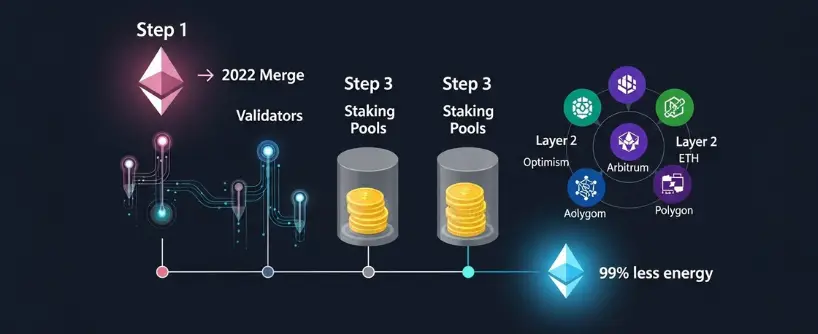
Post-Merge, the Ethereum blockchain operates under Proof of Stake with validators securing the network. Validators must stake at least 32 ETH to participate directly, although smaller holders can join through staking pools.
The impact of Ethereum Proof of Stake includes:
Ethereum Proof of Stake continues to evolve, but the transition marked a defining moment in blockchain history.
The divergence between Bitcoin and Ethereum illustrates two different philosophies:
Both approaches remain valid, serving different purposes within the crypto economy. Bitcoin continues as a store of value, while Ethereum powers programmable money, decentralized finance, and decentralized applications.
What is Proof of Stake?
Proof of Stake is a consensus mechanism where validators stake cryptocurrency to secure the network. Validators are chosen to confirm transactions and create blocks based on their stake, consuming far less energy than Proof of Work.
What is Proof of Work?
Proof of Work requires miners to solve complex mathematical puzzles using computational power. This process secures the network and issues new coins as rewards for miners.
Why is Proof of Stake more energy-efficient?
Proof of Stake eliminates the need for high-powered mining equipment. Validators only need to run lightweight software and stake coins, reducing energy consumption by over 99%.
Why did Ethereum move to Proof of Stake?
Ethereum moved to Proof of Stake to improve scalability, reduce energy consumption, and prepare for future upgrades like sharding. The shift also opened opportunities for more users to participate in securing the network.
Why does Bitcoin still use Proof of Work?
Bitcoin remains on Proof of Work because it provides unmatched security and decentralization. The Bitcoin community values stability and the proven resilience of its existing system.
Proof of Stake vs Proof of Work: Which is better?
Neither is inherently better. Proof of Work prioritizes security and immutability, while Proof of Stake emphasizes scalability and sustainability. Their effectiveness depends on the goals of the blockchain network.
What is crypto staking?
Crypto staking is the process of locking up cryptocurrency in a Proof of Stake network to support operations such as transaction validation and block creation. Stakers earn rewards for their contribution.
How does Ethereum Proof of Work differ from Ethereum Proof of Stake?
Ethereum Proof of Work relied on miners to validate transactions, while Ethereum Proof of Stake relies on validators staking ETH. The shift reduced Ethereum’s energy usage and set the stage for greater scalability.
Bitcoin and Ethereum illustrate the diversity of blockchain innovation. Bitcoin chose Proof of Work for its unparalleled security and resilience, making it the foundation of decentralized digital money. Ethereum transitioned to Proof of Stake to scale its ecosystem of applications while addressing energy concerns.
For users and traders, understanding Proof of Stake vs Proof of Work is essential when evaluating networks for investment, staking, or development. Both mechanisms will continue to shape the future of blockchain, each serving a unique role in the global crypto economy.