Alphabet Inc. on Bitunix: How to Trade GOOGLUSDT
Learn what Alphabet is and how to trade GOOGLUSDT on Bitunix. Explore Google stock forecast themes, Alphabet AI stock narratives, earnings catalysts, and beginner trading basics.

Cardano (ADA) is a proof-of-stake blockchain designed for smart contract development and the execution of decentralized applications. It stands out from Ethereum and other similar platforms through its commitment to academic excellence, as every technology developed on its blockchain must undergo rigorous peer-reviewed research before launch.
ADA is Cardano’s native token, a digital asset enabling holders to make P2P transactions and participate in staking, among other functionalities. The ADA token has marked every stage in Cardano’s development, allowing users to vote on software changes within the network’s open-source protocol.
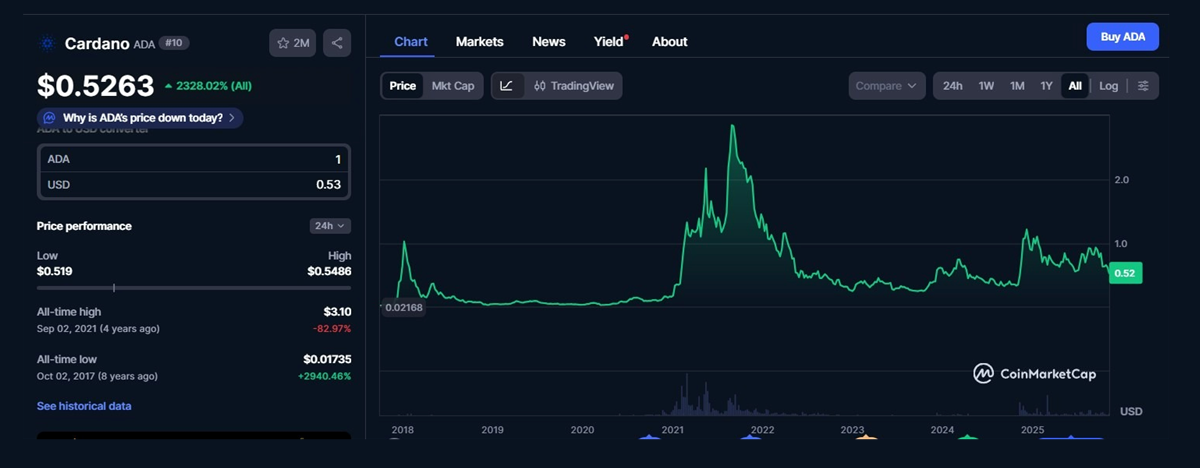
Currently, ADA is far from its ATH of $3.10, set in late 2021. A long-term resident of the top-10 cryptocurrencies by market cap, ADA has recently fallen off the trading radar for many investors. A slow development, coupled with a decline in value to its current $0.5, has contributed to its brief fall from grace.
Nevertheless,Cardano remains one of the most secure and stable blockchain networks. Its development may lag that of competitors such as Ethereum and Solana. Still, it’s innovative, ongoing, and backed by strategic partnerships. Cardano’s PoS mechanism makes it energy-efficient and environmentally friendly, enabling long-term sustainable growth. Meanwhile, the network’s fast speeds, low fees, and scientifically rooted architecture make it a top choice for developers and startups.
With this in mind, traders are wondering whether Cardano will continue its steady growth or stagnate. The current market dip doesn’t help, but a swift recovery could be the spark ADA needs to reignite a bullish rally. This ADA price prediction guide aims to clear the air on whether this is the best time tobuy crypto or wait a little longer.
[ez-toc]
The ADA all-time price chart. Source: CoinMarketCap
Cardano is an open-source, third-generation blockchain with a multi-layered architecture that enables smart contract building and execution with limitless scalability. The platform is renowned for its flexibility and speed without compromising security.
The Cardano project was started by Charles Hoskinson in 2015. As an Ethereum co-founder, Hoskinson brought his blockchain experience to the project, placing extra emphasis on transparency and fairness. In his view, a blockchain network has to “redistribute power from unaccountable structures to the margins to individuals.” To this end, Cardano aims to be a secure, user-centric network backed by a non-profit organization that prioritizes the participants’ input.
The project is named after the 16th-century Italian polymath Gerolamo Cardano. Meanwhile, the ADA token is named after the 19th-century mathematician Ada Lovelace, widely considered the world’s first computer programmer. In fact, the team has used notable figures from history and mythology to name its development stages, hard forks, and features. For example, the Foundation Era is named after Lord Byron, the 19th-century poet and Ada Lovelace’s father.
Cardano eventually launched in 2017 on a bullish market trend. The project instantly stood out from other blockchain networks through its data-driven approach and developer-friendly philosophy. The platform uses the Ouroboros blockchain, the first PoS mechanism to be peer-reviewed.
During the Foundation Era (Byron), which lasted from 2017 to 2020, Cardano established itself as a unique, lightweight blockchain platform, launching the ADA token at $0.01735 and two wallets, Daedalus and Yoroi. During this period, ADA hit its first ATH above $1 during the 2018 market rush, reaching $1.02.
The Decentralization Era (Shelley) began in the summer of 2020 during another market uptrend. This period saw the launch of Cardano’s mainnet, including staking facilities and increased community participation. Unfortunately, these changes did little to improve ADA’s trading value, which remained at $0.10.
The Goguen mainnet launched in March 2021, ushering in a new development stage for Cardano. The project’s upgrade increased functionality for novice developers and improved interoperability with other smart contracts, regardless of coding differences.
In 2021, Cardano launched the Alonzo hard fork, allowing dApps and smart contracts to be developed with modularity. This major upgrade drove the ADA price up 116% in just one month, reaching its ATH at $3.10.
Cardano has two more development eras in the works. The Basho Era should increase the network’s scalability and enable the formation of sidechains, among other features. The Voltaire Era, also known as the Governance Era, will introduce on-chain governance, including voting and treasury management, enabling ADA holders to shape the protocol’s future development.
TheVoltaire Era started unofficially with the 2024 Chang update, which fully implemented community governance and allowed ADA holders to table proposals and vote on governance decisions. The upgrade allowed ADA’s price to increase to about $0.7 before being slashed in half over the next few months.
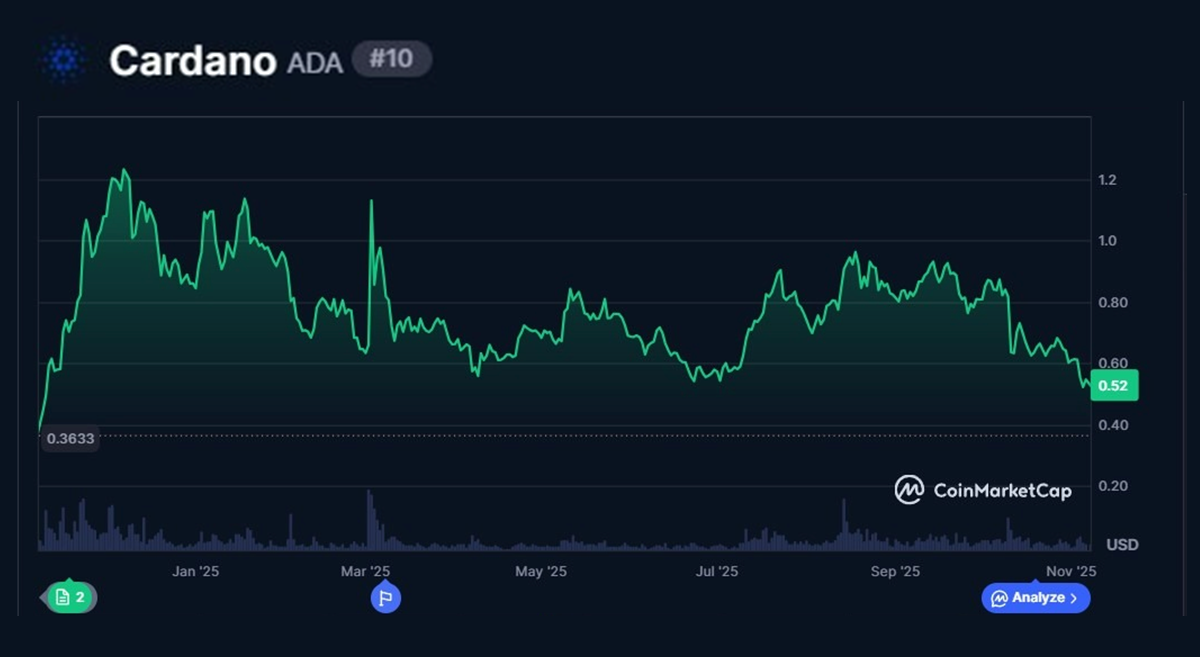
The last time ADA surged above the $1 barrier was in March 2025, pushed by another market rally. Unfortunately, the climb didn’t last long, and ADA traded at $1.12 for only a few hours.
Despite its failed attempts to cement a trading value above $1, ADA remains a major cryptocurrency brand with a market capitalization exceeding $19.6 billion. Moreover, it represents a project with extensive use in various industries. For example, agricultural companies use Cardano to track fresh produce from field to fork. The platform’s security and tamper-proof foundation serve educational and research institutions worldwide.
The 12-month ADA price evolution. Source: CoinMarketCap
With 2026 just around the corner, the ADA price prediction remains moderately positive. This has been a challenging year for Cardano, as ADA has gone in and out of the top 10 cryptocurrencies. While Bitcoin, BNB, and the BTC USDT price set new heights, ADA had a forgettable performance.
Many users still lament Cardano’s slow adoption of new technologies, which lags behind competitors like Ethereum and Solana. Some believed that the 2024 Bitcoin halving would propel Cardano and the rest of the market into an unprecedented surge. However, the opposite happened, sending ADA’s value into a sharp decline from $0.50 to $0.33, and the coin failed to recover until December 2024.
While the Cardano ecosystem continues to grow, with more dApps launching, trading volume has been declining, suggesting low demand and limited trader confidence. According toDefiLlama, since October 1st, 2025, Cardano lost over $100 million in TVL (Total Value Locked), showcasing a decrease in user adoption.
Leading Price Predictions:
Changelly expects ADA to increase slightly by the end of 2025, but not beyond $0.712. Meanwhile, the average trading price is expected to be around $0.708.
CoinCodex has a similar price prediction for ADA, expecting it to trade between $ 0.5267 and $0.8043.
All in all, ADA has a low chance of surpassing $1 by the end of December 2025. Most analysts believe the coin will hover around $0.5, with a more optimistic forecast for 2026.
The present may look bleak for Cardano, but the future has plenty in store for the project. At the dawn of the Voltaire Era, the implementation of full on-chain governance will mark a technological shift that will ripple through the ADA community and beyond. This upgrade will introduce a voting and treasury system, enabling network participants to use their stake and voting rights. Users’ influence will shape the network’s future toward a self-sustaining digital environment.
Most analysts agree that ADA will increase gradually over the next two years, albeit not exponentially. The most optimistic forecast calls for a 72% price surge in 2026, with ADA soaring to $0.96. In the meantime, a pessimistic price prediction places ADA as low as $ 0.52. For 2027, ADA may reach as high as $2.32, according to the most positive forecasts.
Leading Price Predictions:
Changelly predicts ADA will trade at a minimum of $0.71 in 2026, with a maximum of $0.946 achievable toward the end of the year. For 2027, the same website shows ADA swinging between about $1.88 and $2.32.
Benzinga sees a brighter future for ADA, with an average of $1 across 2026 and $1.62 for 2027. The analysts believe that in two years, ADA’s value is unlikely to drop below $1.34 or climb higher than $1.7
Overall, ADA supporters can hope for a better period in the coming two years. The optimistic price forecasts are based on Cardano’s slow but predictable growth, which should bring more developers to the platform. More innovative dApps should attract more investors and increase the project’s TVL.
Experts believe that Cardano has significant potential to reach $5 within the next 5 years. Only a select minority of analysts see ADA struggling to set a new ATH by 2030. To achieve its most optimistic price target, Cardano must expand its user base beyond governments and institutions.
Cardano is well-known for its stability and security, but also for its lack of pace and delayed upgrades. The network could expand its reach to enterprises and individuals by incorporating innovative dApps. An increase in enterprise use, supporting more Web3, digital identity, and payments applications, could drive demand for and use of ADA.
Leading Price Predictions:
Changelly believes that by 2030, ADA may trade at an average annual price of $5.23, with a bullish prediction hinting at $6.12. Meanwhile, the website’s experts do not exclude an ADA price as low as $4.32 five years from now.
Cex.io expects ADA to maintain a relatively modest trajectory over the next five years. According to its experts, Cardano introduces innovation too slowly to sustain steady, substantial growth. Based on historical data, ADA’s value should range from $0.57 to $0.73 in 2030.
The long-term forecast suggests Cardano could be advantageous for seasoned ADA holders. However, considering the coin’s limited potential for rapid growth, ADA is not among the top cryptocurrencies for short-term gains.
Getting started with ADA trading on Bitunix is quick and straightforward. Follow these steps:
Bitunix caters to all traders, regardless of skills or experience. The platform provides a secure and transparent user experience, evident from the start through its fast, hassle-free registration process. While the user-friendly verification system is only required for fiat operations, the extensive suite of advanced trading tools is available to all users. Moreover, Bitunix ensures the best liquidity in the market, global compliance, and a protection fund dedicated to securing the users’ assets.
The ADA price mainly fluctuated between $0.5 and $0.8 throughout 2025, with minor exceptions. This slow, somewhat predictable trajectory stems from Cardano’s gradual transition toward the much-anticipated Voltaire Era. The prospect of full-on-chain governance is enough to keep long-time holders trusting in the project, which explains its nearly $20 billion market capitalization.
Analysts believe that ADA has the potential to increase substantially in the next five years if all the integrations in its roadmap pass from paper to reality. The increase in real-world uses for the Cardano network supports their optimistic projections. Meanwhile, repeated development delays erode investor trust, leading to a decline in ADA liquidity.
Doing your due diligence and risk management analysis is crucial before endorsing any cryptocurrency. Whether you’re bullish on Cardano’s future or looking to trade its volatility, you can rely on a securecrypto exchange to find the tools you need.
The content published on the Bitunix Exchange Blog is provided for informational purposes only and does not constitute financial, investment, or trading advice. Cryptocurrency markets are highly volatile and can fluctuate rapidly. Always do your own research and consider your individual financial situation before making any investment decisions. Bitunix does not guarantee the accuracy or completeness of any predictions or analysis shared on this blog and is not liable for any losses incurred as a result of relying on this information.
Can Cardano (ADA) really reach $5?
ADA would require a significant increase of over 861% to reach $5 from its current value. While some analysts believe this surge is possible within the next 5 years, Cardano would need to back it up with significant developments. More realistic ADA price predictions expect the coin to not rise above $2.3 in 2026.
What is the biggest challenge facing Cardano?
A decline in DeFi activity is one of Cardano’s main challenges, as it faces a steady decline in TVL.
How will the Voltaire era affect ADA’s price?
The Voltaire Era is an essential milestone in Cardano’s journey towards complete decentralization. A speedy implementation of this upgrade could drive ADA demand and increase DeFi activity. Additionally, it could significantly expand the real-world uses of Cardano’s network, potentially enhancing institutional trust and treasury funding.
How does Cardano’s transaction speed compare to its competitors?
Cardano is slower than many of its competitors, with transaction speeds around 250-300 transactions per second (tps). While it performs better than Ethereum’s network average of around 16 tps, Cardano is far behind Solana’s 2,700 tps.
What is the safest way to buy ADA in 2025?
Bitunix is one of the best exchanges for trading ADA, offering high-performance trading tools and low fees. The platform welcomes all traders, regardless of skill level, with a user-friendly One Chart trading interface.
Altcoin: Any crypto asset that is not Bitcoin.
DeFi: Decentralized finance applications on public blockchains.
Gas: Network fee for processing a transaction.
Layer 1: Base blockchain that verifies and records transactions.
Layer 2: Scaling solution that processes transactions off the main chain and posts proofs to L1.
Volatility: Degree of price fluctuation for an asset over time.
Proof of Stake (PoS): Consensus where validators lock native tokens to secure the network and earn rewards.
Validator: Operator that proposes or attests blocks in PoS and shares rewards with delegators.
Incentive Program: Extra token rewards used to direct liquidity or votes.
Governance: Process for changing parameters or logic, often token based with timelocks.
Stable Pair: Pool of assets that track similar values, such as two stablecoins.
TVL: Total value locked in a protocol, a rough usage proxy.
Bitunix is a global cryptocurrency derivatives exchange trusted by over 3 million users across more than 100 countries. At Bitunix, we are committed to providing a transparent, compliant, and secure trading environment for every user. Our platform features a fast registration process and a user-friendly verification system supported by mandatory KYC to ensure safety and compliance. With global standards of protection through Proof of Reserves (POR) and the Bitunix Care Fund, we prioritize user trust and fund security. The K-Line Ultra chart system delivers a seamless trading experience for both beginners and advanced traders, while leverage of up to 125x and deep liquidity make Bitunix one of the most dynamic platforms in the market.
Bitunix Global Accounts
X | Telegram Announcements | Telegram Global | CoinMarketCap | Instagram | Facebook | LinkedIn | Reddit | Medium