Alphabet Inc. on Bitunix: How to Trade GOOGLUSDT
Learn what Alphabet is and how to trade GOOGLUSDT on Bitunix. Explore Google stock forecast themes, Alphabet AI stock narratives, earnings catalysts, and beginner trading basics.


If you are new to futures trading, the first time you open a futures order screen can feel overwhelming. You might see leverage, mark price, funding, maintenance margin, and reduce-only, all before you even place a trade. The good news is that once you understand a small set of core terms, the screen becomes much easier to read and your decisions become much safer.
This article explains what futures trading is and what trading futures mean in practical terms, then walks through the most important vocabulary you will see on Bitunix futures. If you are serious about crypto futures trading, learning these definitions is one of the fastest ways to avoid avoidable mistakes.
[ez-toc]
If you are searching what futures trading is, here is the straightforward definition: futures trading is trading a contract that tracks the price of an underlying asset, without requiring you to own the asset itself.
In crypto, futures often refer to perpetual futures, which are designed to follow spot price closely and typically do not expire. Futures contracts let you take a position in either direction.
That ability to go long or short is one reason many traders prefer futures trading over spot during volatile markets.
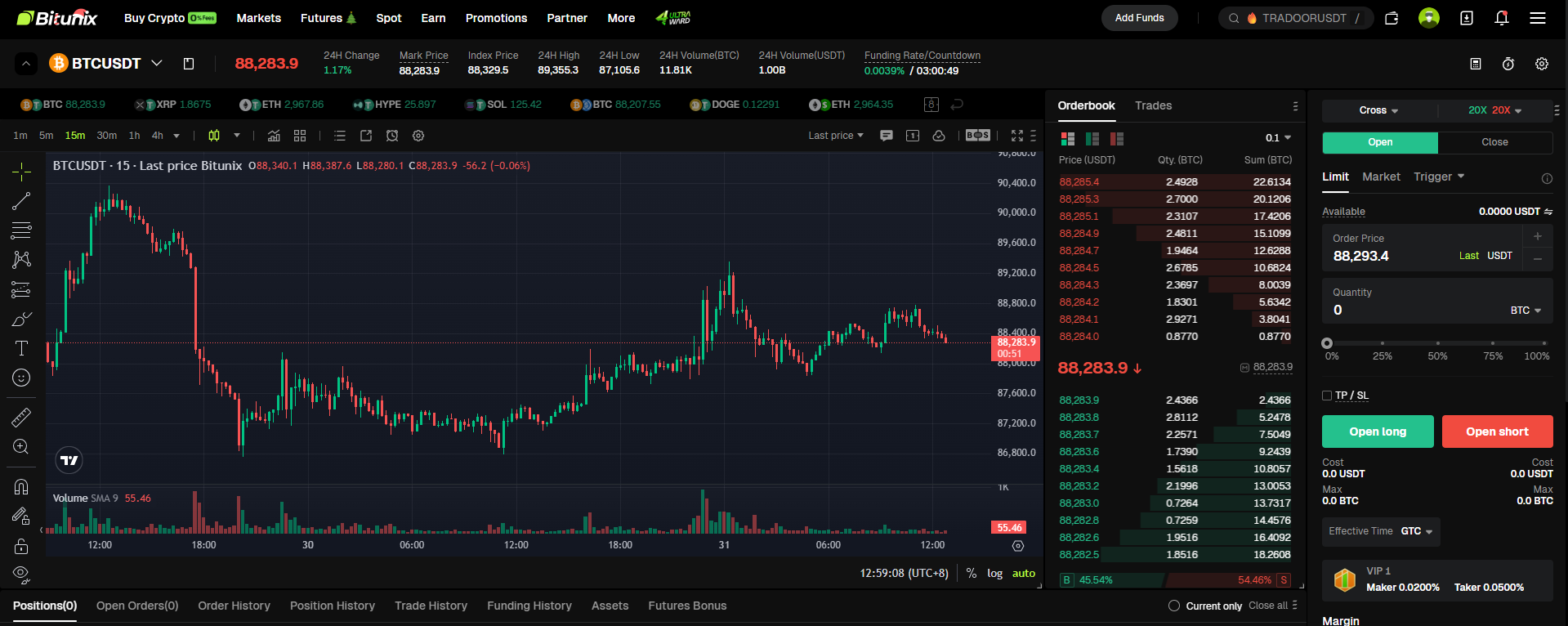
Bitunix Futures Trading Screenshot showing a BTC/USDT price chart, order book, recent trades, and buy/sell options. Bitcoin price displayed is $88,293.9 with a fluctuating candlestick chart.
In practice, trading futures means:
This is why futures trading for beginners should start with terminology and risk awareness. Futures are not complicated once you understand the rules, but they punish guesswork faster than spot.
With spot, you buy or sell the asset itself. With futures, you are trading a price-tracking contract. On Bitunix exchange, futures positions provide exposure without requiring you to hold the asset as the traded instrument.
Spot benefits mainly from up moves. Futures allow long and short positions, which can be useful for hedging or for trading downtrends.
Futures positions are margined. That means your account must maintain sufficient collateral, or the position may be forced closed. This is a core difference that defines trading futures for beginners.
Perpetual futures are futures contracts with no expiration date. Because there is no settlement at expiry, perpetual markets use a funding mechanism to help keep the contract price aligned with spot.
Your position size is your exposure. It is influenced by your selected leverage and margin. Beginners often focus on price direction and forget that position size is the main driver of risk.
A long position benefits when price rises. If you go long BTC futures and BTC moves up, your position’s PnL increases.
A short position benefits when price falls. If you short ETH futures and ETH drops, your position’s PnL increases.
Shorting is one of the most important differences between spot and futures, and it is why many traders explore crypto futures trading in the first place.
Margin is the collateral used to open and maintain a futures position. Think of it as the buffer that absorbs losses.
Initial margin is the amount required to open the position. Higher leverage typically reduces required initial margin for the same exposure.
Maintenance margin is the minimum collateral required to keep the position open. If your margin falls below this level, liquidation risk increases.
For futures trading for beginners, maintenance margin is one of the most important concepts because it explains why positions can be forced closed even before margin hits zero.
Isolated margin limits risk to the margin allocated to a single position. If that trade goes wrong, the loss is largely limited to what you assigned.
Why beginners often start here: it is easier to control risk trade by trade.
Cross margin shares margin across positions in your futures account. This can reduce liquidation risk for a position in some scenarios, but it can also spread losses across the account if multiple trades move against you.
If you are learning bitunix futures trading, isolated margin usually provides clearer guardrails.
Leverage is a multiplier that increases exposure relative to your margin. Bitunix leverage lets you adjust how much exposure you take for a given amount of collateral.
Higher leverage can increase returns in percentage terms, but it also brings the liquidation price closer to your entry and reduces room for normal volatility.
Bitunix 200x leverage is available on selected contracts like BTC/USDT & ETH/USDT. That capability is intended for advanced use. For trading futures for beginners, conservative leverage paired with strong risk control is typically more appropriate than maximum leverage.
Notional value is your total market exposure. It is not the same as margin. A beginner mistake is assuming a small margin means small risk. With high leverage, notional exposure can be large even with modest margin.
Last price is the most recent traded price.
Mark price is a reference price used by many futures venues to reduce unfair liquidations caused by short-term spikes or thin liquidity. Liquidation calculations are often tied to mark price rather than last price.
If you ever wonder why your liquidation risk changes even when the last price looks stable, mark price is usually the reason.
Liquidation is the forced closure of a futures position when margin is insufficient to maintain it.
Beginners often assume liquidation only happens during extreme market moves. In reality, liquidation can happen during normal volatility if:
In crypto futures trading, the goal is to structure trades so liquidation is far away from normal price movement, and your stop-loss triggers first.
Funding is a periodic payment between longs and shorts in perpetual futures. It helps anchor the perpetual price to spot.
Funding can matter for longer holds. For short, intraday trades, it may be less impactful, but it is still worth checking so you understand holding costs.
Profit or loss on an open position. It changes as price moves.
Profit or loss that becomes final once you close the position.
A common beginner mistake is making decisions purely based on unrealized PnL swings instead of following an invalidation-based plan.
Executes immediately at the best available price. Fast, but can slip during volatility.
Executes at your chosen price or better. More control, but may not fill.
Activates when a condition is met. These are essential for controlling risk and avoiding hesitation.
Reduce-only prevents an order from increasing your position size. It helps avoid accidental position additions, especially when you are moving quickly.
These tools matter because most beginner losses in futures trading come from execution mistakes, not lack of market knowledge.
When you open a position on Bitunix futures, do not watch only PnL. Watch the risk structure.
Ask yourself:
If you can answer those questions, your trading becomes less emotional and more consistent.
People often search for the best futures trading platform for beginners. For a beginner, the best platform is not the one with the highest leverage headline. It is the one that makes risk clear.
A beginner-friendly futures platform should offer:
That is the standard you should use when learning on any platform, including Bitunix futures.
Futures trading rewards traders who understand mechanics, not just direction. If you can define the terms on your screen, you can avoid the most common mistakes that cause early losses.
If you are learning on Bitunix futures trading, focus on mastering the essentials first: margin modes, leverage, mark price, funding, liquidation, and order types. Once these concepts feel routine, you will be able to trade BTC futures and ETH futures with far more clarity and control.
Futures trading in crypto is trading a contract that tracks a cryptocurrency’s price, allowing long and short positions using margin and leverage without owning the asset directly.
It means taking a long or short position on a contract and managing risk through margin, leverage, stop-losses, and liquidation rules.
Last price is the most recent traded price. Mark price is a reference price often used for liquidation calculations to reduce unfair liquidations from short-term spikes.
Liquidation is when a leveraged position is forcibly closed because the margin is insufficient to meet maintenance requirements.
It is an advanced feature. Beginners usually benefit more from conservative leverage, isolated margin, and strict stop-loss discipline.
Bitunix is a global cryptocurrency derivatives exchange trusted by over 3 million users across more than 100 countries. At Bitunix, we are committed to providing a transparent, compliant, and secure trading environment for every user. Our platform features a fast registration process and a user-friendly verification system supported by mandatory KYC to ensure safety and compliance. With global standards of protection through Proof of Reserves (POR) and the Bitunix Care Fund, we prioritize user trust and fund security. The K-Line Ultra chart system delivers a seamless trading experience for both beginners and advanced traders, while leverage of up to 200x and deep liquidity make Bitunix one of the most dynamic platforms in the market.
Bitunix Global Accounts
X | Telegram Announcements | Telegram Global | CoinMarketCap | Instagram | Facebook | LinkedIn | Reddit | Medium