Article Summary
- This article provides a head-to-head comparison of the Bitunix and Blofin futures trading platforms.
- The analysis focuses on five critical areas for derivatives traders: Trading Engine & Liquidity, Fees, Security & Reliability, User Interface (UI), and Copy Trading.
- While BloFin is a competent platform, Bitunix distinguishes itself with a more professional and intuitive user interface, a highly curated and trustworthy copy trading ecosystem, and a stronger public commitment to security through verifiable proof-of-reserves.
- Blofin’s UI can be confusing for traders, and its copy trading is more of a free-for-all, presenting higher risks.
- For traders seeking a professional, secure, and user-friendly platform with a reliable copy trading feature, Bitunix is the superior choice.
Trading futures can be one of the most effective ways to maximise returns on a crypto exchange. However, it requires a high-quality platform, as margins are often tight, markets can shift in seconds, funding rates must be monitored constantly, and no trader wants to overpay on fees. Two exchanges frequently cited as strong options for BTC-USDT futures trading are Bitunix and BloFin. Both platforms offer a solid futures trading experience, making it worthwhile to take a closer look before deciding which one to use.
This Bitunix vs BloFin comparison provides a detailed breakdown of both exchanges. It examines the trading engine and liquidity, fee structures, security and reliability, user experience, and copy trading features, allowing traders to evaluate each platform across the factors that matter most.
Overall, while BloFin’s futures tools are of a high standard, Bitunix edges ahead once all factors are considered. Higher leverage options, stronger security transparency, and a slightly more accessible trading interface give Bitunix a clear advantage for active futures traders.
Round 1: Futures Trading Comparison for Experience & Reliability
The first area to consider in the futures trading comparison with BloFin futures and Bitunix futures is trading performance and overall execution quality. Traders are not interested in exchanges with poor liquidity, excessive slippage, or liquidation risk caused by technical issues rather than market conditions.
For a quick snapshot of exchange performance, the trust score system provided by CoinGecko is useful. CoinGecko currently assigns Bitunix a trust score of 8/10, compared to BloFin at 7/10. This score factors in trading volume, liquidity, security, and market depth, where Bitunix holds a slight edge.
Both platforms offer solid liquidity on major pairs such as BTC and ETH, but Bitunix consistently records higher futures trading volume, often up to five times that of BloFin. CoinGecko data shows the most popular futures pair, BTC-USDT, averaging around $1.6 million in 24-hour volume on Bitunix compared to roughly $500,000 on BloFin, indicating stronger demand on Bitunix.
One reason for this difference is leverage and product depth. Bitunix offers up to 200x leverage versus BloFin’s 125x and supports over 550 futures pairs compared to BloFin’s 481. The verdict in this round leans clearly toward Bitunix. While BloFin delivers solid performance, Bitunix offers higher volume, deeper liquidity, more pairs, and a stronger trust score when carrying out a futures trading comparison.
Round 2: Trading Fees
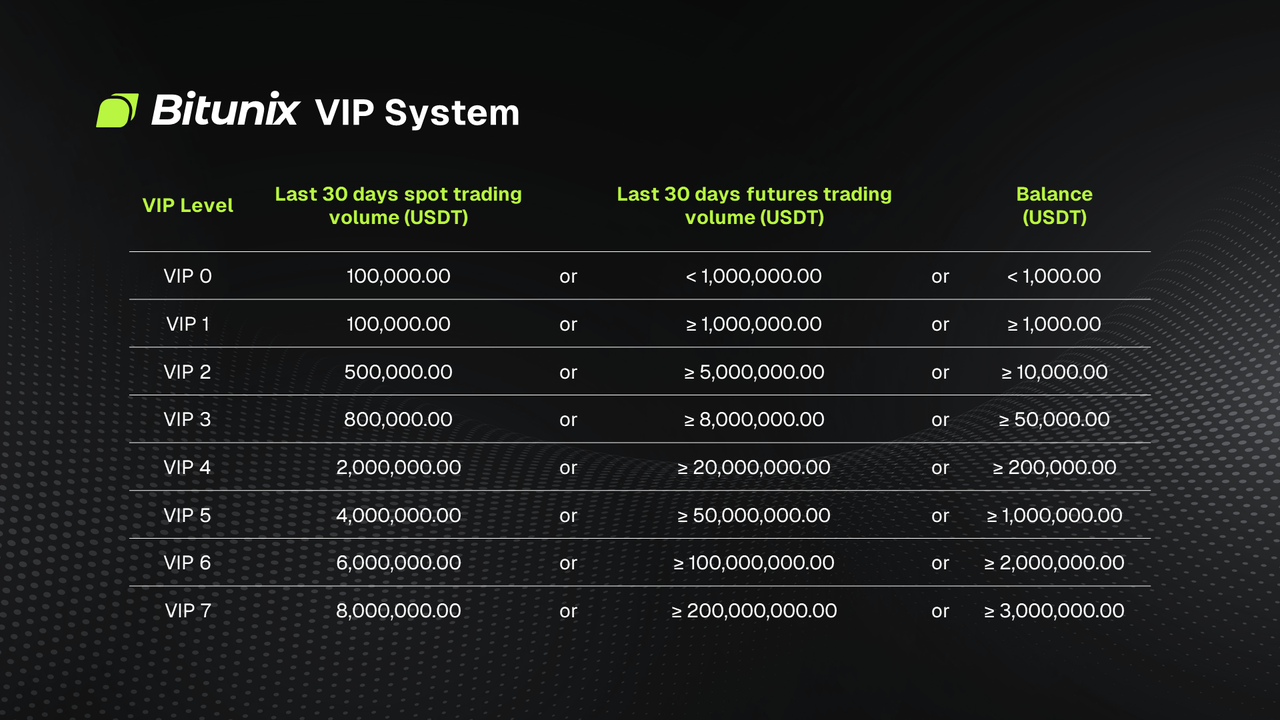
Bitunix Fees and VIP System chart showing eight VIP levels based on 30-day spot trading, futures trading volumes, and balance in USDT.
Trading fees are a profit killer, especially for traders executing multiple futures positions each day. Fees compound quickly over time and are one of the most important factors to consider when choosing a crypto exchange for futures trading.
Bitunix offers a competitive fee structure with added flexibility for high-volume traders. At VIP 0, Bitunix futures fees are set at 0.02% for makers and 0.06% for takers. As traders progress through higher VIP tiers, fees are reduced significantly, with top-tier users paying as little as 0.0060% maker and 0.0300% taker, making Bitunix increasingly cost-effective for active and professional traders.
BloFin matches Bitunix’s base futures fees at 0.02% maker and 0.06% taker. However, BloFin does not offer the same depth of VIP fee reductions, meaning Bitunix becomes the cheaper option as trading volume increases.
Round 3: Security & Reliability
Following the 2022 bear market, partly triggered by the dramatic collapse of the FTX exchange, security has become one of the most important factors when choosing a futures platform. Traders need confidence that funds are fully backed, withdrawals will always be honored, and the risk of hacks or misuse of user assets is minimized.
BloFin employs solid security practices, including a standard 1:1 proof of reserves model supported by Merkle tree verification, which allows users to confirm asset backing.
Bitunix goes further by offering a public, verifiable proof of reserves that can be checked live on its website, providing continuous transparency. Both exchanges have demonstrated strong uptime and reliability, although Bitunix arguably has a longer operational track record.
In addition, Bitunix extends protection through its Bitunix Care Fund, a $30 million USDC reserve designed to safeguard users in extreme scenarios. While both platforms are secure, Bitunix’s added transparency and protection measures offer greater peace of mind.
Round 4: User Interface (UI) & Experience
User interface preferences are often subjective. Some traders naturally prefer one platform over another without being able to pinpoint exactly why. In the Bitunix vs BloFin comparison, both exchanges score highly for user interface design. Each platform makes futures trading accessible and presents all essential information clearly within a single trading screen.
Both Bitunix and BloFin offer professional layouts with intuitive order panels, clear charts, and easy access to risk management tools. Order placement, leverage adjustments, and position monitoring are straightforward on both platforms, making them suitable for traders at different experience levels.
In this category, it is difficult to choose a clear winner. Both interfaces are well-designed and functional. The best way to decide is to visit each exchange directly and spend time using the trading interface to determine which layout and workflow best suit your personal trading style.
Round 5: Copy Trading – Quality Over Quantity
Copy trading is an interesting addition to standard futures trading. It allows users to gain exposure to experienced traders by automatically mirroring the positions of professionals with established track records. Both Bitunix and BloFin offer copy trading features, making this a relevant comparison point for users seeking more hands-off strategies.
BloFin provides a fairly solid roster of copy traders that users can follow, including traders who focus specifically on futures markets. Its copy trading operates as an open marketplace, offering a wide selection of traders with different styles and risk profiles. While this gives users flexibility, it also requires careful due diligence to avoid following inexperienced or overly aggressive traders.
Bitunix arguably offers a more secure and reliable copy trading environment through a curated approach. Lead traders are vetted and selected based on proven performance, reinforcing a “quality over quantity” philosophy. As a result, Bitunix takes this round, offering greater confidence and risk control, although BloFin remains a credible alternative.
Final Thoughts: BloFin Futures vs. Bitunix Futures
The results are in, and Bitunix has managed to fend off BloFin Futures. Overall, it offers better security, more leverage, and a copy trading system that reduces the risk of non-vetted traders exposing the community to losses. However, BloFin is also a solid platform, and this is reflected in its trading volume, which, although considerably lower than that of Bitunix, has held up well even during market downturns. To start trading futures on Bitunix today, sign up for an account or download the application and enjoy up to 200x leverage on hundreds of trading pairs.
FAQs
Is BloFin a good exchange for futures trading?
Yes. BloFin offers a solid futures trading experience with reliable execution, competitive fees, and acceptable liquidity on major pairs. It is a credible option for derivatives traders.
Are the fees on Bitunix lower than on BloFin?
At the base level, fees are the same. However, Bitunix becomes cheaper for high-volume traders due to its tiered VIP system, which significantly reduces maker and taker fees over time.
Which platform has better liquidity?
Bitunix generally has stronger futures liquidity, with consistently higher trading volume across major pairs like BTC-USDT compared to BloFin.
What is Proof of Reserves, and why does it matter?
Proof of Reserves is a transparency mechanism that shows user funds are backed 1:1 by an exchange. It matters because it reduces counterparty risk and builds trust, especially after past exchange failures.
Is copy trading on BloFin risky?
BloFin’s copy trading operates as an open marketplace, which means risk depends heavily on the trader you choose. Less curation increases exposure to inexperienced or aggressive strategies.
Why is Bitunix’s copy trading considered safer?
Bitunix uses a curated copy trading model where lead traders are vetted based on performance and risk management. This reduces the likelihood of following reckless traders and provides a more controlled environment.
Which platform is better for beginners?
Bitunix is generally more beginner-friendly due to its cleaner interface, clearer risk tools, curated copy trading, and transparent security features that simplify decision-making for new traders.
Does BloFin have a better mobile app than Bitunix?
Both platforms offer functional mobile apps for futures trading. Preferences vary, but Bitunix’s app is often viewed as more intuitive and easier to navigate for active traders.
Glossary
Liquidity: Ability to enter or exit trades efficiently.
Trading Engine: System that matches orders and executes trades.
Proof of Reserves: Verifiable evidence that user funds are fully backed.
Copy Trading: Automatically mirroring trades from experienced professionals.
Leverage: Borrowed capital used to amplify trading exposure.
Maker Fee: Fee paid for adding liquidity to order books.
Taker Fee: Fee paid for removing liquidity via market orders.
About Bitunix
Bitunix is a global cryptocurrency derivatives exchange trusted by over 3 million users across more than 100 countries. The platform is committed to providing a transparent, compliant, and secure trading environment for every user. Bitunix offers a fast registration process and a user-friendly verification system supported by mandatory KYC to ensure safety and compliance. With global standards of protection through Proof of Reserves (POR) and the Bitunix Care Fund, Bitunix prioritizes user trust and fund security. The K-Line Ultra chart system delivers a seamless trading experience for both beginners and advanced traders, while leverage of up to 200x and deep liquidity make Bitunix one of the most dynamic platforms in the market.
Bitunix Global Accounts
X | Telegram Announcements | Telegram Global | CoinMarketCap | Instagram | Facebook | LinkedIn | Reddit | Medium