Published on February 20, 2026 by AG - Content Manager • 14 min read
With roughly $16B TVL (L2BEAT) and a record ~5.95M daily transactions in Sep-2025, Arbitrum is the L2 where the most capital and activity converge. It acts as Ethereum’s scaling layer. Transactions run much faster and cheaper while still inheriting mainnet security.
As a quick gauge of traction, Arbitrum One secures roughly $16B in value today (L2BEAT) and recently hit a record ~5.95M daily transactions (Sep 25, 2025). Numbers that anchor its lead in L2 activity.
The launch of the ARB token and the shift to decentralized governance gave users and builders formal ways to participate in protocol decisions, turning Arbitrum from a purely technical solution into a community-governed ecosystem.
This ARB Price Prediction 2026-2030 article lays out a broad price outlook for ARB, explaining why it leads among rollups, which Ethereum upgrades and native innovations could drive or limit adoption, and how competition changes the landscape.
What Is Arbitrum (ARB)?
Arbitrum is a family of Ethereum Layer-2 solutions developed by Offchain Labs. Its core goal is to improve scalability across the Ethereum ecosystem by shifting most computation and storage to secondary layers where operations require less gas and confirm faster, while preserving mainnet security through cryptographic and verification mechanisms.
Optimistic Rollups
In the classic Arbitrum design, transactions are handled optimistically. The network assumes submitted blocks are valid and only triggers checks if someone provides a fraud proof.
This model sharply reduces execution costs because not everything needs to be recomputed on Ethereum right away, and disputes can be resolved later through fraud proofs. In practice, users get immediate speed and lower fees with a challenge window that protects integrity.
The Arbitrum Ecosystem
The ecosystem has expanded quickly. Many DeFi apps, decentralized exchanges, NFT markets, and games have moved to or launched on Arbitrum. Notable protocols on the network include GMX, a leading crypto derivatives exchange, and collections and infrastructure supported by TreasureDAO.
There is also a long list of projects backed by grants and community initiatives. This diversity makes Arbitrum an attractive hub for both traders and developers.
Arbitrum (ARB) Price History & Key Milestones
The ARB token was distributed via airdrop on March 23, 2023, marking Arbitrum’s transition to a more decentralized governance model. Since then, ARB’s price has seen periods of significant volatility, with rallies and corrections tied to market cycles, upgrade announcements, and broader crypto sentiment.
Key technical and product milestones shaping the project’s narrative include:
Arbitrum Nova launched as an AnyTrust chain aimed at low-fee, high-throughput applications such as gaming and social, offering a complement to Arbitrum One.
Stylus and Multi-Language Support aims to let developers write contracts in languages that compile to WASM, such as Rust, opening the door to a wider set of tools and developer bases. This broadens interoperability and speeds up the development of more sophisticated dApps.
Leadership in TVL Arbitrum has consistently ranked near the top in total value locked among L2s, reinforcing its DeFi adoption and the depth of liquidity available to traders and protocols.
Arbitrum (ARB) Price Prediction 2026-2030
ARB Price Prediction 2026: The Bull Market Catalyst
Within the ARB Price Prediction 2026-2030 framework, if crypto enters another bull cycle with new capital inflows, stronger institutional appetite, and fresh users migrating to efficient networks, Arbitrum is a natural candidate to capture a large share of that momentum.
Its status as a leading Ethereum Layer-2, with low fees, fast transactions, and deep liquidity, gives it a strategic edge. Arbitrum already reports more than $16 billion in TVL and roughly 37% market share among L2s, which strengthens the case that it could be a preferred destination for this kind of capital.
Based on that setup, ARB in 2026 could range from $3.00 in a more conservative scenario to $9.00 in an optimistic one, with a midpoint around $5.00. Hitting those levels would depend on a broad market recovery, solid technical execution, and wider adoption across the Arbitrum ecosystem.
ARB Price Prediction 2026-2027: The Battle of the L2s
In 2026-2027, competition among Layer-2 solutions is likely to intensify. Rival networks such as OP (Optimism), emerging ZK-rollups, and others could capture market share. In that environment, Arbitrum’s advantage will rest on its track record, brand, liquidity, and especially technical upgrades that attract more developers to the network.
Stylus, which enables multiple programming languages, is a good example. Another key factor will be how the ARB token evolves as a value instrument. Beyond governance via the Arbitrum DAO, the project could introduce value-capture mechanisms such as shared sequencer fees, token buybacks, or staking models that align user and treasury incentives with network performance.
For 2026, a reasonable baseline is an average price near $8.50. For 2027, the average estimate rises to about $12.00, reflecting network maturation, broader adoption, and potential consolidation among L2s.
ARB Price Prediction 2028-2030: The Default Ethereum Experience?
A plausible 2028-2030 scenario is one where most Ethereum interactions happen on Layer-2, and Arbitrum, as an early mover with developer mindshare, liquidity, and infrastructure, becomes the default experience for users and applications.
In that future, everyday transfers, swaps, on-chain games, and NFT activity would occur primarily on L2s like Arbitrum, with the mainnet reserved for final settlement and data sovereignty. That would imply heavy sequencer usage, stronger demand for ARB trading pairs, and greater exposure of the token to ecosystem value flows.
Under this path, 2028 could average around $15 with growing DeFi and gaming adoption on L2. In 2029, an average of $20 would reflect Arbitrum’s role as a primary destination for high-volume Ethereum applications. By 2030, a baseline near $25 is feasible, with upside toward $45 in an optimistic case where ARB integrates value-capture models and avoids severe macro shocks.
Key Factors Influencing ARB’s Price
Total Value Locked (TVL): TVL signals the liquidity and confidence DeFi protocols place in a network. Arbitrum has been among the TVL leaders across L2s, and swings in this metric tend to influence demand for ARB through usage, collateral needs, and incentive programs.
Daily Active Users (DAU) and Transactions: Real usage, transaction counts, active addresses, and daily volumes, show whether the network is truly being used. Sustained growth in these indicators increases utility and overall interest in the ecosystem.
Competition Among L2s: Optimism, Base, and especially ZK-rollups (such as zkSync and Scroll) present competitive pressure. ZK-rollups promise faster finality and lower costs in some scenarios. Arbitrum’s edge will depend on how quickly Stylus and developer tooling gain adoption and how well the network differentiates itself.
Governance Decisions (DAO): Community-voted actions, such as fee sharing, staking models, token burns, or buybacks, can directly change how value accrues to ARB. Governance can shift the token from a coordination-only asset to one with more direct revenue capture.
How to Trade Arbitrum (ARB) on Bitunix
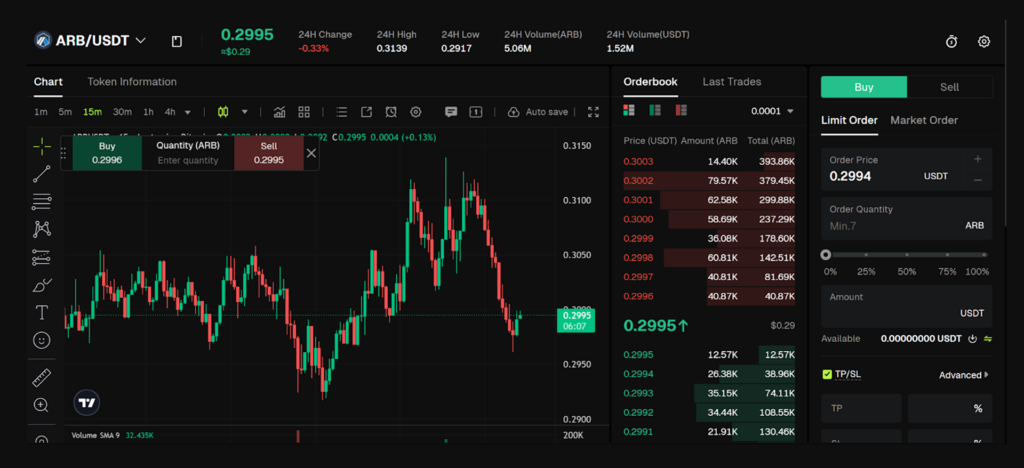
ARB can be bought on the spot market or traded on the futures market.
Buy and Hold
If you want to buy ARB and keep it in your portfolio, spot trading on Bitunix is the straightforward path. The platform provides a One Chart interface that consolidates analysis tools for both new and experienced traders, an order book with deep liquidity, ARB/USDT pairs, and a robust crypto spot trading platform experience.
Sign-up is quick, with simplified verification (KYC required only for fiat operations), and you can deposit stablecoins or crypto to place market or limit orders.
Trade With Leverage
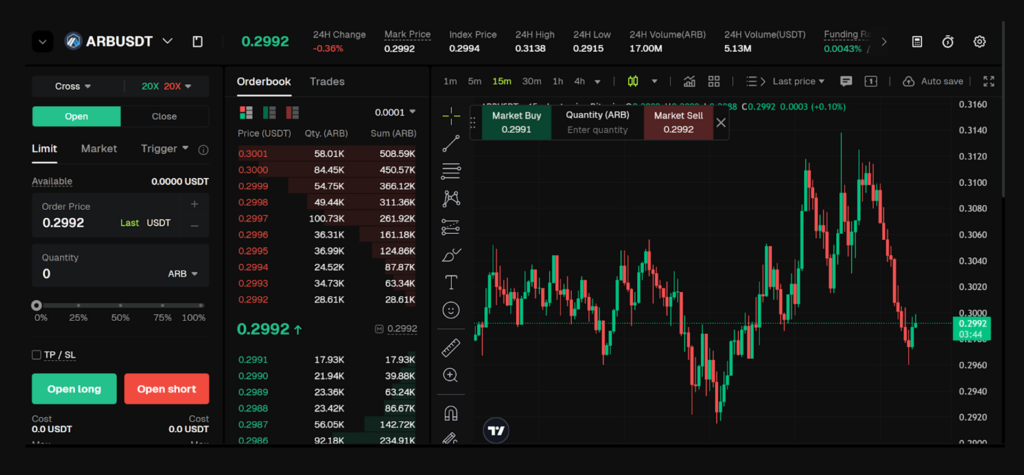
For active traders, Bitunix offers perpetual futures that let you speculate on ARB’s price with leverage. The exchange operates as a crypto futures trading platformwith high futures liquidity, multiple pairs, leverage up to 200x in select markets, and built-in risk management tools.
Experience Ethereum at its best. Trade ARB, the token powering a leading Layer-2, on Bitunix. Sign up for low fees and a seamless experience.
Why Trade With Leverage on Bitunix?
Bitunix makes leveraged trading simple and secure with fast registration, user-friendly verification (light KYC for fiat), and global compliance that includes a Protection Fund to help mitigate counterparty risk. The platform combines One Chart, a unified interface for beginners and pros, with deep liquidity that helps reduce slippage on large orders.
On derivatives venues, popular crypto futures pairs can provide additional liquidity and tighter spreads during volatile sessions. It is an exchange that genuinely cares. You get proactive support, public Proof of Reserves, and robust risk management tools. Put these advantages to work. Register on Bitunix and start trading with confidence.
Conclusion: Can Arbitrum Maintain Its Reign?
Price performance hinges on a strong 2026 upswing driven by a broader bull market, consolidation through 2026-2027 amid tougher L2 competition, and potential maturation by 2030 if Arbitrum keeps capturing real usage while introducing value-capture mechanisms.
Its large user base, TVL leadership among Layer-2s, and technical initiatives such as Stylus form a solid fundamental case for ARB. Network effects, developers, DeFi projects, and liquidity already concentrated on Arbitrum are hard to replicate quickly.
In short, Arbitrum is well-positioned to stay relevant, but its success as an asset depends on technical execution, adoption, and the DAO’s strategic choices. The future of Ethereum is scalable. Be part of a leading solution by trading ARB on Bitunix today.
FAQ
Is Arbitrum (ARB) a Good Long-Term Investment?
Arbitrum shows strong fundamentals for an L2, adoption, TVL, and a growing ecosystem, which makes a long-term thesis plausible.
Can ARB Reach $20 or Even $50?
It is theoretically possible with massive adoption and meaningful value capture. Prices in that range would imply a much higher market cap and depend on macro conditions and tokenomics.
What Is the Difference Between Arbitrum and Optimism?
Both are optimistic rollups for Ethereum but differ in architecture, governance, incentives, and product focus. Optimism has its own incentive framework (OP token and retroactive public goods funding), while Arbitrum has led in TVL and early adoption for certain protocols.
How Does Arbitrum Help Ethereum Scale?
By moving execution and data to Layer-2, Arbitrum reduces mainnet congestion and gas costs, enabling faster and cheaper transactions while anchoring security to Ethereum’s mainnet through verification mechanisms.
Does the ARB Token Have Any Utility?
Today ARB is a governance token used to vote in the Arbitrum DAO. Future proposals could add value-capture features such as fee sharing, staking, or buybacks, subject to DAO approval.
What Are the Biggest dApps on Arbitrum?
Well-known names include the GMX exchange and multiple DeFi protocols, gaming infrastructure and marketplaces, plus numerous DEXs and yield apps. The ecosystem is broad and still expanding.
What Is the Total Supply of ARB and Will More Tokens Be Released?
Total supply is fixed at 10 billion tokens. Circulating supply is around ~5.5 billion and changes over time with vesting and unlock schedules. Distribution and unlock timelines are public and follow the original tokenomics.
What Are the Risks of Investing in Arbitrum?
Key risks include high volatility, competition from other L2s (especially ZK-rollups), governance outcomes that may not favor value accrual, token unlocks increasing circulating supply, and system-wide regulatory risks.
How Can I Bridge Assets to Arbitrum?
Use official or reputable bridges (for example, the Arbitrum Bridge) to transfer ETH, USDC, and other assets from mainnet to Arbitrum. Always verify the URL and fees and account for finality times based on the bridge mechanism.
Where Is the Best Place to Buy ARB?
For users who want advanced features such as futures, leverage, and One Chart tools, Bitunix is a robust option to buy crypto online, with proof of reserves, a protection fund, and support for both spot and perpetual contracts.
Glossary
Arbitrum (Network): A family of Ethereum Layer-2 (L2) solutions that scale execution off L1 while inheriting Ethereum’s security.
ARB (Token): Arbitrum’s governance token used to vote in the Arbitrum DAO and influence protocol parameters, grants, and treasury use.
Arbitrum One: The flagship optimistic rollup chain focused on DeFi, NFTs, and general-purpose dApps.
Arbitrum Nova (AnyTrust): An L2 optimized for ultra-low fees and high throughput (e.g., gaming/social) that uses a Data Availability Committee (AnyTrust) to keep costs down.
Optimistic Rollup: L2 design that assumes batches are valid by default and relies on fraud proofs during a challenge window to catch invalid state transitions.
Fraud Proof / Dispute Game: The interactive verification process used to prove a posted batch is wrong and revert it on Ethereum.
Challenge Window / Finality: The period during which a batch can be disputed. User-perceived finality is fast on L2; economic finality is after the challenge window on L1.
Sequencer: The service that orders L2 transactions and posts batches and commitments to Ethereum. A potential source of fee revenue and MEV policy.
Batch / Posting (Commitment): Aggregated L2 transactions compressed and committed to Ethereum for data availability and settlement.
Data Availability (DA): Where transaction data is stored so the chain can be reconstructed (Ethereum calldata/blobs for rollups; committee DA for AnyTrust).
Nitro Stack: Arbitrum’s modern tech stack with optimized proving, compression, and Geth-compatibility for high performance.
ArbOS: The Arbitrum L2 operating system layer that handles gas accounting, bridges, and chain logic.
Stylus (WASM Contracts): Multi-language smart-contract support that compiles Rust, C, and C++ to WASM, enabling faster and more memory-efficient programs alongside Solidity.
Multi-Language Support: Capability for developers to build in non-EVM languages (via WASM), widening the talent pool and improving performance.
Orbit (L3/Custom Chains): Framework to deploy app-chains and Layer-3s that settle to Arbitrum, inheriting its tooling and security assumptions.
AnyTrust DA Committee: A set of entities that attest to data availability for Nova-style chains, lowering costs versus full L1 DA.
EVM Compatibility: Ability to run Solidity and Vyper contracts and use Ethereum tooling (e.g., MetaMask, Hardhat) with minimal changes.
Gas on L2: Transaction fees paid on Arbitrum (derived from L1 data costs + L2 execution costs), typically lower than Ethereum mainnet.
EIP-4844 (Blobs) / Dencun: Ethereum upgrade that introduced blob space for cheaper DA, materially reducing L2 posting costs.
TVL (Total Value Locked): The value deposited in protocols on Arbitrum; a proxy for liquidity depth and adoption.
DAU / Transactions: Daily active addresses and transaction counts, key indicators of real usage and network health.
Bridge (Canonical): The official mechanism to move assets between Ethereum and Arbitrum (deposits and withdrawals with respective finality timelines).
Retryable Ticket: Arbitrum’s deposit mechanism that guarantees execution on L2 or later retry if immediate execution fails.
MEV (Maximal Extractable Value): Value captured from transaction ordering. Sequencer policies and auctions influence user experience and fairness.
Shared Sequencing (Concept): Emerging designs where multiple L2s share sequencing to reduce cross-domain latency and reorg risk.
Governance (Arbitrum DAO): Token-holder governance that controls upgrades, funding (e.g., grants/stimulus), and potential value-accrual designs.
Value Capture (Token Economics): Potential mechanisms (e.g., fee sharing, staking, buybacks) that could route part of network fees to ARB holders, subject to DAO approval.
Grants / Incentives: Treasury-funded programs to attract builders, liquidity, and users to the ecosystem.
Perpetual Futures (ARBUSDT): Derivatives to long/short ARB with leverage, subject to funding, margin, and liquidation rules.
Funding Rate: Periodic payment between longs/shorts on perpetuals to keep the contract price aligned with the index.
Security Assumptions: Rollups inherit Ethereum’s security (for DA and settlement); AnyTrust chains add committee trust for cheaper DA.
Competition (L2s): Optimism, Base, zkSync, Scroll, Starknet, Polygon zkEVM, etc. Compete on costs, UX, DA, tooling, and ecosystem effects.
Unlock / Vesting Schedule: Timeline for ARB tokens to enter circulation from allocations (team, investors, treasury), relevant for supply dynamics.
Regulatory Considerations: Policies that may affect tokens, bridges, or DA providers; can influence liquidity, listings, and risk premia.
Key Metrics to Watch: L2 fee levels (post-4844), TVL share vs. L2 peers, DAU/tx growth, Stylus/WASM adoption, grants ROI, governance decisions, and unlock cadence.
About Bitunix
Bitunix is a global cryptocurrency derivatives exchange trusted by over 3 million users across more than 100 countries. The platform is committed to providing a transparent, compliant, and secure trading environment for every user. Bitunix offers a fast registration process and a user-friendly verification system supported by mandatory KYC to ensure safety and compliance. With global standards of protection through Proof of Reserves (POR) and the Bitunix Care Fund, Bitunix prioritizes user trust and fund security. The K-Line Ultra chart system delivers a seamless trading experience for both beginners and advanced traders, while leverage of up to 200x and deep liquidity make Bitunix one of the most dynamic platforms in the market.
AG | Content Manager | Bitunix
May 27, 2026 No Comments
Learn how stablecoin regulation in 2026, the GENIUS Act, AML rules, DeFi yield limits, and stablecoin payments may affect crypto traders and everyday users.
AG | Content Manager | Bitunix
May 27, 2026 No Comments
Discover which Layer 1 blockchains will survive 2026 and learn how traders can park liquidity long-term across the best L1 crypto networks with Bitunix tools.