Published on February 20, 2026 by AG - Content Manager • 14 min read
From a simple utility token to the engine of a growing digital nation, BNB has secured its place among crypto’s elite. With a deflationary model and a steady cycle of innovation, the question is not whether BNB can rise, but how far.
Today, BNB carries a dual identity. On one side, it is the fee and utility token of Binance, the largest crypto exchange by volume. On the other, it is the native gas asset that powers transactions across the BNB Smart Chain (BSC), where thousands of dApps, DeFi protocols, and GameFi projects run
Binance’s leadership in the spot market reinforces BNB’s relevance as infrastructure and as a fee token, creating a flywheel in which liquidity and utility reinforce each other. This article presents a complete BNB price prediction 2026-2030.
We examine tokenomics with quarterly Auto-Burn and real-time fee burns, the growth path of the Layer-1 BSC and the Layer-2 opBNB to scale throughput and reduce costs, and the key challenges BNB must overcome to reach new highs, including L1 and L2 competition, regulation, and tech execution.
What Is BNB?
BNB is the native cryptocurrency of the BNB Chain ecosystem, which includes the BNB Smart Chain and complementary solutions. It is used to pay fees and for utility across applications and protocols on the network.
The token provides trading fee discounts on Binance and functions as gas to process transactions and interact with thousands of BSC dApps, from DEXs to games and lending protocols. This dual role underpins structural demand by combining utility on a CEX with utility on-chain.
BNB uses a quarterly Auto-Burn calculated by a formula that considers the average BNB price and blocks produced in the period, plus BEP-95, which burns a portion of fees in real time. The Auto-Burn is auditable and independent of the centralized exchange.
Burns are executed on-chain and sent to a blackhole address. The long-term goal is to reduce total supply to 100 million BNB, increasing scarcity over time.
BNB Price History & Key Milestones
Launched in 2017 via ICO, BNB went through multiple market cycles before gaining traction as a utility and infrastructure asset. The DeFi and GameFi boom on BSC in 2020–2021 was an inflection point. In October 2025, BNB set a new all-time high of around $1,300, surpassing prior peaks.
That milestone coincided with headlines about institutional partnerships and ecosystem expansion. Despite regulatory shocks along the way, the asset showed resilience, supported by real utility and deep liquidity. On September 1, 2020, the BNB Smart Chain launched to scale high-performance applications, becoming a DeFi hub and the base for thousands of contracts.
Later, opBNB, a Layer-2 built on the OP Stack from Optimism, added higher throughput and lower fees by processing off the L1 and posting data to the mainnet. It was a strategic step to handle usage spikes.
Meanwhile, the burn program advanced, combining quarterly Auto-Burn and BEP-95 to reduce circulating supply in line with activity and market conditions. Incentive mechanisms can increase on-chain retention when linked to opportunities to earn crypto rewards within the ecosystem’s protocols.
Binance’s continued spot volume leadership and the growth in TVL and users on BNB Chain through 2026 reinforce the view that BNB has evolved from an exchange token into core infrastructure for the Web3 economy. That positioning is essential to support medium-term appreciation narratives.
BNB Price Forecast 2026–2030
BNB Price Prediction 2026: The Push for $1500
A broad bull market with rotation into infrastructure assets tends to favor BNB for its dual utility (fees on Binance and gas on BSC) and the network effects of an ecosystem with millions of daily active addresses, high throughput, and strong DEX volumes.
In 2026, BNB Chain held TVL in the billions and weekly DEX volumes in the tens of billions, while Binance remained the leader in spot share, reinforcing liquidity and price discovery. That backdrop creates room to extend the rally that began with the ATH near ~$1,370.
In addition, the quarterly Auto-Burn removes BNB from circulation based on a transparent formula independent of the CEX, while BEP-95 burns a share of gas fees on BSC in real time. During periods of heavy usage, higher fees and on-chain activity tend to lower net supply pressure, which has historically improved upside asymmetry in hot demand cycles.
Recent burns and the ongoing effect of BEP-95 support the thesis of growing scarcity through the cycle. Hence, a $750 to $1,600 range for the year, with an average around $1,150.
BNB Price Prediction 2026–2027: The L1 Battleground
The head-to-head with Ethereum and Solana intensifies in 2026–2027. BNB Chain’s advantages, low fees, high throughput, a large user base, and an aggressive app pipeline, are counterbalanced by perceptions of centralization in governance and validation and by the need to sustain security and performance under peak loads.
Resilient DEX volumes and strong stablecoin circulation, plus CeFi↔DeFi integrations, remain differentiators for retaining liquidity. opBNB, built on the OP Stack, offers low and stable costs and greater scale for games, SocialFi, and high-volume activity.
If the L2 consolidates developer adoption (tooling, bridges, robust sequencers) and user experience (latency, wallets, on-ramps), it can widen the funnel for new users into the BNB ecosystem, lift retention, and reduce friction for complex dApps. That setup supports higher on-chain valuation multiples and, indirectly, BNB pricing.
The price could reach $1,800 in 2026 and move above $2,000 in 2027.
BNB Price Prediction 2028–2030: A Mature Financial Ecosystem
In a base case, BNB Chain cements itself as a primary hub for DeFi, GameFi, and Web3 apps in high-growth markets, supported by millions of daily active users, tens of millions of transactions per day, and weekly DEX volumes in the tens of billions of dollars.
That usage density, together with opBNB’s expansion as a low-cost EVM L2, creates a fee engine that feeds BEP-95 real-time burns and reinforces the scarcity thesis via the quarterly Auto-Burn. To sustain higher multiples, the asset still depends on regulatory clarity in the United States and other key jurisdictions.
Binance’s market dominance in spot and derivatives is a pillar for liquidity and price discovery. Changes in enforcement, licensing, or custody rules could shift flows and valuations.
Binance remains in the lead for spot and derivatives, providing the liquidity buffer that supports BNB, but keeping that position through 2030 requires strong governance, compliance, and operational continuity. Accordingly, the average price is expected to be above $1,500 in 2028, to exceed $2,600 in 2029, and to surpass $2,900 in 2030.
Key Factors Influencing BNB’s Price
Millions of daily active addresses, 20M+ transactions per day, and robust DEX volumes create organic demand for gas and strong network effects across DeFi, gaming, and SocialFi dApps, drivers that have historically lined up with price expansion.
The Auto-Burn plus BEP-95 combo reduces supply over time, increasing scarcity during periods of heavy on-chain demand. Recent burns reinforce BNB’s deflationary profile.
Market share in spot and derivatives supports deep order books and healthy price discovery, which favors BNB as an infrastructure asset. Preserving that leadership is critical for the long-term thesis.
The most sensitive factor for price is regulation. Changes that affect listings, fiat ramps, custody, or market structure can shift the ecosystem’s cost of capital and liquidity flows.
How to Trade BNB on Bitunix
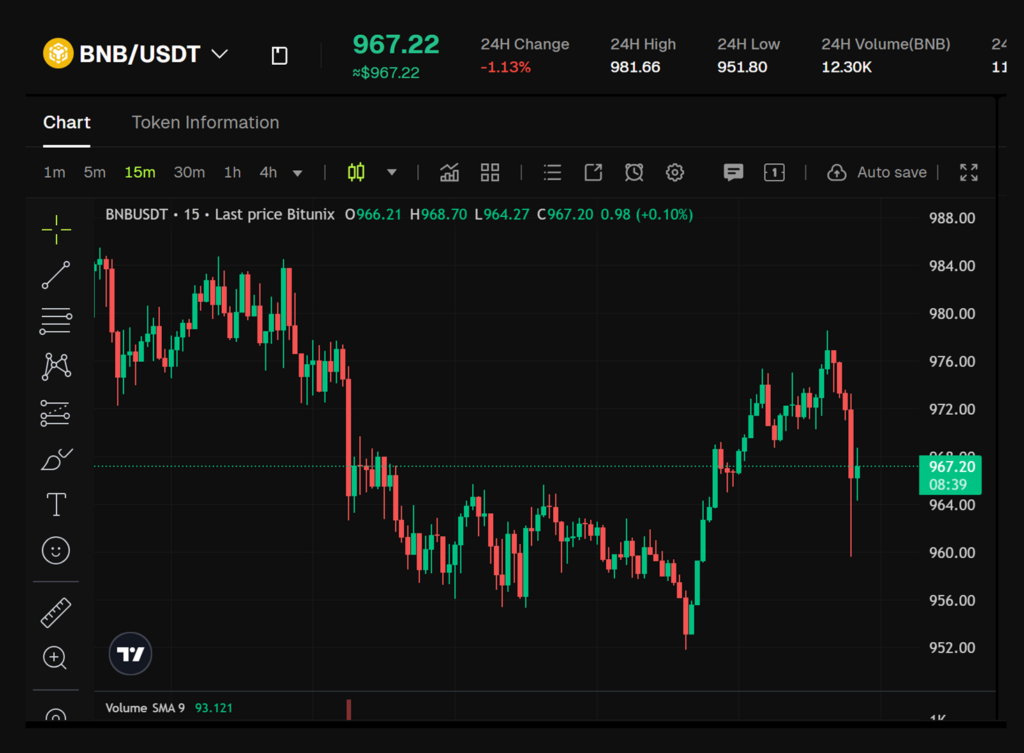
Spot Market: Straightforward for accumulation. On Bitunix’s crypto spot trading platform, you can buy and hold BNB with an intuitive interface, basic and advanced order types, and One Chart. For fiat on-ramps, KYC is required only for fiat. If you already operate in crypto, you can deposit and withdraw on-chain and trade directly.
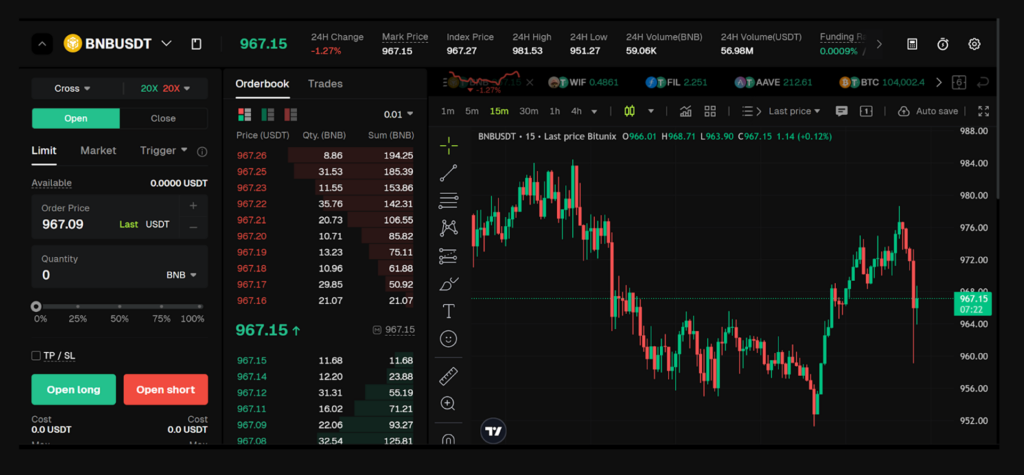
Futures Market: Directional exposure with leverage. The BNB perpetual on Bitunix’s crypto futures trading platform lets you go long or short and manage risk with stop-loss, take-profit, and leverage up to 200x. Deep liquidity and competitive funding help execution.
Trade the engine of the world’s largest crypto ecosystem. Get exposure to BNB on Bitunix with low fees and a secure, user-friendly platform. Sign up today.
Why Trade BNB on Bitunix?
Trading a major like BNB takes three things: deep liquidity, analysis tools that stay out of your way, and transparent security. Bitunix delivers all three. Consistent volume and order book depth help minimize slippage on entries and exits, crucial when scaling into a fast pair like BNB/USDT.
On the chart, One Chart brings drawing, technical indicators, and execution into a single screen, speeding up trend reading, confirmation (RSI, EMA, VPVR, for example), and order placement without tab hopping. For operational confidence, Bitunix maintains real-time Proof of Reserves with an auditable Merkle tree and a Protection Fund, adding a clear security layer over balances and platform risk management.
Conclusion: Can BNB Overcome Gravity?
Our BNB price prediction 2026-2030 points to a medium to long-term setup supported by deflationary tokenomics, ecosystem growth, and ample liquidity at the asset’s primary counterpart. In 2026, BNB has already shown it can break new highs and anchor narratives for a continued cycle, a context in which $1,500 moves from theoretical to execution dependent.
Network effects, millions of users, thousands of dApps, and elevated DEX volume, plus programmed scarcity, set BNB apart as infrastructure, not just an exchange token. Whether you are a long-term believer in the BNB ecosystem or a trader looking to capitalize on its moves, Bitunix is your premier destination for trading BNB. Get started now.
FAQ
Can BNB Realistically Reach $1,500 by 2026?
Plausible under a broad bull market with strong on-chain adoption, liquidity dominance, and continued burns. In 2026, BNB already printed new all-time highs, which supports an extended range if those drivers stay aligned.
Is BNB a Good Long-Term Investment Considering the Regulatory Issues?
Regulatory risk is the most sensitive variable. Market reports and supervisor alerts (EU/ESMA, for example) highlight how concentration and authorization rules matter. The long-term case depends on regulatory clarity and consistent execution across the ecosystem.
How Does the BNB Auto-Burn Work and How Does It Affect the Price?
The Auto-Burn adjusts the quarterly burn amount based on BNB’s price and the number of blocks produced. In parallel, BEP-95 burns a share of gas fees in real time. Lower effective supply tends to favor price during periods of heavy demand.
What Is the Difference Between BNB and the BNB Smart Chain (BSC)?
BNB is the native token (used for fees, discounts, and as gas). BSC is the blockchain where dApps run. One is the asset; the other is the network.
How Does BNB Chain Compete With Ethereum and Solana?
It leans on low fees, high throughput, a large user base, and now opBNB (an L2 using the OP Stack). The perceived drawback is centralization and governance. The outcome depends on adoption and the quality of dApps.
What Are the Most Popular dApps on the BNB Smart Chain?
Rankings change, but DEXs, lending, and yield platforms dominate TVL. Check aggregators like DefiLlama and DappRadar for current leaders by category.
Is BNB Considered a Security?
It depends on the jurisdiction and each regulator’s interpretation.
How Many BNB Tokens Are Burned Each Quarter?
It varies according to the Auto-Burn formula and network activity; official reports publish the total for each quarter.
Can I Stake BNB to Earn Rewards?
Yes. You can delegate to BNB Chain validators or use third-party liquid staking solutions.
Where Is the Safest Place to Trade BNB?
Bitunix offers real-time proof of reserves and a protection fund, plus robust UX and tools to buy crypto online, trade spot, and use perpetuals.
Glossary
BNB (Binance Coin): Native crypto of the BNB Chain ecosystem; used for trading-fee discounts on Binance and as gas for on-chain transactions.
BNB Chain: The ecosystem that includes BNB Smart Chain (BSC) and auxiliary solutions (such as opBNB), EVM compatible and focused on high performance for dApps.
BSC (BNB Smart Chain): The primary Layer-1 of BNB Chain where DeFi, GameFi, SocialFi, and NFT dApps run.
opBNB: BNB Chain’s Layer-2 based on the OP Stack that lowers costs and increases throughput while keeping EVM compatibility.
BEP-20: The token standard on BSC (similar to Ethereum’s ERC-20).
Auto-Burn (BNB): Quarterly mechanism that burns BNB using a formula based on price and blocks produced, reducing total supply over time.
BEP-95 (Real-Time Burn): Burns a portion of gas fees from transactions continuously.
Blackhole Address: An irrecoverable address where BNB is sent during burns.
Circulating Supply: Tokens effectively in the market (excludes burned or locked tokens).
Gas: The fee paid to execute transactions and smart contracts on BSC.
Validator: Operator that produces blocks and validates transactions; earns rewards and can be slashed for misconduct.
Delegator: User who delegates BNB to a validator to share in staking rewards (with associated risks).
Staking / Liquid Staking (LST): Locking BNB to secure the network and earn yield; with LST, you receive a liquid token that represents staked BNB.
TVL (Total Value Locked): Capital allocated to DeFi protocols; a metric for adoption and stickiness.
DAU / MAU: Daily/monthly active on-chain users; signal demand and network effects.
DEX (Decentralized Exchange): Non-custodial exchange for swaps and liquidity provision (AMMs).
AMM (Automated Market Maker): Price formation via liquidity pools without a traditional order book.
Impermanent Loss: Relative loss incurred by LPs when pool asset prices diverge.
Bridge: A tool to move assets across chains or L2s.
Sequencer (in L2): Component that orders transactions before publishing to L1; affects latency and UX.
EVM Compatible: Able to run Ethereum-ecosystem contracts and tooling (Solidity, dev tools).
Spot Trading: Direct buying and selling of the asset (e.g., BNB/USDT) without leverage.
Perpetual Futures (Perp): No-expiry contracts for long/short positions with leverage.
Funding Rate: Periodic payment between longs and shorts that keeps perp prices near the spot index.
Mark Price / Index Price: Reference prices for PnL and liquidations; the index aggregates quotes from multiple sources.
Open Interest (OI): Total outstanding perp contracts; measures aggregate positioning.
Basis / Contango / Backwardation: The difference between perp and spot prices (positive or negative), reflecting premium and market stress.
Leverage: Magnifies exposure using margin; increases potential gains and liquidation risk.
Isolated / Cross Margin: In isolated, each position has dedicated collateral; in cross, account balance backs all positions.
Stop-Loss / Take-Profit (SL/TP): Automated orders to cap losses and lock in gains.
Maker / Taker: A maker adds liquidity to the book (usually lower fee); a taker removes liquidity by executing existing orders.
Order Book Depth: Volume available near the mid price; deeper books mean lower slippage.
Slippage: The gap between expected and executed price; rises with low liquidity and large orders.
Proof of Reserves (PoR): Public verification (for example, via a Merkle tree) that an exchange holds 1:1 reserves.
Protection Fund / Insurance Fund: A reserve that covers extreme events (for example, liquidation gaps), increasing platform resilience.
Fiat On-Ramp / Off-Ramp: Methods to convert fiat to crypto and back (cards, bank transfers).
Compliance: Adherence to regulatory requirements and global standards (licenses, reporting, controls).
Realized / Implied Volatility: Historical vs. expected price variability; influence risk pricing and leverage.
Liquidity: How easily you can buy or sell without moving the price; critical for majors like BNB.
Market Narrative: Macro themes that guide flows (for example, L2, DeFi, restaking); can drive temporary premiums.
Regulatory Clarity: Predictability of rules; key for institutional adoption and long-term valuation.
Roadmap / Technical Deliverables: Upgrade timeline (for example, opBNB improvements, security, dev tooling) that supports usage and on-chain metrics.
About Bitunix
Bitunix is a global cryptocurrency derivatives exchange trusted by over 3 million users across more than 100 countries. The platform is committed to providing a transparent, compliant, and secure trading environment for every user. Bitunix offers a fast registration process and a user-friendly verification system supported by mandatory KYC to ensure safety and compliance. With global standards of protection through Proof of Reserves (POR) and the Bitunix Care Fund, Bitunix prioritizes user trust and fund security. The K-Line Ultra chart system delivers a seamless trading experience for both beginners and advanced traders, while leverage of up to 200x and deep liquidity make Bitunix one of the most dynamic platforms in the market.
AG | Content Manager | Bitunix
May 27, 2026 No Comments
Learn how stablecoin regulation in 2026, the GENIUS Act, AML rules, DeFi yield limits, and stablecoin payments may affect crypto traders and everyday users.
AG | Content Manager | Bitunix
May 27, 2026 No Comments
Discover which Layer 1 blockchains will survive 2026 and learn how traders can park liquidity long-term across the best L1 crypto networks with Bitunix tools.