Published on March 3, 2026 by AG - Content Manager • 6 min read
Brazil has quickly become one of the most active and influential countries in the global cryptocurrency market. Between July 2024 and June 2025, the country processed around $318.8 billion in crypto transactions, a growth of nearly 110% compared with the previous year. This surge places Brazil not only at the top of Latin America but also among the five largest crypto markets in the world.
This rapid rise has been driven by widespread adoption, heavy use of stablecoins, fintech integration, and regulatory clarity. Most of Brazil’s crypto activity is powered by stablecoins such as USDT and USDC. Over 90% of crypto inflows involve stablecoins, making them practical for payments, remittances, savings, and cross‑border settlements. Because stablecoins can be used on low-fee networks and avoid multiple conversions between crypto and fiat, users save on transaction costs compared with traditional crypto transfers. This makes digital assets more accessible and efficient, encouraging greater adoption across both everyday users and businesses.
One of the most notable developments is the emergence of $BBRL, a Brazilian Real–backed stablecoin. Having their own stablecoin allows users to reduce transaction fees, and by integrating with major blockchain networks like Polygon, BBRL enables Brazilian Real to move on-chain efficiently and even trade it against other currencies, similar to forex, but with lower fees and faster settlement through DeFi networks.
Understand why BBRL is such a significant development for Brazils crypto market
To understand why BBRL is such a significant development for Brazil’s crypto market, let’s take a closer look at what this coin actually is.
What is $BBRL?
BBRL is a stablecoin, a crypto token pegged 1:1 to the Brazilian Real (BRL), so 1 BBRL is roughly equal to 1 BRL. It is issued by Braza Bank, the largest currency exchange in Brazil, under the country’s regulatory framework and fully audited to ensure it is backed by actual reais. Stablecoins like BBRL bring the benefits of blockchain with programmable, fast, and transparent transactions while maintaining the stability of a fiat currency.
Original BBRL (Before Polygon Integration)
BBRL first became available in 2025, starting with institutional clients and later opening to the public. It was not deployed on Polygon and was issued on other blockchains like XRP Ledger or BNB Chain.
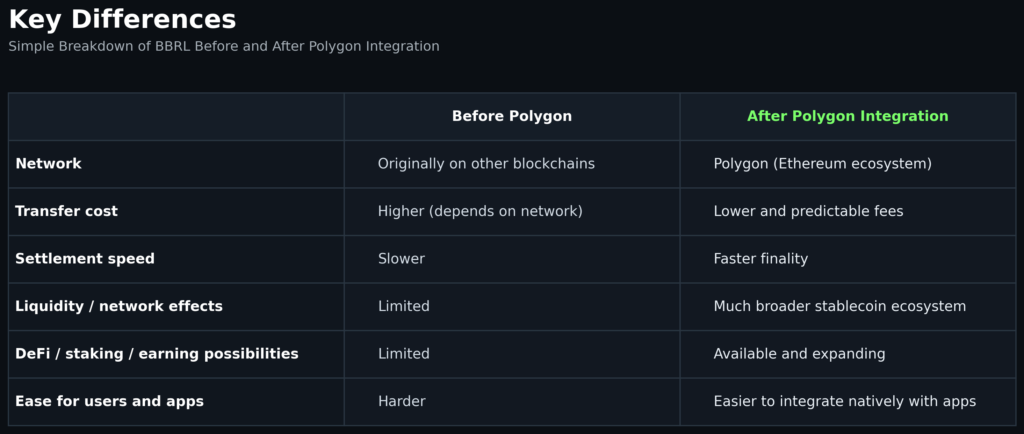
Without Polygon, transfers were slower and sometimes more expensive, and liquidity was limited. Using BBRL in decentralized finance was less efficient, and adoption was constrained by network limitations. The ecosystem had demand, but it was smaller and harder to use for real-time transactions.
BBRL Now Deployed on Polygon
BBRL expanded to Polygon around February 25, 2026. Polygon is a Layer-2 network for Ethereum that offers fast, low-cost transactions and strong integration with stablecoin infrastructure.
With Polygon, BBRL now has lower fees, faster confirmations, and access to deeper liquidity and DeFi opportunities. Cross-border payments, settlements, and transfers are more efficient and transparent. BBRL can now interact with other DeFi apps, including lending, yield farming, and automated market makers.
For businesses, this makes the Brazilian Real programmable across decentralized protocols, allowing cheaper and faster cross-border trade settlements.
Why Polygon Matters
Polygon is one of the most active networks for stablecoins and payments. By late 2025, the total value of stablecoins on Polygon had already reached several billion dollars, reflecting strong adoption, liquidity, and trust from users.
Its Layer‑2 architecture provides fast, low-cost transactions while benefiting from Ethereum’s security. Polygon’s growing ecosystem supports DeFi, automated market makers, and cross-chain bridges, making it a key network for stablecoins like BBRL to operate at scale.
DeFi with stablecoins (USDT, USDC, EURC, BBRL) vs. Traditional Forex (FX)
Traditional forex (FX) is usually faster and cheaper for large transactions between banks or on major platforms, because it’s centralized and optimized for liquidity. But for everyday users or cross-border payments, forex often involves:
High fees for currency conversion;
Intermediaries (banks, brokers) taking a cut;
Longer settlement times for smaller transactions or remittances.
However, DeFi with stablecoins like $BBRL can be faster and cheaper for smaller, retail-level or cross-border transfers, because:
Transactions are peer-to-peer, no middlemen;
Networks where Stabblecoins operate have very low fees (Polygon, Tron, BNB Chain);
Settlement is almost instant on-chain.
So it’s not strictly “better than forex” in all cases, but for retail users and on-chain use, it’s often faster and cheaper than using traditional FX services.
Market and Brazilian Response
The crypto market reacted positively to the Polygon deployment. Liquidity increased and investors are optimistic about BBRL’s expanded use. In Brazil, crypto communities see this move as adding real utility and institutional legitimacy. Media coverage frames it as innovation in digital payments and cross-border efficiency. Brazilians involved in crypto see BBRL as a tool for practical use, not just speculation, especially for payments and remittances.
Why This Matters
Before Polygon, BBRL worked but had clear limits. Transactions were slower, fees were higher, and liquidity was lower, which made it harder to use in practice.
On Polygon, BBRL becomes fast, cheap, and connected to deeper liquidity, making it fully usable on-chain for payments, transfers, and DeFi applications.
In short, BBRL is now fully practical. On Polygon, it can be used for real payments, cross-border transfers, and DeFi applications with lower fees and faster settlement. It has become a scalable form of digital money that works for both everyday users and businesses.
About Bitunix
Bitunix is a global cryptocurrency derivatives exchange trusted by over 3 million users across more than 100 countries. The platform is committed to providing a transparent, compliant, and secure trading environment for every user. Bitunix offers a fast registration process and a user-friendly verification system supported by mandatory KYC to ensure safety and compliance. With global standards of protection through Proof of Reserves (POR) and the Bitunix Care Fund, Bitunix prioritizes user trust and fund security. The K-Line Ultra chart system delivers a seamless trading experience for both beginners and advanced traders, while leverage of up to 200x and deep liquidity make Bitunix one of the most dynamic platforms in the market.
Disclaimer: Trading digital assets involves risk and may result in the loss of capital. Always do your own research. Terms, conditions, and regional restrictions may apply.
Table Of Contents
Ready To Place Your Next Trade?
Choose a market, set your order, and manage risk in one place.
AG | Content Manager | Bitunix
May 27, 2026 No Comments
Learn how stablecoin regulation in 2026, the GENIUS Act, AML rules, DeFi yield limits, and stablecoin payments may affect crypto traders and everyday users.
AG | Content Manager | Bitunix
May 27, 2026 No Comments
Discover which Layer 1 blockchains will survive 2026 and learn how traders can park liquidity long-term across the best L1 crypto networks with Bitunix tools.