Published on March 11, 2026 by AG - Content Manager • 11 min read
Privacy coins are some of the best-performing cryptocurrencies of 2026. As demand for stronger financial privacy increases, crypto coins like Monero and Zcash are rising in prominence.
Traders rely on these anonymity-enhancing coins for an extra layer of protection, despite the regulatory controversies surrounding them. But are they entirely beneficial to our digital presence or a decoy for rising criminality?
Bitcoin opened the door to the limitless potential of blockchain technology, ushering in a new form of financial freedom. Ethereum went a step further, creating a fertile ground for countless decentralized financial applications (dApps) to emerge. Other networks followed in their footsteps, gradually building the multi-trillion-dollar crypto market of today.
The option to engage in financial transactions outside the barriers of centralized authorities is a luxury nowadays. But not everyone takes advantage of it, citing the lack of complete privacy. Trading on the blockchain is only pseudo-anonymous, not entirely anonymous. Bitcoin and Ethereum, among other networks, have public ledgers, meaning anyone can trace transactions. Privacy coins may offer a solution to this issue.
This guide will explain what privacy coins are, explore the different technologies they use, and rank the leading projects in 2026 to help you understand this crucial sector of the crypto market. Read on to discover and better understand privacy coins before you decide tobuy crypto.
What Are Privacy Coins?
Privacy coins are a type of cryptocurrency that aim to obscure all the sensitive details in blockchain transactions, such as the origin, destination, and amount involved.
One of the aspects that allowed Bitcoin to become a globally used network was its public ledger. The nearly full disclosure and immutable transaction records allowed it to gain users’ trust. Privacy coins defy this fundamental principle of blockchain technology by design.
However, their commitment to anonymity and untraceability does not impede the adoption of privacy coins. On the contrary, many users regard them as an application of financial privacy as a fundamental human right on the blockchain. Both businesses and individuals should be able to include anonymity as an option in their digital transactions.
The privacy coin detractors argue that cryptocurrencies like Monero, Zcash, Dash, and others are only facilitating money laundering and terrorism funding. However, blockchain-based illicit activities persist even without widespread use of privacy coins. A report from theBank for International Settlements estimates that unlawful operations via cryptocurrencies have amounted to $51.3 billion in 2024 alone.
How Do Privacy Coins Work?
Generally, a privacy coin will hide a user’s real wallet balance and address to ensure their transactions remain private. Alternatively, it can mix multiple transactions to outwit chain analysis. Here are the most common strategies used by privacy coins to maintain anonymity and untraceability:
Stealth Addresses
This technique allows the sender to generate new addresses for each transaction they initiate. This way, a stealth address cannot be linked to the receiver. Monero, one of the top privacy coins, uses a stealth address mechanism called the Dual Key Stealth Address Protocol (DKSAP).
Ring Signatures
Privacy coins that use ring signatures aim to hide the sender’s public key from other users on the blockchain. Monero uses a similar tactic, mixing a user’s transaction signature with a group of different signatures, making it unclear who actually signed the transaction. When a user starts a transaction, their private key is assigned as the single signature of the group. As a result, it becomes a valid transaction without revealing which key in the group is the actual sender.
Zk-SNARKs
Zk-SNARK stands for Zero-Knowledge Succinct Non-Interactive Argument of Knowledge. It is a cryptographic proof that allows crypto holders to verify a transaction’s validity without divulging critical data, including the identities of the parties involved and account balances.
The Top Privacy Coins of 2026
Privacy coins emerged as controversial outcasts in the crypto industry a few years ago. Today, they form a robust niche with a market capitalization of over $68 billion and a trading volume exceeding $7 billion, according toCoinMarketCap. Here are the top privacy coins in this niche with a standout performance in 2025:
Monero (XMR): The King of Anonymity
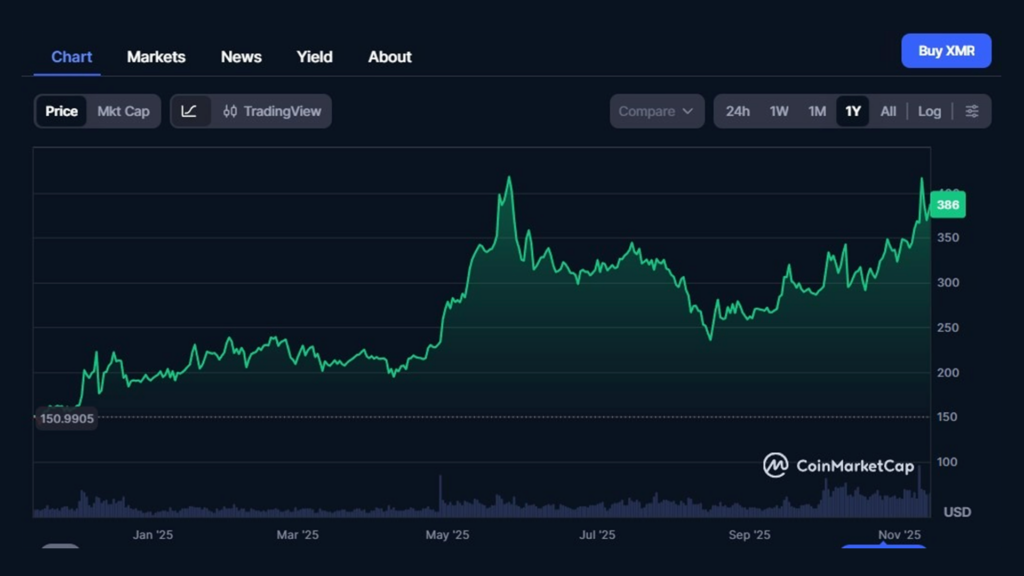
The Monero price chart for 2025 Source CoinMarketCap
Monero is the oldest and most well-known privacy coin, boasting a versatile suite of privacy tools, including stealth addresses and ring signatures. One of its standout features is Ring Confidential Transactions (RingCT). This technology hides the transaction amount, allowing only the sender and receiver to see the transferred value.
The past transactions of most cryptocurrencies can be traced to the public ledgers. However, Monero is a fungible coin, meaning that all Monero coins are interchangeable and cannot be linked to a specific transaction.
Monero’s privacy features are mandatory for all transactions, and its level of anonymity is unprecedented. Notably, the US Internal Revenue Service (IRS) announced a $625K reward for anyone who could crack its technology.
Monero is one of the best-performing privacy coins of 2025. It started the year trading at around $190, and it increased steadily from there, reaching as high as $424. Currently, it is trading at nearly $40, roughly 166% more than this time last year.
Monero holds the gold standard for privacy, making it one of the most widely used privacy coins. Its commitment to privacy and the low transaction fees help it maintain its position at the top of the niche.
The primary downside of using Monero is that the coin is often targeted by regulators. Compliance challenges and regulatory pressure have forced some exchanges, including Kraken and Binance, to delist it in certain regions.
Zcash (ZEC): The Power of Choice
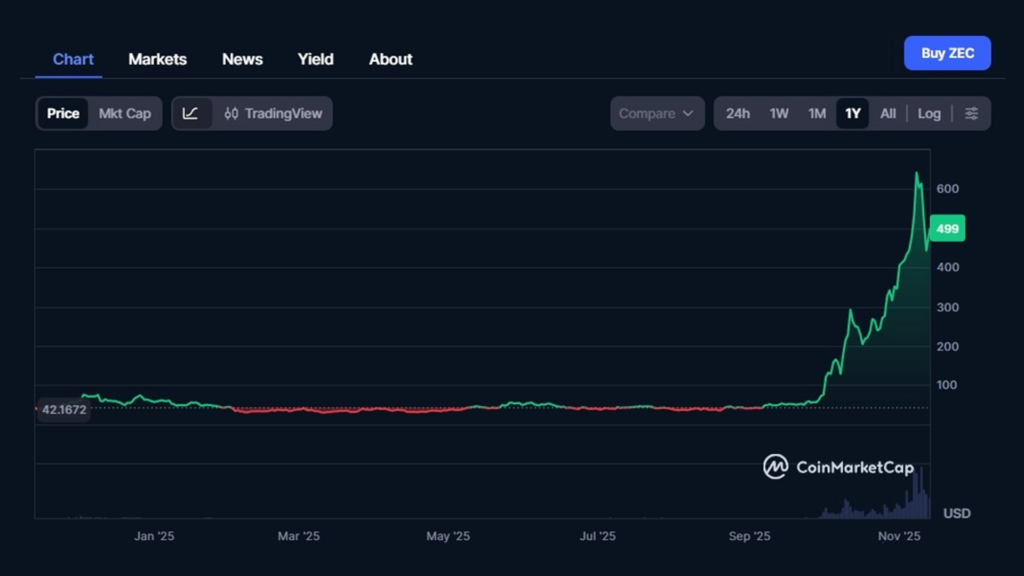
Zcash is another privacy coin that has outperformed all expectations in 2025. The coin records a staggering increase from $58 to $500 in less than 11 months. This surge put the entire privacy coin niche into the spotlight. Moreover, it defied the extreme volatility and bearish trends of the crypto market. One reason is that Zcash’s developer, the Electric Coin Company, released an update that introduced cross-chain swaps and private payments to the network.
The Zcash price chart for 2025 Source CoinMarketCap
Zcash was launched in 2016 from the same root as another privacy coin, Dash, which is a fork of Bitcoin. The coin’s protocol uses the PoW mechanism to confirm transactions and employs untraceability features via shielded transactions and zk-SNARKS.
Unlike Monero, Zcash allows users to choose between transparent (public) and shielded (private) transactions. This approach helps it elude regulatory restrictions in some regions and cover a broader range of users. Another great feature of Zcash is its strong cryptography, which provides bulletproof protection for private data in transactions.
The primary downside of using Zcash is that it relies heavily on its miners. Unfortunately, a significant portion of the coin’s mining power is under the control of a single entity. This aspect may lead to potential network manipulation.
Other Contenders to Watch
Monero and Zcash may be leading the privacy coin sector for now, but other projects are rising to challenge for their spots. These projects include Secret Network, an initiative that brings privacy to smart contracts, and Oasis Network, a project focused on a more private and scalable DeFi. They are part of a growing niche aiming to make privacy a fundamental feature of blockchain operations, rather than an option.
The Challenges and Risks of Privacy Coins
Privacy coins have performed well in the crypto market in 2025. Despite increased adoption, they still face significant challenges that may limit their availability. Here are some of the risks involved in using privacy cryptocurrencies:
Regulatory Scrutiny
Governments and traditional banking institutions have never embraced the advancement of decentralized financial transactions. Privacy coins make them lose even more control, leading regulators to become increasingly hostile to anonymity-enhancing technologies. This often results in crypto exchanges delisting privacy coins or restricting access to certain operations that involve them.
Lower Liquidity
Delistings on major trading platforms lead to lower liquidity and declining trading volumes. This means some users may return to using non-privacy coins for better stability.
Development Complexity
Privacy coins rely on highly complex infrastructure, including advanced cryptography, which may impede rapid development. This feature also makes third-party auditing difficult, potentially leading to additional regional restrictions.
How to Trade Privacy Coins on Bitunix
Due to regulatory pressures, the availability of privacy coins can be limited on centralized exchanges, especially in certain regions. Nevertheless, you can still find reliable and secure platforms where you can buy, sell, and trade privacy coins efficiently.
Bitunix is a crypto exchange that aims to provide a compliant trading environment. While Monero and Zcash are not yet available on this platform, the exchange may list certain privacy coins that meet regulatory standards in the user’s jurisdiction.
If you are ever in the market for privacy coins, check the Bitunix market for the most up-to-date list of available assets and thelatest crypto news. Bitunix is committed to offering a wide range of digital assets while adhering to global compliance standards.
Why Trade on Bitunix?
Bitunix is a cryptocurrency derivatives exchange with millions of users worldwide. The platform is firmly committed to regulatory compliance and adheres to the highest security standards.
Trading privacy coins involves certain risks, as does any form of crypto trading. Bitunix pledges to minimize risk by offering user-friendly features, such as a Protection Fund that safeguards the users’ assets. Moreover, new users must undergo a verification process that aligns with the platform’s commitment to transparency and safety.
Conclusion: The Unstoppable Need for Privacy
Privacy coins have had a positive year so far, refusing to join the market’s downtrend. Projects like Monero and Zcash have impressed and risen to address the increasing demand for better security, enhanced privacy, and complete anonymity.
Despite regulatory challenges, the demand for financial privacy as a human right is fundamental. As the digital economy expands, this demand will grow, potentially resulting in the mainstream adoption of privacy coins across the crypto ecosystem.
Explore the world of digital assets securely on Bitunix. Sign up and start your trading journey on a crypto exchange you can trust!
FAQ
Are privacy coins legal?
Privacy coins are legal in most places. However, regulatory and compliance restrictions apply in some regions.
Is Bitcoin anonymous?
Bitcoin is not anonymous. However, it masks users’ true identities, making it pseudo-anonymous.
What is the difference between Monero and Zcash?
Monero offers transaction privacy by default. On the other hand, Zcash provides both transparency and privacy features.
Why do some exchanges delist privacy coins?
Government and regulatory authorities require crypto exchanges to delist certain privacy coins in certain regions. Generally, platforms meet the requirements to maintain business operations in those jurisdictions.
What is the most anonymous cryptocurrency?
Monero is widely considered the most anonymous cryptocurrency. Other privacy coins, such as Zcash, are challenging their position.
How can I buy privacy coins safely?
Bitunix provides a safe and secure environment for trading a wide variety of cryptocurrencies. While privacy coins like Monero and Zcash are not yet listed on the platform, the exchange seeks to incorporate all digital assets free of regulatory restrictions.
Glossary
Privacy Coin: A cryptocurrency that obscures transaction details like sender, receiver, and amount, offering a high degree of anonymity.
zk-SNARKs: A type of cryptographic proof called Zero-Knowledge, Succinct, Non-Interactive Argument of Knowledge. They allow one entity to prove to another party that a statement is true without revealing any additional information.
Altcoin: Any crypto asset that is not Bitcoin.
Meme Coin: A cryptocurrency inspired by internet jokes, pop culture, or viral trends.
DeFi: Decentralized finance applications on public blockchains.
Gas: Network fee for processing a transaction.
Layer 1: Base blockchain that verifies and records transactions.
Layer 2: A scaling solution that processes transactions off the main chain and posts proofs to L1.
Volatility: Degree of price fluctuation for an asset over time.
Proof of Stake (PoS): Consensus where validators lock native tokens to secure the network and earn rewards.
Validator: Operator that proposes or attests blocks in PoS and shares rewards with delegators.
Incentive Program: Extra token rewards used to direct liquidity or votes.
Governance: Process for changing parameters or logic, often token-based with timelocks.
Trading Pair: A combination of two different digital or fiat currencies that can be exchanged for one another on a cryptocurrency exchange.
Stable Pair: A pool of assets that track similar values, such as two stablecoins.
TVL: Total value locked in a protocol, a rough usage proxy.
About Bitunix
Bitunix is a global cryptocurrency derivatives exchange trusted by over 3 million users across more than 100 countries. The platform is committed to providing a transparent, compliant, and secure trading environment for every user. Bitunix offers a fast registration process and a user-friendly verification system supported by mandatory KYC to ensure safety and compliance. With global standards of protection through Proof of Reserves (POR) and the Bitunix Care Fund, Bitunix prioritizes user trust and fund security. The K-Line Ultra chart system delivers a seamless trading experience for both beginners and advanced traders, while leverage of up to 200x and deep liquidity make Bitunix one of the most dynamic platforms in the market.
Disclaimer: Trading digital assets involves risk and may result in the loss of capital. Always do your own research. Terms, conditions, and regional restrictions may apply.
Table Of Contents
Ready To Place Your Next Trade?
Choose a market, set your order, and manage risk in one place.
AG | Content Manager | Bitunix
May 27, 2026 No Comments
Learn how stablecoin regulation in 2026, the GENIUS Act, AML rules, DeFi yield limits, and stablecoin payments may affect crypto traders and everyday users.
AG | Content Manager | Bitunix
May 27, 2026 No Comments
Discover which Layer 1 blockchains will survive 2026 and learn how traders can park liquidity long-term across the best L1 crypto networks with Bitunix tools.