Best Fiat to Crypto Exchange in 2026: How to Buy Crypto With Local Currency
Compare Bitunix, BingX and BloFin for fiat-to-crypto buying in 2026, including local currency options, payment methods, fees, safety and trading access.


Gold has been one of the most recognized financial assets for generations. Long before digital assets entered the mainstream, traders, institutions, and investors were already watching gold as a market linked to value preservation, macroeconomic shifts, and global risk sentiment. Today, gold still plays an important role in trading, and that is one reason Bitunix has expanded its TradFi offering to include gold-linked markets.
For users who are familiar with crypto trading but new to commodities, gold futures may seem like a different world at first. In reality, the basic idea is straightforward. Gold trading on Bitunix gives users a way to access gold price movement through a market environment that feels much closer to modern exchange trading. Bitunix also offers up to 200x leverage on its gold and silver pairs, which makes these markets especially relevant for active traders who want higher capital efficiency, while also making risk control even more important.
At Bitunix, gold is part of a broader TradFi expansion that also includes stocks and other commodity-linked products. This matters because traders no longer think in only one category. They may watch Bitcoin during one phase of the market, shift to stock-linked markets during another, and turn to gold when macro uncertainty becomes the dominant theme. Bringing these markets together creates a more flexible trading environment for users who want broader exposure from one platform.
In this guide, we explain what Bitunix gold futures are, how XAUUSDT works, why traders pay attention to gold, how to start trading gold futures on Bitunix, and what risks beginners should understand before entering the market.
Gold futures on Bitunix are trading products linked to the price movement of gold. Instead of buying physical gold bars or coins, users trade a market pair that tracks gold price action in a more active trading environment.
On Bitunix, the key gold-linked market shown in the TradFi section is XAUUSDT. Bitunix also shows 200x leverage on both the gold and silver pairs in its markets interface, which means users can access these commodity-linked markets with higher leverage than many beginners may expect.
This distinction is important. Trading XAUUSDT on Bitunix is not the same as directly owning physical gold. It is a way to participate in price movement through a trading product designed for users who want market access, flexibility, and a structure that fits naturally with how exchange-based traders already operate.
For beginners, the main takeaway is simple. Gold futures on Bitunix are about trading gold price movement, not storing physical gold.
Gold remains relevant because it is one of the few assets that consistently stays part of the global macro conversation. Even in a market environment shaped by crypto innovation, tech stocks, and high-speed digital trading, gold continues to attract attention.
There are a few reasons for that.
First, gold is widely associated with defensive market behavior. When inflation concerns rise, when interest rate expectations shift, or when geopolitical uncertainty becomes more intense, gold often becomes a focus again.
Second, gold is globally recognized. Unlike newer market categories that may require more explanation, gold already carries clear meaning for most traders. It is familiar, established, and easy to connect to broader financial narratives.
Third, gold often behaves differently from risk-heavy assets. That does not mean gold never moves sharply, but it does mean it is often watched for reasons that differ from the drivers behind altcoins or speculative meme tokens.
At Bitunix, adding gold futures reflects that continued relevance. Users want the flexibility to follow not only crypto-native opportunities, but also traditional assets that respond to macro trends and broader financial sentiment.
At Bitunix, we recognize that traders increasingly want more than crypto-only access. The market has matured, and user behavior has changed with it. Today, many users follow multiple asset classes at once. They may track Bitcoin, major stocks, and precious metals all in the same week, sometimes all in the same day.
Gold futures are a natural part of that broader trading picture.
By adding XAUUSDT to the TradFi section, Bitunix gives users a way to engage with one of the most established financial assets in the world without leaving the broader exchange environment. The fact that Bitunix offers up to 200x leverage on gold and silver pairs also makes these markets more appealing to active traders looking for flexibility and stronger capital efficiency in commodity-linked trading.
Gold also fits naturally into the Bitunix TradFi offering because it helps broaden the types of market exposure users can access. Crypto may dominate during one cycle. Stocks may take the lead during another. Gold becomes especially relevant when macro uncertainty, inflation narratives, or defensive positioning start shaping market interest.
In other words, adding gold is not just about adding another pair. It is about giving users a more complete market environment.
XAUUSDT is the Bitunix gold-linked market pair tied to gold price movement. In traditional market notation, XAU is commonly associated with gold, while USDT is the stablecoin framework many Bitunix users already know.
This structure matters because it makes gold trading easier to approach for crypto-native users. Instead of treating gold as something that belongs only in old financial systems, Bitunix places it into a format that feels familiar to active exchange traders.
That means users can view gold in the same broader environment where they already manage crypto and other TradFi-linked positions. The result is a smoother workflow and a more direct bridge between traditional commodities and digital trading behavior.
For beginners, XAUUSDT is the core gold market to understand on Bitunix. Once that pair makes sense, the rest of the learning process becomes much easier.
This is one of the most important distinctions to understand.
Physical gold ownership and gold futures trading are not the same thing. Physical gold is usually associated with storage, direct possession, and long-term holding. Gold futures, on the other hand, are designed for price exposure and active trading.
Many users choose gold futures because they want flexibility. They want to respond to price movement rather than deal with the logistics of buying, storing, or securing a physical asset. That makes futures more practical for traders who care about market access, speed, and trading strategy.
Gold futures can also be useful for users who are already comfortable monitoring charts, market structure, and short-term volatility. Instead of thinking about gold as a static store of value, they can engage with it as a live market that moves with changing macro conditions.
At Bitunix, this is one of the reasons XAUUSDT can be appealing. It lets users access gold as an active trading market inside a familiar platform environment.
Gold may come from traditional finance, but it is increasingly relevant to crypto traders too.
One reason is market contrast. Crypto markets often move based on token-specific narratives, ecosystem developments, blockchain adoption, and digital asset sentiment. Gold, by contrast, tends to respond more directly to macro themes such as inflation, central bank policy, currency trends, and broader uncertainty.
Another reason is structure. Because Bitunix offers up to 200x leverage on gold and silver pairs, users who are already comfortable with active futures trading may find these markets especially attractive when they want exposure beyond crypto without leaving a familiar exchange workflow.
There is also a familiarity factor. Gold is one of the easiest traditional assets to understand conceptually. Even users who have never traded commodities before usually know what gold is and why financial markets pay attention to it.
For Bitunix users, gold creates an additional layer of flexibility. It allows them to stay within one platform while exploring a traditional commodity that often holds attention when macro headlines start driving the market.
The basic concept is simple. Users trade XAUUSDT to gain exposure to gold price movement. Rather than buying physical gold, they participate in a market-linked product that reflects changes in the gold market.
Because Bitunix uses a USDT-based framework, the overall experience is more familiar to exchange users who already manage capital and positions through stablecoins. That reduces friction and makes the learning curve more manageable.
In practical terms, users can review the market, watch price movement, monitor daily changes, study chart behavior, and decide whether gold fits their strategy. This is especially helpful for beginners because it makes gold part of a system they may already understand from crypto trading.
The key difference is the market driver. Gold does not move for the same reasons as Bitcoin or altcoins. That means users should not assume that strategies used in one category will always apply in the same way to another.
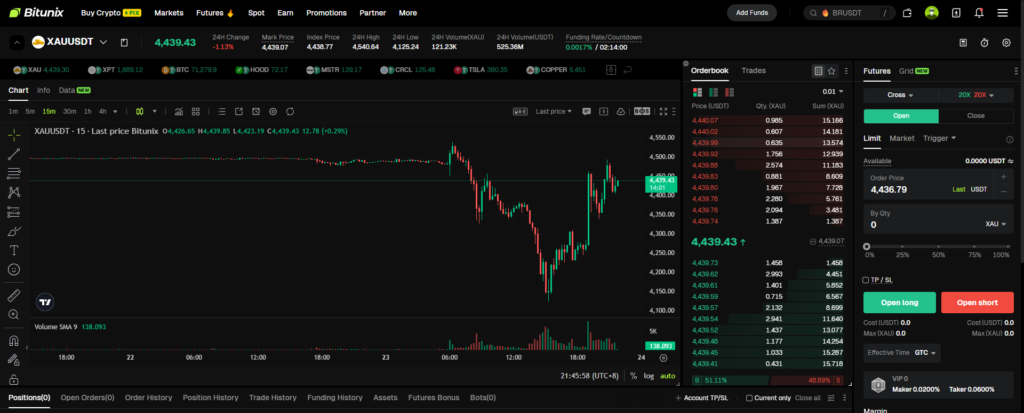
For beginners, it helps to break the process into steps.
Start by locating XAUUSDT in the Bitunix TradFi section. This is the main gold-linked pair users will want to understand.
Before placing any trade, study the current price, 24-hour movement, trading range, and general market behavior. This helps users understand whether gold is moving calmly or showing stronger volatility.
Gold is often influenced by macroeconomic narratives. Even if a user is not doing deep macro analysis, it still helps to know whether inflation, interest rates, or broader uncertainty are currently shaping gold market sentiment.
Once the market context is clearer, users can decide whether they want exposure based on their strategy and risk tolerance.
Before entering any gold trade, users should understand how leverage works and how margin affects position exposure. This is especially important for beginners.
Gold may be more established than many crypto assets, but that does not make it risk-free. Position sizing and disciplined planning remain essential.
Gold trading requires attention, especially when major macro headlines or broad market reactions emerge.
A structured approach matters. Beginners should not treat gold like a passive asset if they are using an active trading product.
Leverage can make gold futures more flexible, but it also increases risk.
On Bitunix, gold and silver pairs are offered with up to 200x leverage, which gives active traders access to higher position efficiency in these commodity-linked markets. That also means even relatively small price movements can have a much larger effect on an open position when leverage is used aggressively.
For beginners, this is one of the most important parts of the learning curve. Gold may seem more stable than many crypto assets, but high leverage changes the picture quickly. A move that looks moderate on the chart can become much more significant when the position size is amplified.
That is why risk discipline matters. New users should understand the role of margin, how liquidation risk works in leveraged environments, and why lower exposure is often the more responsible starting point when learning a new market.
At Bitunix, gold futures can be useful, but only when users approach leverage with clarity and caution.
Gold occupies a unique place in the Bitunix TradFi lineup.
Compared with stock-linked pairs, gold is not tied to company earnings, sector growth, or product launches. It behaves more like a macro-sensitive asset and is often watched during periods of broad economic stress or uncertainty.
Compared with silver, gold is usually seen as the more established precious metal benchmark. Silver can show stronger industrial influence and sometimes more pronounced volatility.
Compared with copper, platinum, or palladium, gold is usually less tied to industrial use and more closely associated with financial sentiment, safe-haven demand, and macro positioning.
This gives XAUUSDT a unique role. It is not just another commodity pair. It is one of the most globally watched financial assets in the broader TradFi category.
Gold futures and crypto futures may look similar in platform structure, but the markets behave differently.
Crypto futures are often driven by ecosystem sentiment, token launches, adoption developments, and digital asset speculation. Gold futures are usually more connected to inflation narratives, monetary policy expectations, currency pressure, and global uncertainty.
That difference matters because user expectations need to be realistic. A gold market setup does not always move with the same speed or logic as a crypto setup. Traders who understand that difference are generally better positioned to adapt their strategy.
At the same time, there is a useful overlap. Users who already understand charts, position sizing, and active trading discipline may find it easier to learn gold than they expect, provided they respect the fact that the underlying market dynamics are different.
Gold is established, but it is still a live trading market and still carries real risk.
Gold can react sharply to inflation data, central bank signals, global stress events, or major economic surprises.
Because Bitunix offers up to 200x leverage on gold and silver pairs, users should be especially careful not to overextend positions. Higher leverage can magnify both opportunity and downside very quickly.
Gold futures are active trading products. They are not the same as passive investing or physical gold ownership.
Because gold is familiar and established, some users may underestimate the need for discipline. That can lead to poor position sizing or overconfidence.
A strategy that works in crypto does not automatically work in gold. Traders should respect the differences between asset classes.
At Bitunix, we believe that broader access works best when paired with clear understanding. The more users understand the structure and risks of gold futures, the better they can use the market responsibly.
One of the strongest reasons to include gold in the Bitunix TradFi section is that modern traders increasingly think across categories.
They do not only watch crypto. They also follow stocks, commodities, and macro narratives. Gold fits into that mindset because it often becomes relevant when broader market confidence changes.
In some phases, gold may act as a defensive market focus. In others, it may simply provide a non-crypto lens through which users can better understand overall risk sentiment.
By offering gold alongside crypto and stock-linked products, Bitunix gives users a broader framework for market participation. This is part of the long-term value of TradFi integration. It is not only about more pairs. It is about giving users a more complete view of how markets connect.
Gold remains one of the most important assets in global finance, and its relevance has not disappeared in the digital era. On Bitunix, gold futures give users a practical way to access gold price movement through XAUUSDT in a format that feels familiar to exchange-based traders. Bitunix also offers up to 200x leverage on both gold and silver pairs, making these markets especially relevant for active users who want broader TradFi exposure with more trading flexibility.
For beginners, the most important point is that trading gold futures is about price exposure, not physical ownership. It is an active market product designed for users who want flexibility, broader market access, and a USDT-based workflow that fits naturally within the Bitunix ecosystem.
As more traders move across crypto, stocks, and commodities, gold is likely to remain one of the most useful bridge assets between traditional finance and digital trading culture. At Bitunix, adding gold to the TradFi category helps build a broader, more connected platform experience for users who want to follow where the market narrative goes next.
XAUUSDT is the Bitunix gold-linked market pair that gives users exposure to gold price movement through a USDT-based trading structure.
Bitunix offers up to 200x leverage on its gold and silver pairs.
Yes. Gold futures on Bitunix are available through a USDT-based framework, making the market easier to approach for users familiar with stablecoin trading workflows.
No. Trading gold futures is not the same as directly owning physical gold. It is a way to gain exposure to price movement through a trading product.
Gold is widely followed because it is linked to macroeconomic themes such as inflation, interest rates, currency pressure, and broader market uncertainty.
Gold and crypto are different asset classes with different market drivers. Gold is often viewed as a more established macro asset, but it still carries trading risk, especially when high leverage is involved.
Bitunix added gold futures to give users broader market access and to expand its TradFi offering with one of the most recognized commodity markets in global finance.
It can be suitable for beginners who first understand how the market works, how leverage affects exposure, and why disciplined risk management is essential.
Bitunix is a global cryptocurrency derivatives exchange trusted by over 3 million users across more than 100 countries. The platform is committed to providing a transparent, compliant, and secure trading environment for every user. Bitunix offers a fast registration process and a user-friendly verification system supported by mandatory KYC to ensure safety and compliance. With global standards of protection through Proof of Reserves (POR) and the Bitunix Care Fund, Bitunix prioritizes user trust and fund security. The K-Line Ultra chart system delivers a seamless trading experience for both beginners and advanced traders, while leverage of up to 200x and deep liquidity make Bitunix one of the most dynamic platforms in the market.
Bitunix Global Accounts
X | Telegram Announcements | Telegram Global | CoinMarketCap | Instagram | Facebook | LinkedIn | Reddit | Medium
Disclaimer: Trading digital assets involves risk and may result in the loss of capital. Always do your own research. Terms, conditions, and regional restrictions may apply.