Published on April 7, 2026 by AG - Content Manager • 10 min read
Amazon remains one of the most important names in global equities because it sits at the center of e-commerce, cloud computing, digital advertising, AI infrastructure, and consumer spending. That is one reason we added AMZNUSDT to the Bitunix TradFi lineup.
For traders, Amazon is more than a familiar tech giant. It is a business tied to online retail demand, AWS cloud growth, AI-related infrastructure spending, advertising momentum, and broader large-cap tech sentiment.
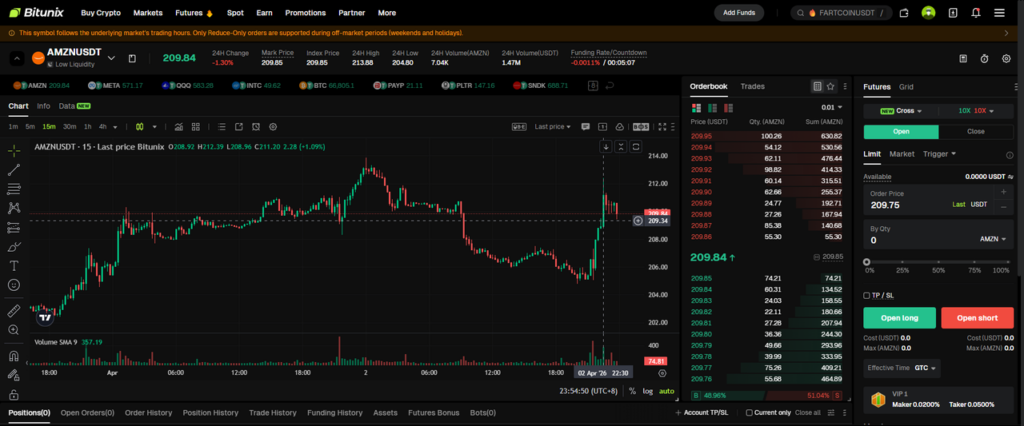
With AMZNUSDT on Bitunix, users can access Amazon-linked price movement in a USDT-based trading environment that fits the way active traders already approach the market. In this guide, we explain what Amazon is, why traders watch it, how AMZNUSDT on Bitunix works, and what beginners should understand before trading Amazon stock on Bitunix.
What Is Amazon?
Amazon is a global technology and commerce company best known for e-commerce, cloud computing through AWS, digital services, and online advertising.
In simple terms, Amazon sits in one of the most important parts of the digital economy. Its business touches online shopping, logistics, cloud infrastructure, AI tools, and enterprise technology.
That matters for traders because Amazon is connected to several major market themes:
E-commerce growth
AWS and cloud computing demand
AI infrastructure and cloud services
Digital advertising momentum
Consumer spending trends
Earnings and guidance
Why We Added Amazon Stock (AMZNUSDT) to Bitunix TradFi
We added AMZNUSDT because traders are not only watching pure AI names or single-sector plays. They are also watching platform companies that can capture growth across commerce, cloud, advertising, and infrastructure at the same time.
Amazon was a natural fit for Bitunix TradFi because it gives users exposure to one of the market’s most influential companies through a structure they already understand.
That makes AMZNUSDT Bitunix relevant for users who want exposure to e-commerce, cloud growth, AWS momentum, and broader large-cap tech leadership through a market they already know how to trade.
Why Amazon Matters to Traders
Amazon matters because it is connected to several important market themes at once.
Traders watch Amazon because:
Amazon is one of the biggest names in e-commerce. Its core retail business remains closely tied to consumer demand and online shopping trends.
Amazon is closely tied to cloud computing through AWS. That keeps the company central to enterprise tech and AI infrastructure discussions.
Amazon is now deeply linked to AI and cloud capabilities. Amazon can benefit from AI demand across both enterprise infrastructure and consumer operations.
Amazon is a large-cap tech leader. That keeps it relevant when traders focus on index leadership and major earnings-driven moves.
Amazon earnings can move the market quickly. Revenue growth, AWS performance, margins, and forward guidance all matter to traders.
What Is AMZNUSDT on Bitunix?
AMZNUSDT on Bitunix is a stock-linked trading market tied to Amazon price movement in a USDT-based format.
This is the first thing beginners need to understand. Trading Amazon stock on Bitunix is not the same as buying Amazon shares through a traditional broker. Users are not purchasing direct equity ownership. They are trading a market product linked to Amazon price action.
For beginners, the key points are simple:
AMZNUSDT is tied to Amazon price movement.
It uses a USDT-based trading framework.
It is designed for active trading.
It is not the same as directly owning Amazon shares.
That distinction matters because the goal here is price exposure and active trade management, not long-term share ownership.
What Does It Mean to Trade Amazon on Bitunix?
To trade Amazon on Bitunix means using a USDT-based market to gain exposure to Amazon-linked price movement.
For many users, that feels more practical than opening a separate stock brokerage account. If they already understand chart analysis, position sizing, risk management, and active trade execution, then AMZNUSDT fits naturally into a workflow they already know.
This is why how to trade Amazon on Bitunix is becoming a more relevant topic. Users are not only looking for access. They also want a trading structure that feels familiar and flexible.
Amazon Stock Forecast: What Traders Are Watching
An Amazon stock forecast is usually built around a few major themes rather than one single catalyst.
The biggest things traders watch include:
E-commerce demand
AWS growth and cloud margins
AI and cloud infrastructure sentiment
Advertising momentum
Operating income trends
Earnings results and guidance
When AWS momentum stays strong and large-cap tech sentiment improves, Amazon often attracts more attention. When retail margins weaken or cloud growth slows, the stock can reprice just as fast.
Amazon AI Stock: Why This Theme Matters
The phrase Amazon AI stock matters because AI is now part of how the market sees Amazon’s future growth.
Amazon is often seen as a company that can benefit from AI in multiple ways at once, including cloud usage, enterprise workloads, retail optimization, and broader digital infrastructure demand.
For traders, that creates a distinct angle. Amazon is not only a retail and cloud company. It is also part of the broader AI infrastructure and enterprise technology industry.
Is Amazon Stock a Buy?
For long-term investors, the answer may depend on their view of retail growth, AWS momentum, advertising strength, AI positioning, and margin expansion. For active traders using AMZNUSDT on Bitunix, the better question is whether there is a clear setup worth trading right now.
That is an important difference.
On Bitunix, the focus is not on building a long-term stock portfolio through direct ownership. The focus is on identifying price opportunities, understanding the current market narrative, and managing trades with discipline.
So instead of reducing the question to a simple yes or no, it is often more useful to ask:
Is AWS growth staying strong?
Is AI sentiment supporting large-cap tech?
Is the chart structure clear?
Is there a defined invalidation level?
Does the setup fit your risk plan?
That approach is more practical for actual trading.
AMZN Earnings Forecast: Why Earnings Matter
An AMZN earnings forecast matters because earnings are one of the biggest drivers of price movement in any stock-linked market.
For traders, earnings matter because the market does not only react to headline revenue. It also reacts to AWS growth, operating income, retail efficiency, advertising performance, and forward guidance.
How to Trade AMZNUSDT on Bitunix
Trade AMZNUSDT on Bitunix Amazon Stock Guide
If you want to trade AMZNUSDT on Bitunix, the best approach is to keep the process structured.
1. Understand the Product
Know that AMZNUSDT on Bitunix is tied to Amazon price movement, not direct stock ownership.
2. Understand the Amazon Narrative
Before entering a trade, ask what is driving Amazon right now. Is it e-commerce demand, AWS growth, AI sentiment, earnings expectations, or broader large-cap tech momentum?
3. Study the Chart
Look at:
Trend direction
Support and resistance
Recent volatility
Breakout levels
Reaction to market news
4. Build a Setup
Do not trade Amazon just because the stock is familiar. Trade only when your setup is clear.
Examples include:
Trend continuation
Breakout above resistance
Rejection from a key level
Range trade inside a defined structure
5. Understand Leverage and Margin
If you are using a leveraged market, position sizing and risk control matter even more.
6. Define Risk Before Entry
Before opening a position, decide:
Entry level
Stop-loss area
Invalidation point
Position size
Exit logic
7. Monitor Actively
Bitunix AMZNUSDT futures are built for active trading. Amazon-linked price action can react quickly to earnings updates, AWS headlines, retail data, and broader tech-market sentiment.
Risks Beginners Should Understand
Before trading Amazon stock on Bitunix, beginners should understand the main risks.
Volatility risk: Large-cap tech names can still move sharply when sentiment changes.
Leverage risk: If leverage is involved, both gains and losses can be amplified.
Headline risk: Earnings updates, AWS developments, consumer spending signals, and AI-related news can move Amazon quickly.
False familiarity: Knowing the Amazon brand does not make the market easy to trade.
Product misunderstanding: AMZN-linked trading markets are active trading products, not direct Amazon share ownership.
Conclusion
AMZNUSDT on Bitunix gives users a practical way to trade Amazon-linked price movement through a USDT-based market.
We added AMZNUSDT to Bitunix TradFi because Amazon gives traders exposure to one of the most important e-commerce and cloud stories in the market. The company is tied to online retail demand, AWS growth, AI infrastructure, advertising momentum, and broader large-cap tech leadership.
For beginners, the key point is simple. Amazon stock on Bitunix is built for active trading, not direct stock ownership. Anyone exploring how to trade Amazon on Bitunix should first understand what Amazon does, why the company matters, and what kinds of catalysts can move the market.
FAQ
What Is Amazon?
Amazon is a global technology and commerce company focused on e-commerce, cloud computing, digital services, and online advertising.
What Is AMZNUSDT on Bitunix?
AMZNUSDT on Bitunix is a stock-linked trading market tied to Amazon price movement in a USDT-based format.
Is Amazon Stock on Bitunix the Same as Owning Amazon Shares?
No. Amazon stock on Bitunix refers to a trading product linked to Amazon price movement, not direct share ownership.
What Affects an Amazon Stock Forecast?
An Amazon stock forecast is usually influenced by e-commerce demand, AWS growth, advertising momentum, earnings results, guidance, and broader large-cap tech sentiment.
Why Is Amazon Called an AI Stock?
Amazon is often described as an AI stock because AWS and Amazon’s broader business can benefit from AI infrastructure, cloud growth, and AI-related business opportunities.
Is Amazon Stock a Buy?
That depends on timeframe and strategy. For active traders, the better question is whether there is a clear setup, defined risk, and a market narrative that supports the trade.
Glossary
AMZN earnings forecast: Market expectations around Amazon’s upcoming or recent earnings results and guidance.
AMZNUSDT: The Amazon-linked trading market on Bitunix.
Amazon: A global technology and commerce company focused on e-commerce, cloud computing, digital services, and online advertising.
Amazon AI stock: A market phrase used to describe Amazon’s link to AI infrastructure, cloud growth, and AI-related business opportunities.
Amazon price prediction: A market view on where Amazon-linked price action may move next.
Amazon stock forecast: A market outlook built around Amazon’s potential future price direction.
Bitunix TradFi: Bitunix’s broader traditional finance market offering, including stock-linked products.
USDT: A stablecoin commonly used for pricing, settlement, and trading on exchange platforms.
About Bitunix
Bitunix is a global cryptocurrency derivatives exchange trusted by over 3 million users across more than 100 countries. The platform is committed to providing a transparent, compliant, and secure trading environment for every user. Bitunix offers a fast registration process and a user-friendly verification system supported by mandatory KYC to ensure safety and compliance. With global standards of protection through Proof of Reserves (POR) and the Bitunix Care Fund, Bitunix prioritizes user trust and fund security. The K-Line Ultra chart system delivers a seamless trading experience for both beginners and advanced traders, while leverage of up to 200x and deep liquidity make Bitunix one of the most dynamic platforms in the market.
Disclaimer: Trading digital assets involves risk and may result in the loss of capital. Always do your own research. Terms, conditions, and regional restrictions may apply.
Table Of Contents
Ready To Place Your Next Trade?
Choose a market, set your order, and manage risk in one place.
AG | Content Manager | Bitunix
May 27, 2026 No Comments
Learn how stablecoin regulation in 2026, the GENIUS Act, AML rules, DeFi yield limits, and stablecoin payments may affect crypto traders and everyday users.
AG | Content Manager | Bitunix
May 27, 2026 No Comments
Discover which Layer 1 blockchains will survive 2026 and learn how traders can park liquidity long-term across the best L1 crypto networks with Bitunix tools.