
Aave is one of the original DeFi pioneers and a cornerstone of the decentralized economy. With the launch of its native stablecoin GHO and a push into real-world assets, is Aave ready to lead the next rally in credit protocols? Well, Aave operates as a leading decentralized liquidity protocol.
Users deposit crypto to earn interest, and others borrow against collateral, all without centralized custody. Today, the platform combines strong brand recognition, deep liquidity, and robust usage metrics. Its Total Value Locked remains among the highest in the sector, reflecting both institutional and retail adoption.
In this article, we present an AAVE price prediction for 2026–2030, examining the evolution of the Aave ecosystem, the impact and adoption of GHO as a native stablecoin, and the expansion initiatives that could drive demand for AAVE over the coming years.
What Is Aave (AAVE)?
Aave is an open-source, non-custodial protocol that enables permissionless lending and borrowing of crypto. Depositing funds in the protocol generates yield for liquidity providers, and users who need leverage can borrow by posting collateral.
Aave’s primary use case is to serve as an on-chain money market. Liquidity pools adjust rates and parameters dynamically to balance supply and demand. Key features include flash loans for atomic, unsecured transactions, reserve mechanisms to mitigate losses, and capital-efficiency tools introduced in V3.
The AAVE token is used mainly for governance, voting on proposals that set protocol direction, and as an economic backstop via the Safety Module, a buffer designed to cover systemic shortfalls if needed. Token ownership provides a voice in decisions and aligns incentives with protocol health.
AAVE Price History and Key Milestones
AAVE emerged as a DeFi blue chip during the DeFi Summer in mid-2020, gaining rapid adoption and posting price peaks across subsequent cycles. Despite crypto’s inherent volatility, AAVE has shown comparative resilience among lending protocols, maintaining relevance in market cap and liquidity.
Key Developments
- Aave V3: Launched with a focus on capital efficiency, enhanced risk tools, and cross-chain interoperability, accelerating the protocol’s multichain expansion.
- Multichain: With V3, deployments expanded across multiple L1s and L2s, Ethereum, Polygon, Avalanche, Fantom, Aptos, and others, broadening liquidity and product reach.
- GHO: The community approved GHO, a stablecoin collateralized within the Aave ecosystem, followed by rollouts on new networks, such as integrations on rollups and SEs, that increase protocol utility and create directed revenue flows to the DAO.
AAVE Price Prediction 2026-2030
AAVE Price Prediction 2026: The GHO Stablecoin Effect
The expansion of the native GHO stablecoin is one of Aave’s most promising catalysts. All interest paid by GHO borrowers flows directly to the Aave DAO treasury, creating a durable revenue stream. That revenue can then be used to buy back and burn AAVE or be distributed to stakers, which tends to reduce circulating supply and lift the token’s residual value.
A broad DeFi recovery, alongside strength in USDT, BTC, and other major pairs, would boost lending and borrowing on Aave, raising rates and liquidity while attracting institutional capital.
Taking this together, the projection is an average price near ≈ $400 for the year, with a downside case around $300 and an optimistic case up to about $550. Desks frequently buy USDT to fund collateral and strategy deployment in these phases.
AAVE Price Prediction 2027–2028: The Real-World Asset (RWA) Integration
In 2027-2028, the focus shifts to Aave’s evolution as a platform integrating real-world assets. Tokenization models for real estate, invoices, receivables, and other traditional assets open a market worth trillions.
Institutional adoption, via permissioned pools or partnerships with banks and asset managers, gives Aave a path to volumes comparable to traditional finance. This migration of fiat capital into DeFi, combined with a modular architecture and the versatility expected in V4, could push Aave toward leadership among decentralized credit platforms.
Sector flows can still fragment as retail cycles in and buy XRP, affecting cross-market liquidity. Based on this structural shift, the estimate is an average price of $650 (low ~$450 and high ~$900) for 2027, and $900 (low ~$600 and high ~$1,300) for 2028.
AAVE Price Prediction 2029–2030: The Foundation of a New Financial System?
AAVE could become a backbone for money markets in Web3, used by individuals, DAOs, and institutions to lend, borrow, build, and scale decentralized financial applications. It would serve as a primary rail for credit, liquidity, and collateralization, overlapping legacy financial systems.
In that case, AAVE would not be only a speculative asset. It would capture value through two main channels. First, governance rights over the protocol, decisions that affect rates, risk models, and pools. Second, real participation in the ecosystem through protocol fees, buybacks and burns, or distributions to stakers.
As assets under management grow, the token becomes a value-extraction mechanism for AAVE holders. Hence, the outlook of a $800 minimum and $1,700 maximum for 2029. A ~$1,000 minimum and ~$2,200 maximum for 2030.
And a $1,300 minimum, ~$3,000 maximum, with an average near $2,000 for 2030. These ranges assume Aave meaningfully expands its market share and that DeFi, RWA, and stablecoin markets grow in sync.
Key Factors Influencing AAVE’s Price
Growth of GHO, Aave’s native stablecoin, generates fees and revenue for the protocol. The greater the adoption, the stronger the value potential for the AAVE token. Likewise, total value locked reflects how much liquidity the protocol attracts. Aave has surpassed tens of billions of dollars in TVLand captures a large share of the DeFi lending sector.
As tokenized real-world assets are introduced as collateral and institutions come on board, the addressable market expands sharply. But protocols like COMP (Compound) and new entrants put pressure on decentralized lending. Aave’s ability to remain the leader will support AAVE’s price.
How to Trade AAVE on Bitunix
Spot Market: On Bitunix, you can easily find the AAVE/USDT pair (or similar) and place a simple order to buy crypto or sell crypto. Deposit or purchase USDT, locate AAVE, and click Buy.
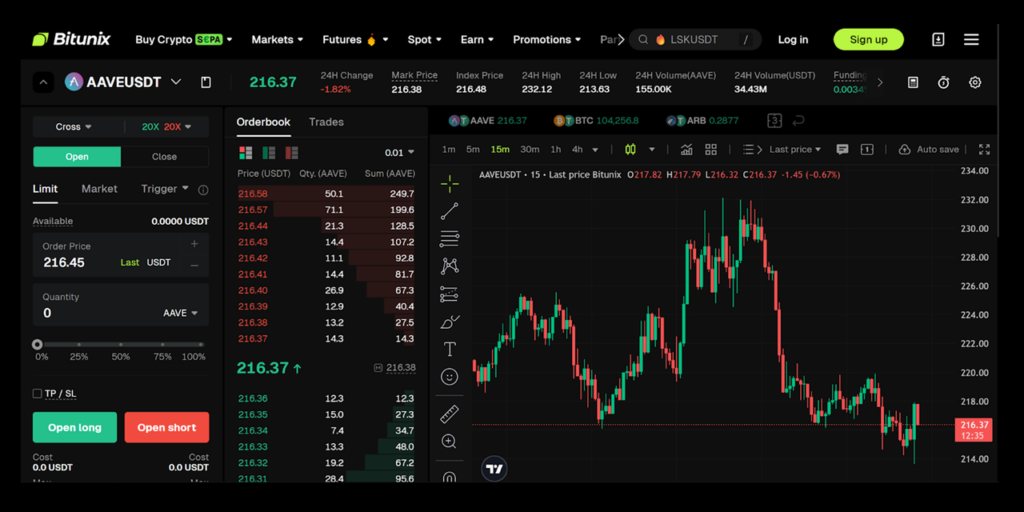
Futures Market: If you want to go further, AAVE perpetual futures let you trade with leverage and capture moves up or down. Bitunix provides a unified interface for all trader profiles in one place. Invest in a DeFi blue chip. Trade AAVE on Bitunix and get exposure to the future of decentralized credit. Sign up now.
Why Trade AAVE on Bitunix?
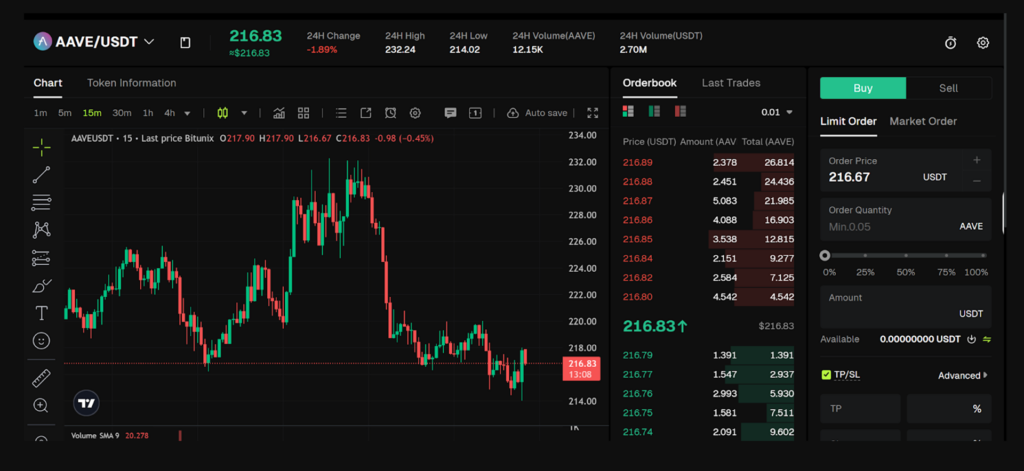
AAVE is one of the most sought-after DeFi assets. To trade efficiently, you need an exchange that combines security, liquidity, and an interface that serves both beginners and professionals, a crypto spot trading platform experience. On Bitunix, this translates into practical benefits:
- Fast sign-up and verification (KYC required only for fiat operations)
- Global compliance, a Protection Fund, and a public proof-of-reserves tracker
- 24/7 customer support
- Advanced tools: orders, indicators, and multiple charts on a single screen
If you want a platform to buy AAVE, trade AAVE futures, or simply hold spot exposure to the DeFi ecosystem with confidence, Bitunix delivers the full package. Open your Bitunix account and start trading AAVE today.
Conclusion: Is Aave Set for a Comeback?
AAVE brings the right ingredients for a strong return: a well-known DeFi brand, technical innovation, and clear growth engines with the GHO stablecoin and a push into real-world assets.
Together, these drivers create direct revenue for the protocol, loan fees, GHO issuance, and RWA services, which can fund buybacks and burns and rewards to stakers, compressing supply and supporting token value.
There are still headwinds from lending-protocol competition, macro swings, and regulation that can cap the rally’s magnitude. Even so, Aave can reclaim and surpass prior highs if it scales GHO and attracts institutional capital into permissioned pools.
If you believe in a financial system built on on-chain markets, Aave holds a privileged position. For practical exposure, trading AAVE on a deep-liquidity, pro-grade exchange makes sense. Trade AAVE on Bitunix today and take part in the next chapter of decentralized credit.
FAQ
Can Aave (AAVE) reach $1,000?
Yes, it is a plausible, optimistic view under strong GHO adoption, rising TVL, and significant institutional inflows.
What is the GHO stablecoin, and how does it benefit AAVE holders?
GHO is Aave’s native stablecoin. Fees from its usage feed the protocol treasury and can be used for buybacks and burns, or distributions to stakers, creating value for AAVE.
Is Aave a safe protocol to use for lending and borrowing?
Aave is considered one of the most audited and battle-tested DeFi protocols, with a strong track record. Still, on-chain and market risks always exist.
How does Aave make money?
The protocol captures revenue through loan fees, pool spreads, and potentially through issuing and managing assets like GHO. Part may flow to the DAO.
What is the difference between Aave V2 and Aave V3?
V3 focuses on capital efficiency, cross-chain interoperability, and enhanced risk features, expanding use cases.
How can I earn passive income with my AAVE tokens?
Options include staking in the Safety Module and joining DAO programs that reward contributions. You can also earn yield by lending assets in the protocol.
Who are Aave’s main competitors?
Compound (COMP), MakerDAO (for lending and stablecoin functions), and newer on-chain lending and credit markets.
Is Aave a good investment for the long term?
It can be, if you believe in continued DeFi adoption, GHO scalability, and RWA integration.
What are flash loans?
Atomic, unsecured loans that must be executed and repaid within the same transaction. Useful for arbitrage, refinancing, and advanced DeFi strategies.
Where is the best place to buy and trade AAVE?
Exchanges with deep liquidity and professional tools like Bitunix are an excellent option to get started with AAVE. This crypto exchange offers spot and futures pairs, a One Chart interface, and 24/7 support for traders of all levels.
Glossary
- Aave (Protocol): A non-custodial, open-source liquidity market where users supply assets to earn yield and borrow against posted collateral.
- AAVE (Token): The governance and safety asset of Aave. Holders vote on proposals and can stake into the Safety Module as an economic backstop.
- Safety Module (SM) / stkAAVE: A staking pool for AAVE that insures the protocol against shortfalls. Stakers earn rewards but accept slashing risk during severe incidents.
- GHO (Stablecoin): Aave’s native, over-collateralized stablecoin minted against borrower collateral within Aave. Interest paid by GHO borrowers flows to the Aave DAO treasury.
- Facilitators (GHO): Whitelisted mechanisms/entities allowed to mint/burn GHO under DAO-set parameters and bucket limits to manage issuance.
- Liquidity Pool (Reserve): Asset-specific pool where suppliers deposit tokens and borrowers draw liquidity. Each pool has risk parameters (LTV, liquidation threshold, reserve factor, caps).
- aTokens: Interest-bearing tokens received by liquidity suppliers. They accrue value in real time, representing a pro-rata claim on the reserve.
- Variable / Stable Debt Tokens: Tokenized liabilities that track a borrower’s variable-rate or stable-rate debt for each asset.
- Utilization Rate: Share of a reserve currently borrowed. It drives the interest-rate curve, higher utilization → higher borrow rates, raising supplier APY.
- Interest-Rate Model: Curve that adjusts borrow/supply APYs as utilization changes (with kinks where rates step up to protect liquidity).
- Reserve Factor: Portion of interest routed to the DAO’s treasury rather than suppliers; supports risk/operations.
- Loan-to-Value (LTV): Maximum borrow size relative to posted collateral (e.g., 75% LTV → borrow up to $75 for $100 collateral).
- Liquidation Threshold: Collateral value ratio below which positions may be liquidated to repay debt.
- Liquidation Bonus / Penalty: Premium paid to liquidators and corresponding penalty to the liquidated position when collateral is sold.
- Health Factor (HF): A numeric indicator of collateral safety (>1 is safer). If HF falls below 1, the position becomes eligible for liquidation.
- Isolation Mode (V3): Lets riskier assets be used as collateral with strict debt ceilings and stablecoin-only borrowing to limit contagion.
- E-Mode (Efficiency Mode, V3): Higher LTVs and thresholds for tightly correlated assets (e.g., stablecoin-stablecoin) to improve capital efficiency.
- Supply / Borrow Caps (V3): DAO-set ceilings on how much of an asset can be supplied or borrowed, used to control risk and liquidity concentrations.
- Risk Parameters (Per-Asset): DAO-governed settings such as LTV, liquidation threshold, reserve factor, collateral eligibility, and oracle configuration.
- Oracle (Price Feed): External price data (commonly Chainlink) used to value collateral and debt for health-factor calculations.
- Flash Loans: Uncollateralized loans that must be borrowed and repaid within a single transaction, useful for arbitrage, refinancing, and operations.
- Credit Delegation: A depositor authorizes another address to borrow against their credit line; terms are enforced by off-chain agreements and on-chain allowances.
- Cross-Chain Deployments (V3): Aave markets live on multiple L1/L2 networks. Governance coordinates parameters and risk across chains.
- Real-World Assets (RWA): Tokenized off-chain collateral (e.g., treasuries, credit) integrated via permissioned/whitelisted pools and institutional frameworks.
- DAO / Governance (AIPs): Community process where token holders and delegates propose (Aave Improvement Proposals), discuss, and vote on upgrades and risk changes.
- Treasury (Aave DAO): Receives protocol revenues (e.g., reserve factor, GHO interest) and funds grants, audits, incentives, buybacks/burns per governance.
- TVL (Total Value Locked): The total value of assets supplied across Aave markets, a proxy for liquidity depth and adoption.
- Backstop / Shortfall Event: A severe deficit scenario where the Safety Module can be tapped (slashing) to recapitalize the protocol.
- Permissioned Pools (Institutions): Whitelisted markets designed to meet KYC/AML and compliance requirements for regulated participants.
- Governance Bridges / Cross-Chain Messaging: Infrastructure coordinating governance actions and risk updates across Aave’s multi-chain deployments.
- Protocol Revenue Flywheel: Usage → interest and fees → DAO treasury → incentives/buybacks/staker rewards → potentially higher AAVE value and security.
- Key Risks (Summary): Smart-contract bugs, oracle failures, market liquidity crunch, collateral volatility, governance misconfiguration, cross-chain and RWA counterparty risks.
About Bitunix
Bitunix is a global cryptocurrency derivatives exchange trusted by over 3 million users across more than 100 countries. The platform is committed to providing a transparent, compliant, and secure trading environment for every user. Bitunix offers a fast registration process and a user-friendly verification system supported by mandatory KYC to ensure safety and compliance. With global standards of protection through Proof of Reserves (POR) and the Bitunix Care Fund, Bitunix prioritizes user trust and fund security. The K-Line Ultra chart system delivers a seamless trading experience for both beginners and advanced traders, while leverage of up to 200x and deep liquidity make Bitunix one of the most dynamic platforms in the market.
Bitunix Global Accounts
X | Telegram Announcements | Telegram Global | CoinMarketCap | Instagram | Facebook | LinkedIn | Reddit | Medium
Leave a Reply