
How AAPLUSDT Trading Works on Bitunix
Learn how to trade Apple stock on Bitunix with USDT, understand how AAPLUSDT works, and explore volatility, leverage, and risk management for beginners.


At Bitunix, we get the same questions repeatedly: what is copy trading in crypto, what exactly gets copied, why follower results can differ from a lead trader, and what settings matter most.
In this guide, we explain crypto copy trading in plain operational terms. We will walk through how Bitunix copy trading works on the Bitunix exchange, what followers control, what lead traders are responsible for, how crypto futures copy trading is executed, and the most common reasons copied trades fail. Our goal is to help you copy with clarity and discipline.
[ez-toc]
Copy trading in crypto is a feature that lets you follow a lead trader and automatically replicate their trading actions in your own copy trading account.
When you start copy trading crypto, you are authorizing an automated process. That means our system attempts to recreate the actions of the selected lead trader in your account without asking you to manually approve every trade. Because copying is automated, your copy settings become your first and most important risk controls.
To understand Bitunix copy trading, you need to understand who does what. Copy trading always has two roles.
As a follower, you choose a lead trader and configure how copying should behave. You control:
You do not control the lead trader’s decisions, and you do not control market volatility. Your job is to configure risk, then monitor consistently.
A lead trader is the strategy provider. Lead traders open positions that followers can copy. In a profit sharing model, lead traders can receive a share of follower profits during a settlement cycle.
Lead traders also operate under platform rules. Those rules are designed to protect followers and system integrity, including restrictions against misleading promotion and abusive behavior.
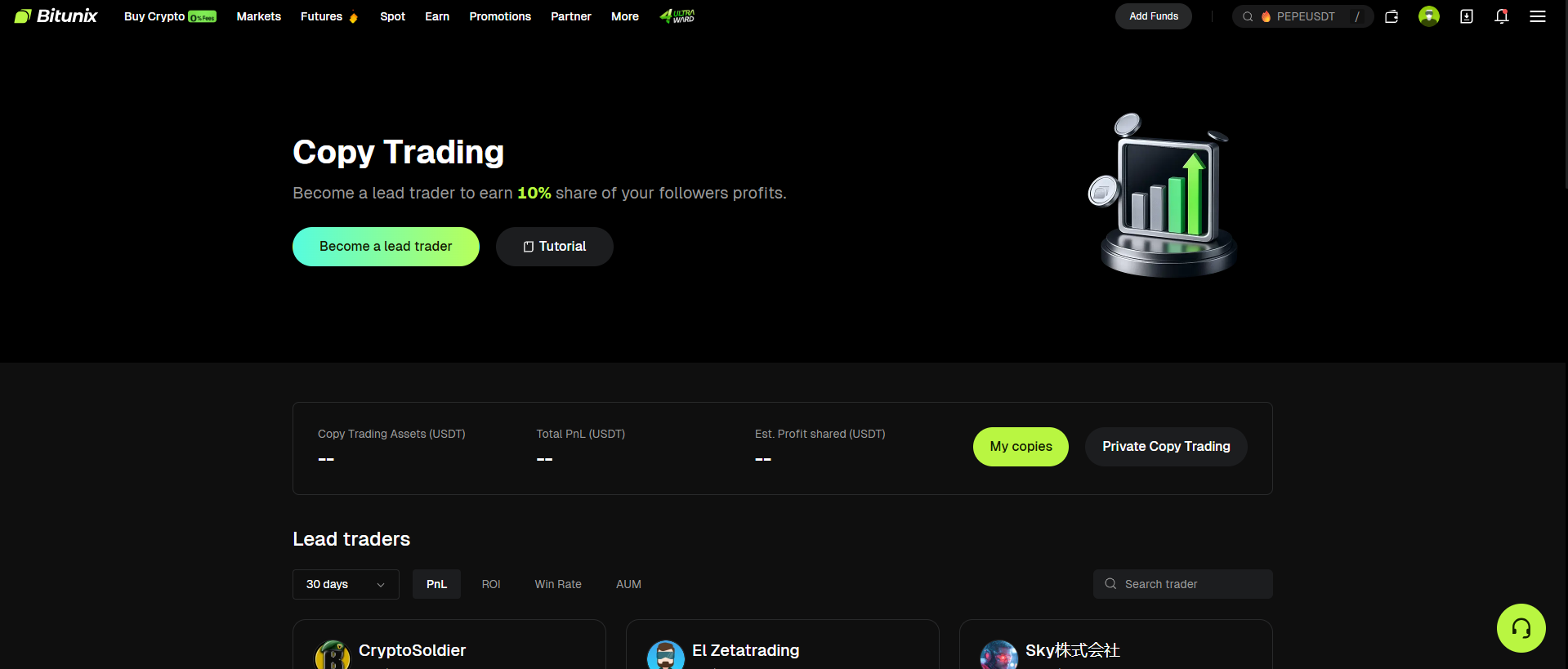
Bitunix webpage featuring Copy Trading. The page promotes earning a share of followers profits, with options to become a lead trader or start a tutorial.
On the Bitunix exchange, the follower workflow is designed to be simple, but the results still depend on the settings you choose.
Copy Square is where you browse lead traders and start copying. You can follow multiple lead traders at once, up to a stated maximum of 10.
Our practical guidance for most beginners is to start with one lead trader. This makes it easier to understand how copying behaves, whether trades are executing reliably, and whether the trader’s style fits your risk tolerance.
Copy mode is one of the most important decisions you make as a follower because it determines how your copied position size is calculated.
We support two core modes that followers commonly use:
In fixed amount mode, each copied order uses a fixed margin amount that you set.
Why many beginners start here:
In fixed ratio mode, your position size is opened based on the margin ratio between your account and the lead trader’s account.
Why some followers prefer it:
Key risk to understand:
Fixed ratio can scale exposure quickly if a lead trader increases size. That is why caps and limits matter more when you use ratio-based sizing.
Copy trading is safer when you define boundaries before you copy. We recommend using limits that prevent two problems:
A clean follower limit set often includes:
My Copy is where you track:
Monitoring matters because lead traders can change behavior over time, and follower outcomes can drift even when you copy the same trader.
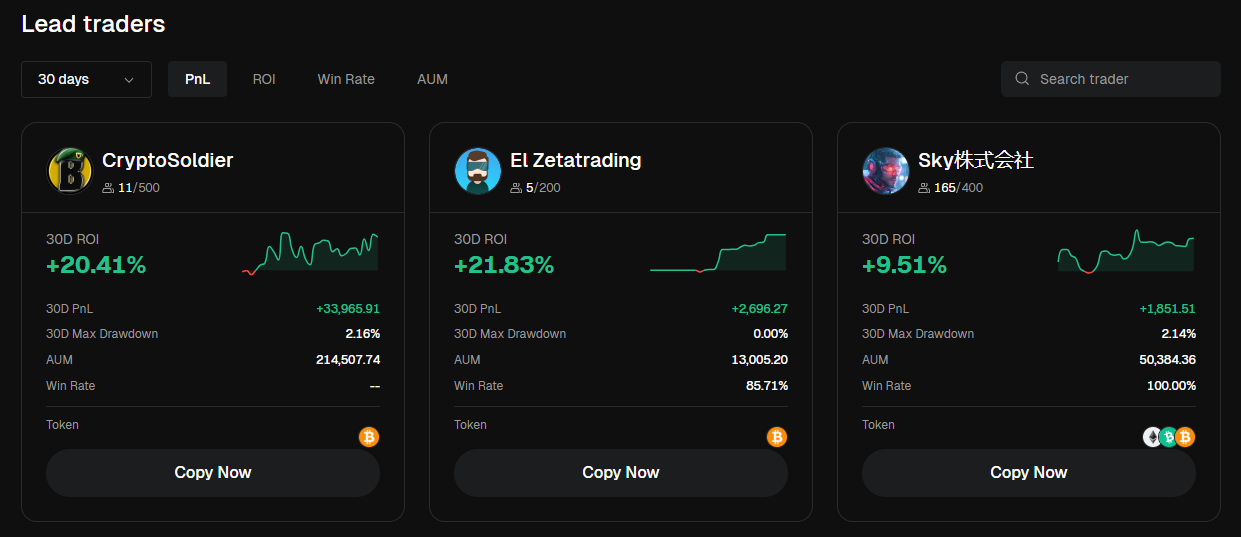
Bitunix A dashboard showing top three lead traders: CryptoSoldier with +20.41% ROI, El Zetatrading with +21.83% ROI, and Sky株式会社 with +9.51% ROI over 30 days. Each has charts, stats, and a Copy Now button.
Most copy trading on derivatives platforms is experienced as crypto futures copy trading. That means you are copying contract positions, not buying spot assets.
Here are the mechanics that matter most.
Our copy trading operates at the position level. Timing matters.
If a lead trader already has an open position before you start copying them, later changes to that existing position may not automatically create the same exposure in your account. This is one reason followers sometimes feel like they did not “catch” the full trade.
Follower takeaway: you are joining a live execution stream, not importing a trader’s full portfolio history.
In fast markets, the price can move between the lead trader’s execution and the follower’s attempted execution. To reduce uncontrolled fills, copy trading uses slippage controls.
On Bitunix copy trading, a commonly referenced slippage limit for copy execution is 0.1%. When the market moves beyond the allowed tolerance, a copy order may fail to execute.
Follower takeaway: if a strategy depends on ultra-precise entries, it can be harder to copy consistently, especially during high volatility.
In the copy trading context, closing and reducing positions are executed as market orders. Market orders prioritize execution speed, but they can lead to different fill prices during volatility.
Follower takeaway: even when copying the same lead trader, your exit price can differ.
A common expectation is that copied results should match lead trader results exactly. In live markets, exact matching is not guaranteed. The most common reasons are operational.
Copying happens after the lead trader’s action occurs. Even small delays can matter in fast-moving markets.
Liquidity can change between the lead trader’s fill and the follower’s fill. Slippage controls can also cause a copy order to fail if price moves too far.
If your copy account does not have enough available margin at the moment a lead trader opens a position, the copied trade can be skipped.
If you hit a maximum margin cap for a specific trading pair, new copy trades on that pair may not be placed until exposure changes.
When evaluating crypto copy trading, it is important to separate three cost categories.
Copied trades are still trades. Standard trading fees for the relevant product type apply.
Copy trading programs can include service fees. Under our terms, service fees may be deducted from the digital assets in your account depending on how the program is structured.
Profit sharing is the incentive model for lead traders. The typical structure is:
We use a weekly settlement schedule:
A commonly referenced standard profit-sharing ratio is 10 percent. Ratios can vary by program rules and lead trader category.
Follower takeaway: always evaluate net performance after fees and profit sharing, not only gross profit and loss.
Most copy trading issues are preventable once you know what causes them.
What it means: your available margin was not enough when copying attempted to execute.
How to reduce it:
What it means: the market moved beyond the allowed slippage tolerance and the copy order failed.
How to reduce it:
What it means: your configured caps for the pair or trader prevented new copy trades.
How to reduce it:
If your goal is safer copy trading crypto, focus on controllable inputs.
If you are new, fixed amount mode is often easier to manage because it makes exposure per copied trade more consistent.
We recommend writing down three numbers before you start:
Because profit sharing is settled weekly, a weekly review routine is practical. Evaluate:
Lead traders can improve follower experience by trading with follower execution in mind.
Crypto copy trading works best when you understand roles, settings, and execution. On the Bitunix exchange, Bitunix copy trading lets followers choose a copy mode, set allocation, apply limits, and monitor performance in My Copy. Because crypto futures copy trading involves real-time execution, follower results can differ from lead trader results due to timing, slippage controls, liquidity, and market-order exits.
If you want the most reliable experience, keep your setup simple, start with predictable sizing, maintain a margin buffer, and review weekly using the settlement cycle.
It is a feature that allows a follower to automatically replicate a lead trader’s trades using follower-defined settings.
Fixed amount mode and fixed ratio mode.
Common causes include insufficient available margin, slippage beyond tolerance, or caps reached for a trader or trading pair.
Yes. Differences can occur due to execution timing, slippage, liquidity conditions, and market-order exits.
Weekly, with settlement on Monday at 00:00 UTC.
Bitunix is a global cryptocurrency derivatives exchange trusted by over 3 million users across more than 100 countries. At Bitunix, we are committed to providing a transparent, compliant, and secure trading environment for every user. Our platform features a fast registration process and a user-friendly verification system supported by mandatory KYC to ensure safety and compliance. With global standards of protection through Proof of Reserves (POR) and the Bitunix Care Fund, we prioritize user trust and fund security. The K-Line Ultra chart system delivers a seamless trading experience for both beginners and advanced traders, while leverage of up to 200x and deep liquidity make Bitunix one of the most dynamic platforms in the market.
Bitunix Global Accounts
X | Telegram Announcements | Telegram Global | CoinMarketCap | Instagram | Facebook | LinkedIn | Reddit | Medium