Futures trading means trading a contract that follows the price of an asset such as Bitcoin or Ethereum. You are not buying the coin itself. You are trading price direction through a contract. That contract can be used to open a long position if you expect price to rise, or a short position if you expect price to fall.
People also ask what trading futures mean. In everyday crypto language, it generally means the same thing. You are opening and managing futures positions rather than buying the asset on spot.
What matters for beginners is the consequence of this structure. Futures often involve margin and leverage. That makes outcomes faster, and it makes risk management a first skill, not an advanced skill.
[ez-toc]
What Beginners Should Look For In A Futures Platform
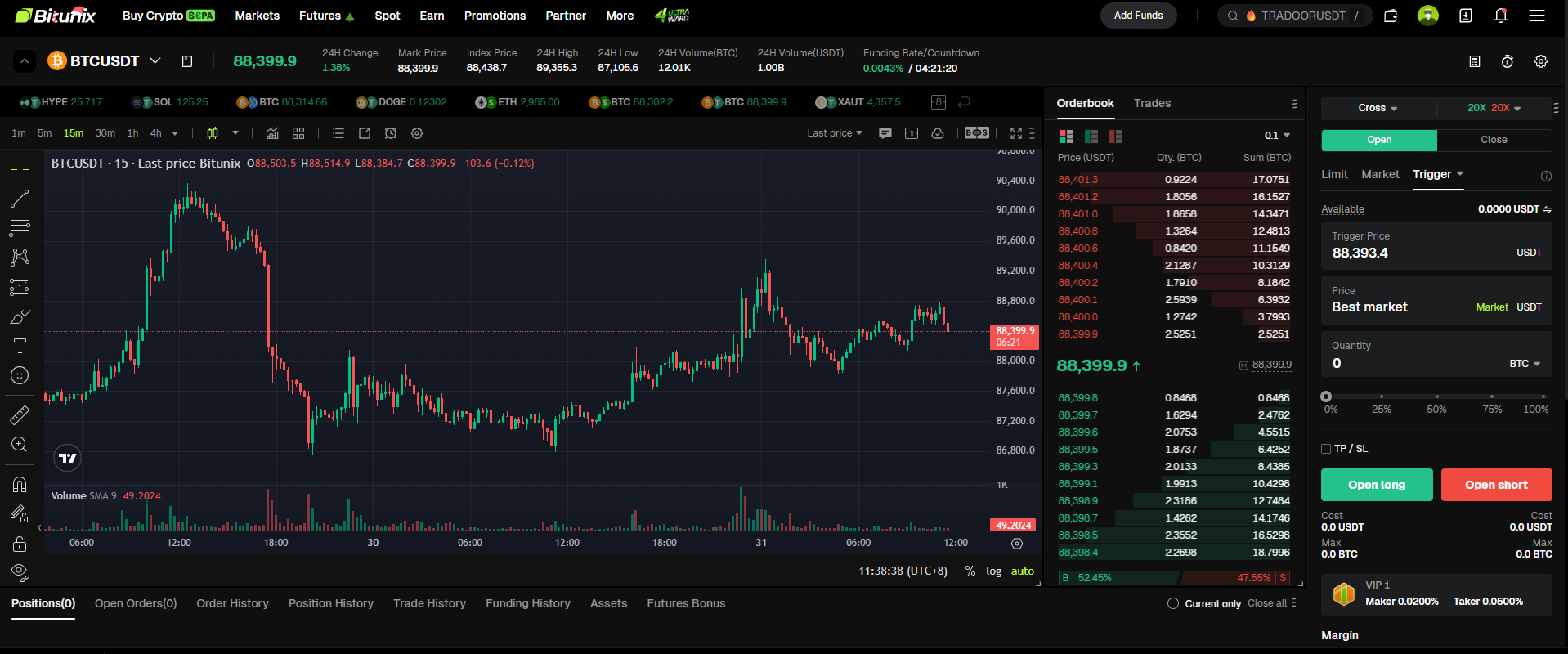
Bitunix Futures Trading Screenshot of the Bitcoin Futures trading interface displaying the BTC/USDT chart, order book, recent trades, and trading options. The chart shows Bitcoin price movement, with buy/sell menus on the right and market data below.
Many traders interpret “best” as more markets or higher leverage. For beginners, that is not the right starting point.
A genuinely beginner-friendly platform should help you do three things consistently.
Make Risk Visible
Before you confirm an order, you should be able to understand your exposure in seconds. That means the interface should make it easy to see:
- Position size
- Margin used
- Leverage setting
- Where your trade is wrong, which is your stop-loss level
- What you stand to lose if that stop is hit
When risk is hidden or unclear, beginners tend to overtrade or oversize without realizing it.
Make Risk Controls Easy To Use
A platform can look professional and still be beginner unfriendly if it makes stop-loss placement awkward.
For beginners, the essential tools are:
- Take-profit
- Stop-loss
- Trigger-based orders if available
On Bitunix, we provide clear tutorials for setting protective orders. Use the official web guide once and keep it as your reference: How to Set Up Take Profit and Stop Loss for Futures Trading on Bitunix Web.
Help You Learn With Structure
Beginners need a repeatable process more than they need a complex strategy. The best platforms support that with clear education and a clean trade workflow.
If you want a short starting lesson that fits beginners, you can use our Academy module: 3-Minute Quick Start to Futures Trading.
The Core Mechanics Beginners Must Understand
If a platform does not teach these mechanics clearly, it is difficult to call it the best futures trading platform for beginners, even if it has every feature.
Margin Explained In Plain Language
Margin is the collateral that supports your position. When price moves against you, losses are taken from that collateral. If your margin buffer becomes too small, your position can be forcibly closed.
Beginner mindset shift:
- Margin is not a ticket to enter the trade.
- Margin is the safety buffer that keeps you alive during normal volatility.
Bitunix Leverage Without The Hype
Leverage increases exposure relative to margin. Higher leverage can reduce the margin required for a position size, but it also reduces the distance you have before a trade becomes unstable.
On Bitunix, we offer adjustable Bitunix leverage so beginners can start low and scale as their execution improves. We have also increased maximum leverage up to Bitunix 200x leverage for BTC/USDT and ETH/USDT perpetual futures. You can review the official update here: Bitunix Increases Maximum Leverage to 200x for BTC/USDT and ETH/USDT Perpetual Futures.
How beginners should interpret that:
- Maximum leverage is flexibility, not a requirement.
- Beginners should start with lower leverage and treat leverage as a risk dial, not a profit dial.
Liquidation As A Risk Boundary
Liquidation is a forced closure that can occur when your margin becomes insufficient under margin requirements. In practical terms, liquidation is what happens when you take too much exposure for the amount of buffer you have.
A beginner rule that works:
If liquidation is uncomfortably close to your entry, your position is oversized or your leverage is too high.
A second rule that works even better:
Your stop-loss should end your trade, not liquidation. Your stop-loss is a decision. Liquidation is a consequence.
Margin Mode Cross And Isolated
Margin mode changes how collateral supports positions.
- Isolated margin typically assigns margin to a single position.
- Cross margin can allow available balance to support positions together.
Beginners often prefer isolated margin because the boundary is clearer. If you want the full explanation of how margin modes work, use our official reference once: What is Margin Mode in Perpetual Futures Trading.
Why Traders Choose Bitunix For Beginner Futures Trading
A platform earns beginner trust when it reduces avoidable mistakes. These are the most common practical reasons beginners choose Bitunix futures to learn.
Clear Allocation Between Spot And Futures
A smart beginner habit is separating learning capital from longer-term holdings.
On the Bitunix exchange, Spot and Futures are distinct areas, and we provide an internal transfer process, so you decide how much capital is allocated to futures activity. Use this guide once if you need the steps: How to Transfer Funds from Spot to Futures on Bitunix.
What this means in real life:
You can practice trading futures for beginners with a defined amount rather than exposing your entire account to leveraged risk.
Practical Order Protection Education
Beginners do not fail because they lack indicators. They fail because they enter without a plan and exit emotionally.
Our education focuses on execution basics, including setting stop-loss and take-profit on mobile. Here is the app tutorial if you prefer learning on your phone: How to Set Take Profit and Stop Loss for Futures Trading on Bitunix App.
A Beginner Friendly Starting Market
Most beginners learn clean execution on majors first. That is why BTC futures and ETH futures are common starting points. They tend to have deeper liquidity than many smaller markets, which can reduce unnecessary slippage while you learn.
If you want to explore the full set of futures resources available, our Help Center futures category is the best single index: Futures Trading Help Center.
A Beginner Workflow On Bitunix Futures
This is a process you can repeat. Repetition builds skill faster than constantly changing strategies.
Step One: Choose A Small Learning Budget
Decide a small amount you are comfortable allocating to futures learning. This keeps your emotions under control because one trade cannot damage your entire plan.
Step Two: Transfer Only That Amount To Futures
Move a defined amount into your Futures balance. This creates a clear boundary and improves decision-making.
Step Three: Start With BTC Futures Or ETH Futures
Pick one market at first. If you trade ten markets, you learn ten sets of behavior at the same time. That slows learning.
For most beginners, BTC futures and ETH futures are the cleanest practice environment.
Step Four: Select Margin Mode And Leverage
Choose a margin mode you understand. Many beginners start with isolated margin for clarity.
Set leverage low enough that normal volatility does not immediately threaten your position. Your goal early on is not to maximize profit. Your goal is to execute correctly 20 times in a row.
Step Five: Enter With A Plan And Place Protection Immediately
Before entering:
- Define where you will exit if you are wrong.
- Define where you will take profit.
- Define how much you are willing to lose.
Then place the trade and set stop-loss and take-profit immediately. This prevents the most common beginner error, which is deciding exits while the trade is already moving against you.
Step Six: Review The Trade Like A Student
After each trade, record:
- Why you entered
- Whether your stop was reasonable
- Whether you followed your plan
- One improvement for next time
This is how trading futures for beginners turns into competence instead of random outcomes.
Two Examples That Teach The Right Habits
These are educational examples, not market predictions.
BTC Futures Example: Built Around Invalidation
You enter based on a level you can explain. You place a stop-loss at the level that proves the idea wrong. You choose a position size that makes that loss acceptable.
What you learn:
A stop-loss is not pessimism. It is discipline. It keeps small losses small.
ETH Futures Example: Built Around Process
You take a short or a long based on a clear setup, not on emotion. You define your exit first, then your entry. You set take-profit so you do not turn a winning trade into a stressful decision.
What you learn:
Direction is not the hard part. The process is the hard part.
Final Checklist For The Best Crypto Futures Trading Platform
If you are comparing platforms, use this checklist. It is a simple way to decide whether a platform truly fits the criteria.
Risk Visibility
You can clearly see margin, leverage, position size, and key trade parameters before confirming.
Easy Risk Controls
Stop-loss and take-profit are easy to set and manage from the trading screen.
Structured Learning Support
The platform provides practical education that teaches actions, not just definitions.
Leverage Flexibility
You can start low and scale up when ready. Maximum leverage exists for flexibility, but beginners are not pushed toward it.
Clear Allocation Control
You can control how much capital is allocated to futures without mixing it with long-term holdings.
The best crypto futures trading platform for beginners is the one that helps you trade safely, learn faster, and avoid avoidable mistakes.
Conclusion
If you are choosing the best futures trading platform for beginners, focus on visibility, protection tools, and a workflow that encourages disciplined learning. That is why many traders choose Bitunix.
On the Bitunix exchange, you can start with Bitunix futures trading in a structured way, practice on BTC futures and ETH futures, control risk with margin modes and protective orders, and scale your Bitunix leverage only after your execution becomes consistent.
About Bitunix
Bitunix is a global cryptocurrency derivatives exchange trusted by over 3 million users across more than 100 countries. At Bitunix, we are committed to providing a transparent, compliant, and secure trading environment for every user. Our platform features a fast registration process and a user-friendly verification system supported by mandatory KYC to ensure safety and compliance. With global standards of protection through Proof of Reserves (POR) and the Bitunix Care Fund, we prioritize user trust and fund security. The K-Line Ultra chart system delivers a seamless trading experience for both beginners and advanced traders, while leverage of up to 200x and deep liquidity make Bitunix one of the most dynamic platforms in the market.
Bitunix Global Accounts
X | Telegram Announcements | Telegram Global | CoinMarketCap | Instagram | Facebook | LinkedIn | Reddit | Medium