
How AAPLUSDT Trading Works on Bitunix
Learn how to trade Apple stock on Bitunix with USDT, understand how AAPLUSDT works, and explore volatility, leverage, and risk management for beginners.


Crypto copy trading should feel simple to understand, not just simple to start. When you copy trades, you are still trading real markets, especially in crypto futures copy trading where leverage, funding, and execution costs can shape outcomes. That is why fee clarity matters.
In this guide, we break down the full cost stack for Bitunix copy trading on the Bitunix exchange, explain when each cost applies, and show how to estimate what you keep after fees.
[ez-toc]
What is copy trading in crypto? It is a feature that allows you to follow a lead trader and replicate their trading actions automatically, based on the settings you choose.
Copy trading crypto simplifies execution, but it does not remove real trading costs. The most useful way to think about fees is not “Is there a fee?” It is “Which costs apply during execution, and which apply at weekly settlement?”
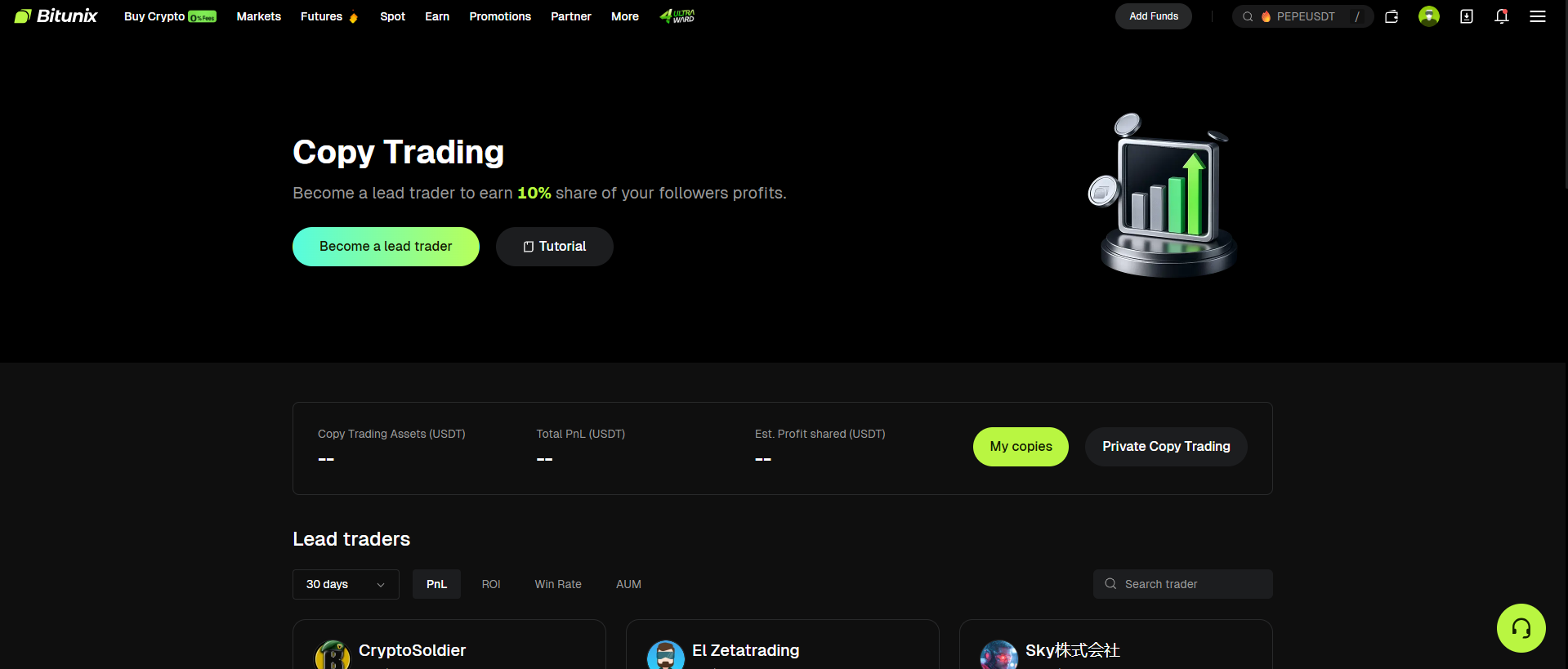
Bitunix webpage featuring Copy Trading. The page promotes earning a share of followers profits, with options to become a lead trader or start a tutorial.
When you copy trades on the Bitunix exchange, your total costs can be grouped into four categories:
Understanding these categories makes it much easier to evaluate net results and compare options when searching for the best crypto copy trading platform.
Copied orders are still futures orders, so futures trading fees apply. Futures fees are typically shown as maker and taker rates, and your specific rate depends on your VIP level.
Fees are not just a “small percentage.” They become meaningful when:
If you want to understand what you keep, always consider trading frequency alongside performance.
Funding applies to perpetual futures. It is not unique to Bitunix copy trading, but it matters in crypto futures copy trading because it can meaningfully affect net results.
Funding is typically settled every 8 hours at 00:00, 08:00, and 16:00 UTC. For certain pairs, funding time may be adjusted based on market conditions.
Two followers can copy the same lead trader and still see different funding outcomes if:
Funding is one of the most important “quiet” costs in crypto copy trading. It is also one of the easiest to plan for once you understand the holding-time factor.
Profit sharing is the core copy trading mechanic that rewards lead traders when followers profit. On Bitunix, profit sharing is handled through a weekly settlement process.
We settle profit sharing every Monday at 00:00 UTC. The earnings calculation period covers the prior week, running from Monday 00:00:00 UTC to Sunday 23:59:59 UTC.
This is why weekly review is a practical routine for copy trading crypto. It aligns with how settlement is calculated.
Profit sharing applies when you have a profitable settlement cycle. If your settlement cycle result is a loss, profit sharing is not charged for that cycle.
This structure is important:
Profit sharing is calculated using realized results from the weekly cycle, meaning profit from closed or partially closed positions during the calculation window.
A simple way to understand the logic is:
Pending Profit Sharing Amount = Max(Cycle Realized Profit × Profit Sharing Ratio, 0)
If the cycle realized profit is negative, the pending profit sharing amount is zero.
The profit-sharing ratio is shown on the lead trader profile. Always review that ratio before you start copying. It is part of the cost structure you are accepting, and it directly affects what you keep during profitable weeks.
In addition to standard trading fees and profit sharing, the copy trading terms also reference possible service fees.
Service fees, if applicable, are separate from futures trading fees and profit sharing. The terms also allow service fees to be deducted from the digital assets in your account.
Practical takeaway: when you model net outcomes, keep service fees as a potential line item alongside trading fees, funding, and profit sharing.
A clear framework prevents confusion when you compare traders or platforms.
Net result (simplified) =
Cycle realized trading outcome
− futures trading fees
− funding paid (or + funding received)
− profit sharing (only when the cycle is profitable)
− any applicable service fees
This framework is also how we recommend evaluating the best crypto copy trading platform from a fee transparency perspective.
These examples are simplified to show structure. Your actual outcome depends on VIP tier, maker vs taker execution, funding rates, and the profit-sharing ratio shown on the lead trader profile.
Assume for one weekly cycle:
Step 1: Result after trading fees and funding
500 − 30 − 10 = 460 USDT
Step 2: Profit sharing for the cycle
460 × 10% = 46 USDT
Estimated net you keep
460 − 46 = 414 USDT
Assume for one weekly cycle:
Because the cycle result is negative, profit sharing is not charged for that cycle.
Estimated net result
−200 − 18 − 4 = −222 USDT
Cost efficiency should come from better processes, not higher leverage.
High-frequency strategies can create higher fee drag and greater sensitivity to slippage. A copy-friendly style is often easier to follow reliably in live market conditions.
If a strategy tends to hold positions through multiple funding intervals, funding can become a larger part of net outcomes. That is not automatically bad, but it should be understood.
A buffer helps reduce skipped copies due to insufficient available margin and supports smoother execution during volatility.
Because profit sharing is settled weekly, a weekly review cadence fits how results are measured:
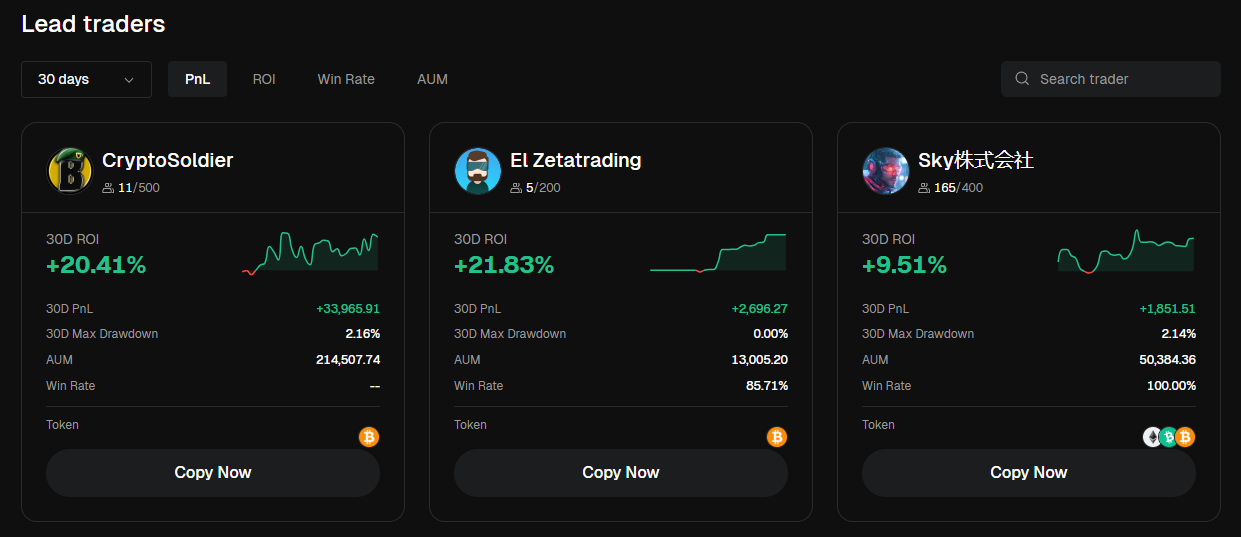
Bitunix A dashboard showing top three lead traders: CryptoSoldier with +20.41% ROI, El Zetatrading with +21.83% ROI, and Sky株式会社 with +9.51% ROI over 30 days. Each has charts, stats, and a Copy Now button.
When comparing platforms, these are the cost questions that matter:
A platform that answers these clearly is closer to “best crypto copy trading platform” standards for transparency.
Clear fee expectations are part of responsible crypto copy trading. On the Bitunix exchange, Bitunix copy trading costs can include futures trading fees, funding fees when positions are held at funding timestamps, weekly profit sharing when the settlement cycle is profitable, and potential service fees described in the terms.
If you want to estimate what you keep with confidence, review the lead trader’s profit-sharing ratio before copying, understand the weekly settlement schedule, and evaluate net outcomes using the cost framework above.
Yes. Copy trades are futures trades, so futures trading fees apply.
Profit sharing is settled weekly on Monday at 00:00 UTC. The earnings calculation period runs from Monday 00:00:00 UTC to Sunday 23:59:59 UTC.
No. If your settlement cycle result is a loss, profit sharing is not charged for that cycle.
Profit sharing is calculated using realized results from closed or partially closed positions during the weekly calculation window.
Yes. Funding applies if your perpetual futures position is open at the funding timestamp, and it can be paid or received depending on the funding rate and your position direction.
Bitunix is a global cryptocurrency derivatives exchange trusted by over 3 million users across more than 100 countries. At Bitunix, we are committed to providing a transparent, compliant, and secure trading environment for every user. Our platform features a fast registration process and a user-friendly verification system supported by mandatory KYC to ensure safety and compliance. With global standards of protection through Proof of Reserves (POR) and the Bitunix Care Fund, we prioritize user trust and fund security. The K-Line Ultra chart system delivers a seamless trading experience for both beginners and advanced traders, while leverage of up to 200x and deep liquidity make Bitunix one of the most dynamic platforms in the market.
Bitunix Global Accounts
X | Telegram Announcements | Telegram Global | CoinMarketCap | Instagram | Facebook | LinkedIn | Reddit | Medium