How AAPLUSDT Trading Works on Bitunix
Learn how to trade Apple stock on Bitunix with USDT, understand how AAPLUSDT works, and explore volatility, leverage, and risk management for beginners.


Leverage is one of the main features that draws traders to futures trading. It allows you to control a larger position with a smaller margin, which can improve capital efficiency and make it easier to hedge risk. At the same time, leverage can magnify losses and move liquidation closer to your entry, which is why it is often the first concept that feels risky to new traders.
If you are searching what futures trading is, you are likely also trying to understand why a small price move can create a large PnL swing. That comes down to leverage and how futures positions are margined. This guide explains how leverage works in futures trading, what it changes, what it does not change, and how to approach it on Bitunix futures in a practical way.
Whether you are exploring crypto futures trading for the first time or trying to tighten your risk habits, this article will help you read the leverage, margin, and liquidation details on your screen with confidence.
[ez-toc]
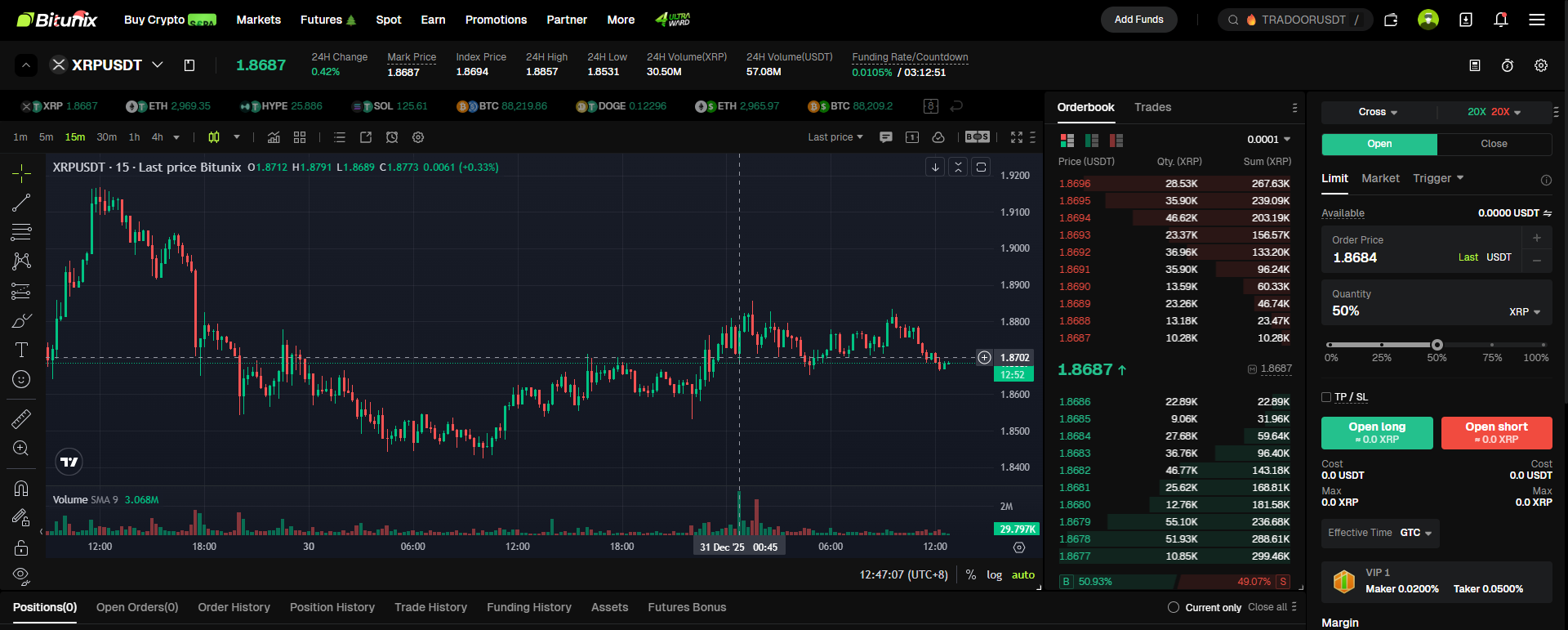
Bitunix Futures Trading Screenshot showing an XRP/USDT candlestick chart, order book, recent trades, and trading panel, with the current price at 1.8687 USDT. Various trading tools and metrics are visible.
To answer the common question, what is futures trading: futures trading means trading a contract that tracks the price of an asset without requiring you to own the asset itself. In crypto, that often includes perpetual futures contracts, which do not have an expiration date.
If you are asking what trading futures is in real terms, the practical explanation is simple: you are trading price direction with defined collateral rules. You can go long if you expect price to rise, or go short if you expect price to fall. Your profit and loss depends on how price moves relative to your entry, and your risk depends on how your margin is set up.
Leverage is what changes the speed and sensitivity of that risk. It is not a shortcut to profits. It is a position-sizing tool that must match your risk plan.
Leverage is a multiplier that determines how much exposure you control relative to the margin you post.
Here is the simplest framing:
This is why futures trading for beginners often feels “too fast.” The chart may not look dramatic, but the position is amplified by leverage.
To use leverage responsibly on Bitunix futures trading, you should understand three terms that work together.
Notional value is the full size of your position exposure. It is what you are effectively controlling in the market.
Margin is the collateral allocated to support the position. Margin absorbs losses as price moves against you.
Liquidation is the forced closure of a position when your margin is no longer sufficient to meet maintenance requirements. In crypto futures trading, liquidation is not unusual. It is the built-in mechanism that protects the system from positions going deeply negative.
The key point for trading futures for beginners is this: liquidation risk is primarily controlled by position size, leverage, and margin mode, not by “how confident you feel.”
Leverage mainly changes one practical thing: how much price can move against you before the position becomes unsafe.
When leverage increases:
This is why traders sometimes get liquidated even if the market later moves in their original direction. Their timing might have been reasonable, but their leverage was too high for the volatility they were exposed to.
On Bitunix exchange, futures trading typically offers both isolated and cross margin modes. Choosing the right one is as important as choosing leverage.
Isolated margin means only the margin assigned to that position is at risk for that position. If the trade goes wrong, the loss is largely limited to that allocated amount.
Why it is popular for beginners:
Cross margin means positions share available margin. This can reduce liquidation risk for a specific position in some scenarios, but it can also spread risk across your account when markets move quickly.
For most futures trading for beginners, isolated margin is a clearer starting point because it creates tighter guardrails.
Let’s use a conceptual example to show how leverage changes sensitivity. Exact liquidation levels vary by contract and maintenance margin rules, but the behavior is consistent.
Assume:
Now compare exposure:
As notional exposure increases, a small percentage move against you translates to a much larger dollar move relative to your margin. That is why higher leverage demands tighter discipline. It is not “more skill.” It is simply less room for error.
The same logic applies to ETH futures, which can move differently from BTC in short bursts. If a market is more volatile, higher leverage becomes harder to manage because liquidation gets closer faster.
Bitunix futures includes adjustable leverage options that allow traders to customize exposure based on strategy. Bitunix 200x leverage is available on selected contracts like BTC/USDT & ETH/USDT, but it is best viewed as an advanced tool for experienced traders who already have strict risk controls.
If you are new, the better approach is:
This is what “responsible” leverage use looks like. Leverage follows the plan, not the other way around.
This checklist is designed specifically for trading futures for beginners. Use it every time until it becomes automatic.
Before setting leverage, decide how much you can afford to lose on this trade. Keep it small and consistent while learning.
Your invalidation level is where your trade idea is wrong. That is where your stop-loss belongs. Liquidation should never be your “stop.”
Choose position size so that if the stop-loss is hit, the loss stays within your risk limit. If the position feels too large, reduce size, not discipline.
Now choose leverage. Your goal is for normal volatility to feel manageable.
A fast self-check:
Before confirming on Bitunix futures:
This ten-second scan prevents the most common beginner mistakes.
Many new traders search for the “best” leverage. In reality, the best leverage is the one that allows you to execute your plan calmly and consistently.
The same is true when people search for the best crypto futures trading platform for beginners. Beginners often focus on maximum leverage. A better standard is whether the platform makes it easy to understand:
Platforms that make risk clear help beginners learn faster and make fewer costly mistakes. That clarity is more valuable than a higher leverage number.
If your goal is sustainable progress in crypto futures trading, practice in a way that reduces account stress:
Leverage becomes useful when it stops being exciting. If it feels thrilling, it is usually too aggressive for your experience level.
Leverage is a core feature of futures trading, but it is not a strategy by itself. It is a multiplier that changes sensitivity, liquidation distance, and how quickly mistakes are punished
On Bitunix exchange, bitunix futures trading provides tools to trade futures with adjustable leverage, including advanced settings like bitunix 200x leverage on selected contracts. For beginners, the most effective approach is conservative leverage, isolated margin, defined invalidation, and repeatable position sizing. That is how you turn leverage into a tool instead of a trap.
Leverage is a multiplier that lets you control a larger futures position using a smaller amount of margin as collateral.
Futures trading uses contracts that track price movements and allow long and short positions with margin. Spot trading involves buying or selling the asset directly.
Yes. Higher leverage usually brings the liquidation price closer to entry, so routine volatility can trigger liquidation if margin buffers are thin.
It is an advanced feature. Futures trading for beginners is generally safer with conservative leverage, isolated margin, and strict stop-loss discipline.
Many beginners start with BTC futures and ETH futures because they are widely traded and typically provide more predictable execution than smaller contracts.
Bitunix is a global cryptocurrency derivatives exchange trusted by over 3 million users across more than 100 countries. At Bitunix, we are committed to providing a transparent, compliant, and secure trading environment for every user. Our platform features a fast registration process and a user-friendly verification system supported by mandatory KYC to ensure safety and compliance. With global standards of protection through Proof of Reserves (POR) and the Bitunix Care Fund, we prioritize user trust and fund security. The K-Line Ultra chart system delivers a seamless trading experience for both beginners and advanced traders, while leverage of up to 200x and deep liquidity make Bitunix one of the most dynamic platforms in the market.
Bitunix Global Accounts
X | Telegram Announcements | Telegram Global | CoinMarketCap | Instagram | Facebook | LinkedIn | Reddit | Medium