How AAPLUSDT Trading Works on Bitunix
Learn how to trade Apple stock on Bitunix with USDT, understand how AAPLUSDT works, and explore volatility, leverage, and risk management for beginners.


Futures trading can feel intimidating the first time you open an order screen. You will see leverage, margin modes, contract types, and fast-moving numbers that look nothing like spot.
This guide is designed to make your first crypto futures trading experience simple, controlled, and repeatable. You will learn what futures trading is and the exact checklist to follow before you place your first position on Bitunix futures.
[ez-toc]
If you are searching what futures trading is, here is the straightforward definition: futures trading means trading a contract that tracks the price of an underlying asset, without needing to own the asset itself. In crypto, that usually means perpetual futures contracts that follow the price of BTC or ETH and let you go long or short.
If you are asking what trading futures is, the practical answer is this: you are trading price direction with defined risk. Your profit and loss comes from how price moves relative to your entry, and your results depend heavily on position sizing and liquidation control.
Crypto futures trading is typically used for three reasons:
Futures are powerful, but they can magnify mistakes faster than spot. That is why futures trading for beginners should start with a checklist, not a prediction.
Liquidation happens when your margin can no longer support the position as price moves against you. Higher leverage generally increases liquidation risk because the allowed adverse price movement is smaller.
Most platforms offer isolated and cross margin.
For futures trading for beginners, isolated margin is usually easier to manage because the maximum risk per trade is clearer.
Bitunix leverage settings change how much exposure you take relative to margin. Higher leverage is not automatically better. It simply requires tighter risk control.
Bitunix 200x leverage exists on selected contracts, but beginners should treat higher leverage as an advanced feature, not a starting point.
Beginners are often best served by liquid, widely followed contracts such as BTC futures and ETH futures, because they typically have deeper participation and more consistent execution than smaller markets.
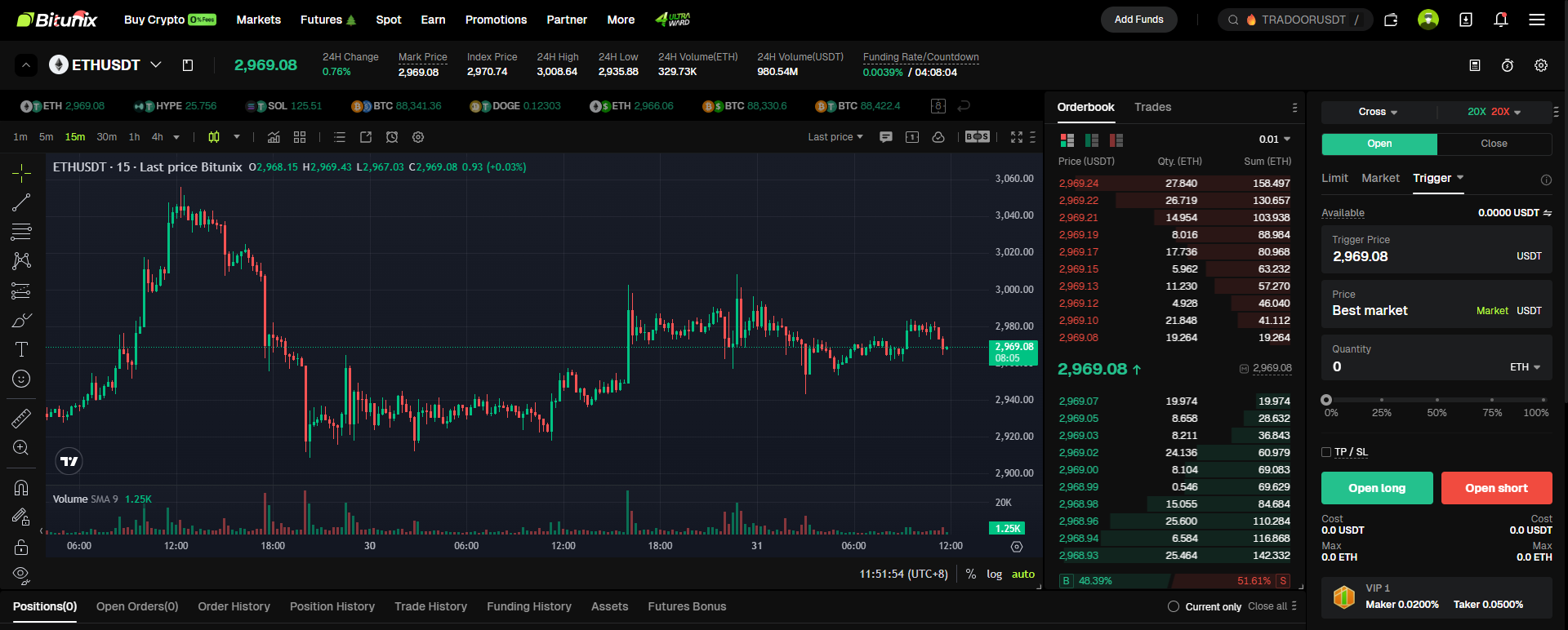
Bitunix Futures Trading Screenshot showing the ETH/USDT price chart, order book, trade options, and market details. The current ETH price is around 2,950 USDT, with charts and trading panel visible.
Follow these steps in order. Do not skip steps.
Write one sentence before you open the order screen:
This prevents emotional entries, especially when the market is moving fast.
For your first position on bitunix futures, prioritize contracts with strong participation. In most beginner cases, that means BTC futures or ETH futures.
This helps reduce slippage risk and makes your execution more predictable.
Select margin mode before setting leverage:
Bitunix futures trading allows leverage selection. For a first trade, the goal is not maximum exposure. The goal is clean execution without getting forced out by normal volatility.
A practical way to check yourself:
Bitunix 200x leverage is a capability, but beginners should not treat it as a default setting.
This is the most important step in futures trading for beginners.
Decide how much you can afford to lose on trade first. Then size the position so that if your stop-loss is hit, the loss stays within that limit. One trade should never be able to derail your account.
A common approach while learning is to risk a small, fixed percentage per trade and keep it consistent.
You need two exits:
If you enter without an invalidation level, you are not trading. You are hoping.
For your first trade, keep it simple:
On Bitunix futures, using stop and trigger orders is one of the easiest ways to keep risk defined.
Before you click confirm, pause for ten seconds and check:
This habit prevents most beginner mistakes.
Once the position is open, focus on:
Beginners often stare at PnL and start changing the plan. A better habit is to monitor whether your invalidation level still makes sense.
After closing, write:
This turns your first ten trades into measurable improvement.
If you are looking for the best futures trading platform for beginners, do not start with maximum leverage. Start with safety and clarity.
A beginner-friendly platform should offer:
When people say best crypto futures trading platform, they often mean “the one that lets me use the most leverage.” Beginners should redefine it as “the one that helps me manage risk, learn faster, and avoid avoidable errors.”
Bitunix exchange is built to make critical risk information visible on the trading screen, so you can make decisions with clarity.
Most futures losses come from position size, not from direction.
Leverage without a stop-loss is one of the fastest paths to liquidation.
Your invalidation level should be based on your trade idea. If the idea is wrong, exit. Do not turn a planned trade into an unplanned hold.
Perpetual futures can include fees and funding that affect PnL. Always check the contract details on the order screen before trading.
It is trading a contract that tracks a crypto asset’s price so you can profit from price moves or hedge risk without owning the asset directly.
Spot trading involves buying or selling the asset itself. Futures trading involves buying or selling a contract that tracks the asset’s price, usually with margin and leverage.
It can be, if you trade small, use isolated margin, set a stop-loss, and treat leverage as optional. It becomes risky when beginners oversize positions or skip exits.
Many beginners start with BTC futures or ETH futures because they are widely traded and typically easier to execute than smaller contracts.
Leverage increases exposure and reduces the distance to liquidation. Start conservative. Bitunix 200x leverage is available on selected contracts, but it is not recommended as a starting point for trading futures for beginners.
Bitunix is a global cryptocurrency derivatives exchange trusted by over 3 million users across more than 100 countries. At Bitunix, we are committed to providing a transparent, compliant, and secure trading environment for every user. Our platform features a fast registration process and a user-friendly verification system supported by mandatory KYC to ensure safety and compliance. With global standards of protection through Proof of Reserves (POR) and the Bitunix Care Fund, we prioritize user trust and fund security. The K-Line Ultra chart system delivers a seamless trading experience for both beginners and advanced traders, while leverage of up to 200x and deep liquidity make Bitunix one of the most dynamic platforms in the market.
Bitunix Global Accounts
X | Telegram Announcements | Telegram Global | CoinMarketCap | Instagram | Facebook | LinkedIn | Reddit | Medium