Alphabet Inc. on Bitunix: How to Trade GOOGLUSDT
Learn what Alphabet is and how to trade GOOGLUSDT on Bitunix. Explore Google stock forecast themes, Alphabet AI stock narratives, earnings catalysts, and beginner trading basics.

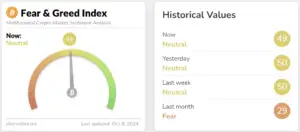
As of this Tuesday, the sentiment index stands at 49, down slightly from last week’s 50, marking a 2% decrease. After BTC dipped below 60,000, it quickly rebounded to around 64,000 and is currently hovering near 62,300.
The Fear & Greed Index remains neutral, reflecting the balanced sentiment in the market.
The launch of Bitcoin spot ETFs has further boosted market optimism. Consistent inflows into ETFs reflect growing investor confidence, further solidifying the market’s upward trajectory.
SEC legal developments and the FTX hearings, which could further stimulate market dynamics.
Thursday, October 10th, 20:30 (UTC+8)
Friday, October 11th, 22:00 (UTC+8)
(All times UTC+8)
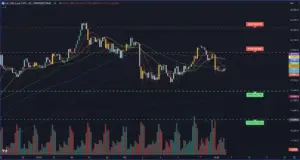
From the chart analysis, the current price is situated near the middle band of the Bollinger Bands, indicating that the market is in a relatively balanced state. However, the wide distance between the upper and lower bands suggests that volatility has increased recently. In the short term, the middle band (19,812 points) serves as an important support level.
The Simple Moving Averages (SMA) show that the short-term averages (such as the 5-day and 10-day SMAs) have started to flatten or slightly tilt downward, signaling a potential weakening of upward momentum. This indicates that the market might be entering a consolidation or downtrend phase. If the price continues to decline, the next significant support level would be around 19,592 points, near the lower Bollinger Band.
In terms of resistance, the previous highs of 19,978 and 20,222 points stand as notable resistance levels, which have repeatedly hindered upward movement.
The market may be facing a short-term pullback, and it is important to watch how the support levels hold up. If the price breaks below the middle band and short-term SMA support, it could further decline toward the lower Bollinger Band support.
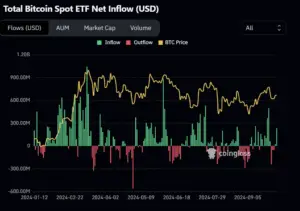
Data from October 1 to October 8, 2024, on Bitcoin spot ETF net inflows demonstrates robust capital movement in the market. The green bars show a marked increase in net inflows during this period, particularly in early October, signaling a sustained interest in Bitcoin spot ETFs. At the same time, Bitcoin’s price followed a steady upward trend (represented by the yellow line), supported by the continuous inflow of funds.
This trend reflects a generally optimistic market sentiment, with inflows bolstering Bitcoin’s price rise. Although there were occasional red bars indicating outflows, the overall increase in net inflows suggests strong investor confidence, with a positive outlook for future price movements. This pattern of capital flow is likely to drive further upward momentum for Bitcoin and sends a positive signal for the broader cryptocurrency market.
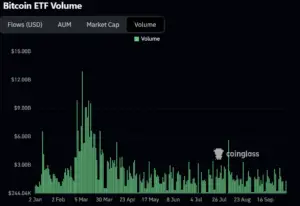
From the Bitcoin ETF trading volume data between October 1 and October 8, 2024, it is clear that volume remained at relatively low levels, without any notable spikes or significant increases.
Compared to the peak trading volumes seen between January and March, the current trading activity appears subdued, reflecting a more cautious market atmosphere.
Despite an uptick in market sentiment and increasing net inflows during this period, the steady volume suggests that investors remain in a wait-and-see mode, refraining from large-scale buying or selling. This could indicate that while market optimism has begun to return, investors are still holding off, awaiting clearer market signals or external catalysts before making decisive moves.
This calm in trading volume, despite positive market sentiment, suggests that while the overall mood is improving, investors are waiting for stronger confirmation before acting more aggressively.
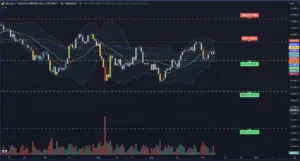
Between October 1 and October 9, 2024, Bitcoin’s price movement can be analyzed through Bollinger Bands, trading volume, and moving averages.
For much of this period, Bitcoin’s price fluctuated between the middle and upper bands, indicating strong upward momentum. However, as it approached the upper band, resistance kicked in, pushing the price back toward the middle band.
The gradual widening of the upper and lower bands suggests that market volatility has increased. The upper band around $65,812 represents short-term resistance.
Trading volume during this period remained relatively stable, without significant spikes. Despite the price rising, the lack of a substantial increase in volume suggests limited interest from traders within this price range.
This stable volume reflects a cautious market sentiment, with no large-scale buying or selling taking place, which could suggest investors are waiting for stronger signals.
The short-term moving averages (such as the 5-day and 10-day MAs) remained in a bullish formation, supporting the previous upward trend. However, there is a slight tendency for these short-term averages to shift toward a bearish crossover as the price has recently pulled back.
If Bitcoin’s price continues to decline, it may test the 50-day MA at $60,719 and the 200-day MA at $59,773, which are critical levels of support to monitor. A break below these levels could signal a more significant correction.
Currently, Bitcoin hovers near the middle band of the Bollinger Bands, facing resistance from the upper band. If it fails to break through this resistance and volume remains low, the market may continue to consolidate or pull back. Support lies between $60,000 and $59,000.
Traders may find it prudent to wait for a pullback to go long, while those seeking short-term profits might consider shorting with appropriate stop-loss measures in place.
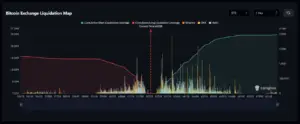
From this Bitcoin liquidation map, we can see that the current price is approximately $62,338. The chart illustrates the liquidation pressure on both long and short leveraged positions:
Overall, the market is in a crucial price range, and the direction of future price movements will determine whether long or short positions will face more liquidation pressure.
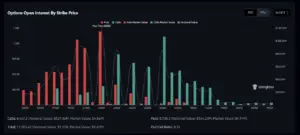
Based on the detailed data from this Bitcoin options open interest distribution chart, the max pain point is located at $62,000, meaning this price level is where both long and short options positions are most concentrated. Here’s a breakdown of the key data
Summary: The options market battle between bulls and bears is focused around $62,000 and $66,000, making these the key price zones to watch. While the sentiment leans slightly bullish, the selling pressure near $62,000 remains substantial. A break above $66,000 could trigger a stronger upward trend.

Interest in “Sui” continues to surge, with the project rising to the top of the trending list this week—largely driven by its price movement, which defied the market and reached a new high. Mysten Labs seems to have realized that “when the technology is good enough, ‘number goes up’ is the best marketing strategy.”

EigenLayer’s Total Value Locked (TVL) surpassed $12 billion last week, marking a significant milestone. The Eigen Foundation also announced that the “EIGEN” token became transferable on October 1st at 12:00 PM Beijing time, effectively making it tradable on exchanges.
EIGEN was listed on nearly all major exchanges, and with an initial listing price of 4.08 USDT, its Fully Diluted Valuation (FDV) was approximately $6.8 billion. This valuation is even lower than the FDV of ether.fi’s ETHFI token at its peak, highlighting the importance of launching tokens at the right market timing.
Notably, Justin Sun sold his entire airdrop of 5.374 million EIGEN tokens at an average price of $4.03, netting a total of 21.66 million USDT. How did your airdrop gains compare?
The platform proactively repurchased EIGEN tokens from the market to ensure all Puffer users received their rightful airdrops. Additionally, Puffer will distribute extra PUFFER tokens to all users as compensation.