How AAPLUSDT Trading Works on Bitunix
Learn how to trade Apple stock on Bitunix with USDT, understand how AAPLUSDT works, and explore volatility, leverage, and risk management for beginners.


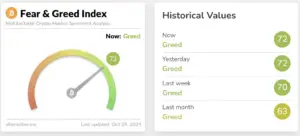
This Tuesday, the sentiment index climbed to 72, a 3% increase from last week’s 70. With BTC breaking through the 71,000 mark, the Fear & Greed Index remains firmly in the “Greed” zone, reflecting a heightened market optimism and anticipation of further gains.
Bullish Factors
Bearish Factors
Wednesday, October 30 at 20:15
Thursday, October 31 at 20:30
Friday, November 1 at 20:30
(All times are UTC+8)

The current price is fluctuating within the Bollinger Bands, reflecting an overall sideways consolidation. After recently touching the upper band, the price has retraced and is now hovering near the middle band, indicating short-term corrective pressure.
In the moving average system, short-term averages (such as the 5-day and 10-day) are closely following the price trend, suggesting a lack of clear market direction and a more pronounced oscillatory pattern.
In terms of trading volume, there have been multiple surges, showing significant buying and selling interest at specific price points. These volume spikes may represent entry and exit activity by short-term traders rather than a strong trend-driving force. If the price continues to move near the middle band with declining volume, it could signal a consolidation phase.
A breakout above or below the Bollinger Bands could then spark a new wave of volatility.
Going forward, monitoring the moving average crossovers and potential breakouts at the Bollinger Band edges, alongside volume changes, will provide insights into the likely direction of price movement.
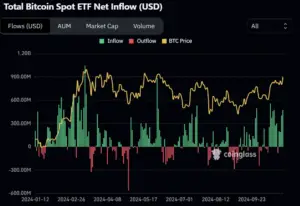
From October 22 to October 28, 2024, the net inflows (in green) and outflows (in red) of Bitcoin spot ETFs are as follows:
In summary, from October 22 to October 28, the substantial net inflows into Bitcoin spot ETFs, accompanied by a steady price increase, indicate a bullish market sentiment and sustained buying interest in Bitcoin.
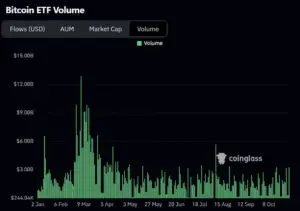
Here is an analysis of the Bitcoin ETF trading volume from October 22 to October 28:
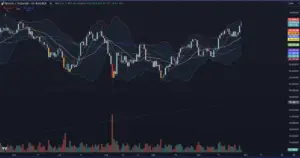
The Bitcoin price trend from October 22 to October 28 can be analyzed through three key indicators: moving averages, Bollinger Bands, and trading volume.
Moving Averages: Short-term moving averages (such as the 5-day and 10-day) are trending upward and positioned above the longer-term moving averages, forming a clear bullish alignment, indicating an uptrend in the market.
The price trading above these moving averages further reinforces a short-term bullish signal, with the alignment of the moving averages providing strong support for Bitcoin’s upward trend.
Bollinger Bands: The Bollinger Bands are gradually widening, reflecting increased market volatility. After breaking above the middle band in late October, the price has stayed close to the upper band for several days, showcasing strong upward momentum.
This behaviour typically signals robust buying pressure, especially when the price remains near the upper band, suggesting that market momentum remains strong.
Trading Volume: Trading volume has increased in tandem with the price rise, indicating growing buy-side interest as the price ascends, adding credibility to the upward movement. The rising volume further supports the price uptrend, highlighting active investor participation.
Overall, from October 22 to October 28, Bitcoin’s price action shows a strong uptrend. The bullish alignment of moving averages, the breakout along the upper Bollinger Band, and the increase in trading volume all reflect a market sentiment favouring the bulls and a dominant buying force.
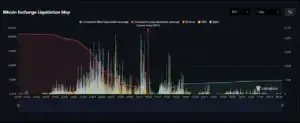
Based on the chart, the analysis by left and right price ranges is as follows:
Left Price Range (Approximately $63,700 to $68,000):
This typically occurs during price declines, especially when the market breaks through key support levels, triggering liquidations of highly leveraged long positions.
Right Price Range (Approximately $68,000 to $74,600):
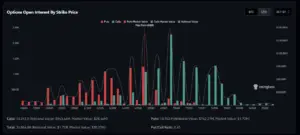
From the chart, we can observe the distribution of open interest in Bitcoin options by strike price:
Overall, the market outlook for Bitcoin remains optimistic, particularly above $68,000, where the substantial open interest in call options could provide additional upward pressure on the price.

Truth Terminal, an AI bot, now holds over a million dollars in Goat tokens. It has befriended “a16z” founder Marc Andreessen, who once provided $50,000 in Bitcoin support to the bot. In a podcast, Marc also discussed Truth Terminal’s origin and the creation of the meme coin GOAT, describing it as “the first true fusion of AI and cryptocurrency.”
Following Binance’s announcement on the 24th to launch the GOATUSDT perpetual contract, GOAT surged briefly past 0.9 USDT, with its market cap exceeding $900 million at one point. This solidified its leading position in the AI + “meme” space, making it the first token launched by “pump.fun” to reach such a valuation and to be listed on Binance contracts.
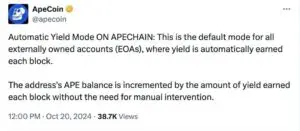
On October 20, ApeChain’s official cross-chain bridge, based on Arbitrum Orbit L3, went live on the mainnet. Users can bridge tokens like ETH and “APE” to ApeChain, where stablecoins bridged to ApeChain are converted to DAI and stored in sDAI, earning yields at MakerDAO’s savings rate.
ApeChain has also launched Ape Express, a meme launch platform similar to Pump.fun. The wealth effect has transformed ApeChain into the latest battleground for Meme PvP:
One wallet address made a striking gain on the ApeChain meme project CURTIS, turning a $1,140 investment into a $2.55 million profit.
The user began buying just one and a half minutes after deployment, spending a total of 1,520 APE ($1,140) to acquire 13.14% of CURTIS’s total supply (131.4 million tokens). They currently hold 11.08% of CURTIS (110.8 million tokens), now valued at $2.55 million.