How AAPLUSDT Trading Works on Bitunix
Learn how to trade Apple stock on Bitunix with USDT, understand how AAPLUSDT works, and explore volatility, leverage, and risk management for beginners.

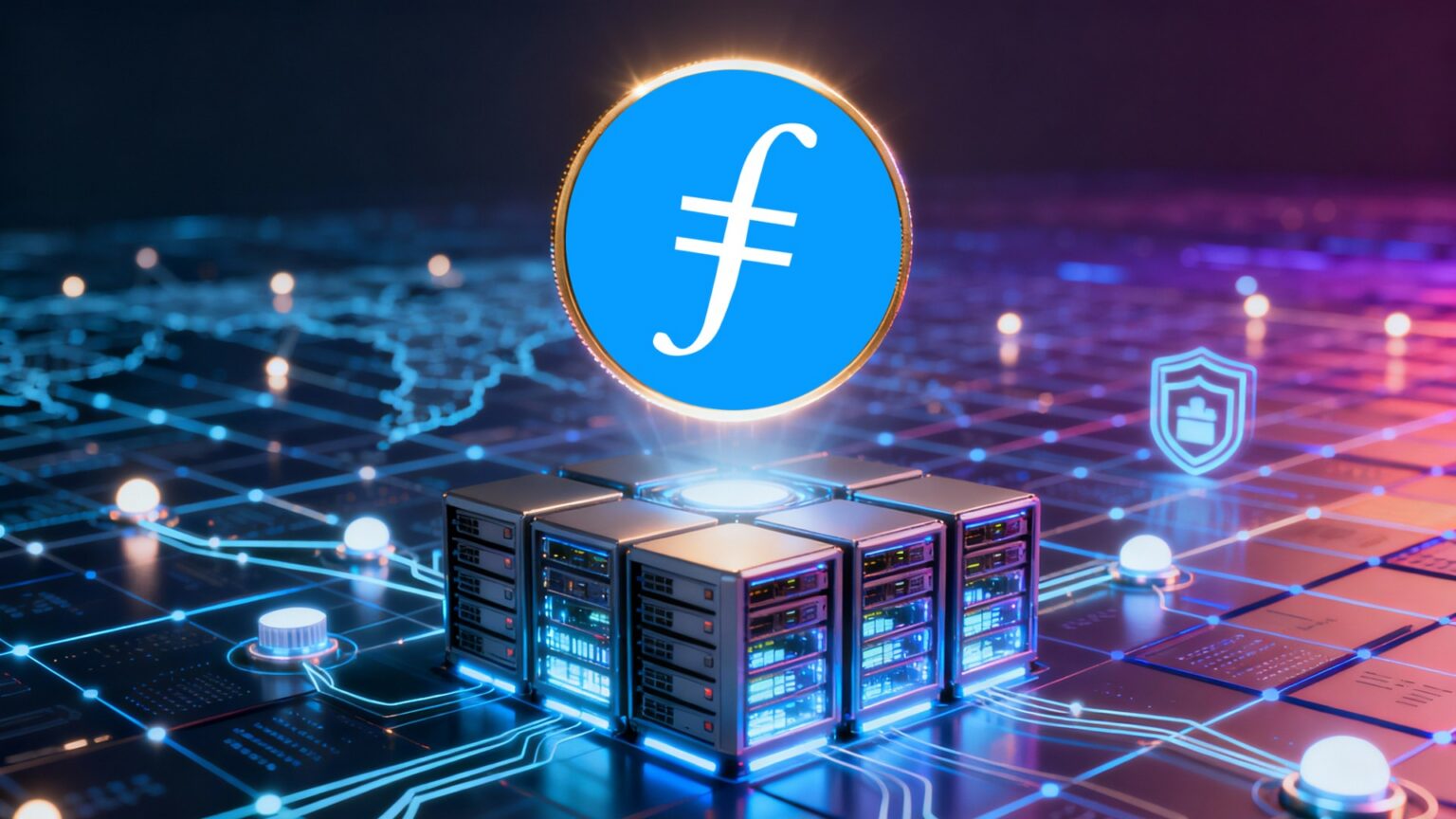
In a world where data has become the new oil, few players concentrate as much power as the major cloud providers. Filecoin’s aim is to break that grip with a global, open, and verifiable storage marketplace where anyone can rent out disk space and be paid programmatically.
That puts it at the heart of the DePIN universe (Decentralized Physical Infrastructure Networks), alongside projects that connect real hardware to on-chain incentives. The sector is facing a tough moment. FIL went through a prolonged down cycle, but the groundwork continued.
The launch of the Filecoin Virtual Machine (FVM) brought EVM-compatible smart contracts to the network, enabling programmable data markets, DataDAOs, and integrations with other chains. In 2025, the Foundation and community began publishing an Ecosystem Metrics Roundup to track what actually matters, including active clients, paid deals, daily data onboarding, and real capacity utilization.
FIL’s price reflects a market that remains volatile and sensitive to macro flows and crypto beta. What matters is the trend and whether price and fundamentals can converge again. This article presents a complete FIL price forecast 2026-2030, connecting demand for decentralized storage, the impact of FVM, and competition with both web2 and web3 solutions.
Filecoin is a peer-to-peer network for storing and retrieving files with built-in economic incentives and cryptographic proofs that ensure data remains stored over time. Clients pay for storage, providers (often called storage providers) post collateral, store the data, and submit daily verifiable proofs on-chain.
Two mechanisms sustain this continuous verification. Proof-of-Replication (PoRep) is used when data is sealed to prove a unique copy was created, and Proof-of-Spacetime (PoSt) is used on a recurring basis to prove the data remains stored for the agreed period, with automatic penalties for failures. Together, PoRep and PoSt make storage resilient, auditable, and censorship-resistant.
With FVM, launched in March 2023, Filecoin added compute and EVM-compatible smart contracts, opening the door to retrieval markets, deal automation, and composability with dapps from other networks. In short, beyond storing data, the network now programs how data is financed, served, and monetized.
The FIL token is the lifeblood of this economy. It is used to pay for storage and retrieval, to incentivize providers, and as collateral to enforce good behavior. These are essential elements in an open market for physical resources.
Filecoin’s mainnet went live in October 2020 after years of research into storage proofs. In the next bull cycle, FIL posted an all-time high near $237 on April 1, 2021, before entering a long correction with the broader crypto market.
From 2022 to 2024, the landscape was marked by a bear market, capacity adjustments, and a focus on real demand for data, while the technical roadmap advanced toward FVM and data products above the storage layer. In 2025, Messari’s quarterly reports highlighted an important inflection on the usage side.
In Q2 2025, utilization rose to about 32%, new daily storage deals climbed roughly 25% QoQ to 3.5 PiB, and the network onboarded more than 2,400 datasets, including 864 large ones above 1 TiB. Despite improving fundamentals, the quarter’s average price fell about 17% QoQ to around $2.30, with a circulating market cap of roughly $1.6B.
A sign of the typical disconnect between adoption and price during transition cycles. Today, FIL trades in the $2-$3 range. That historical backdrop, from an exuberant peak to a rebuild anchored in real usage, frames the FIL price forecast 2025-2030.
2026 could cement Filecoin as one of the clearest DePIN proxies, physical infrastructure for storage coordinated by on-chain incentives. On fundamentals, the data points to an acceleration in new storage deals even as raw capacity shrinks due to provider churn.
Paid, effectively stored data is gaining traction. Quarterly rotations and funding resets can pull liquidity toward crypto futures trending coins, amplifying short-term swings around data-onboarding headlines.
In parallel, FVM is opening room for data-centric dapps such as contract-controlled perpetual storage, DataDAOs, automated deals, and compositions with DeFi and infrastructure on other chains. The Foundation and the ecosystem are reinforcing a focus on real demand rather than raw capacity alone.
If DePIN stays in the spotlight and utilization and new deals keep their pace, FIL could trade in a $6-$18 range in 2026, with an average near $10 under a base case with market beta still elevated. Additional upside depends on sustained technical breakouts and launches that convert hype into measurable data demand.
The driver for 2027 is enterprise adoption. Long-term archiving, backups with verifiable immutability, lower egress fees, and greater data sovereignty. Ecosystem case studies show Filecoin providers and wrappers serving universities, research labs, and companies at PB scale with SLAs closer to corporate language, while onboarding software reduces sealing costs and increases throughput for storage providers.
These factors improve unit economics on the supply side and make Filecoin more competitive with traditional cloud. Interoperability and a storage layer for other chains. With FVM and the IPFS ecosystem, Filecoin can serve as the storage layer for Ethereum contracts and Solana assets through tooling and services like NFT.Storage and Web3.Storage, which expands the addressable TAM.
NFTs, dataset repositories, and applications that require content addressing and cryptographic verification over time. There is a complementary role between IPFS for addressing and distribution and Filecoin for an incentive-aligned storage marketplace with proofs, supported by gateways and builder-friendly SDKs.
Accordingly, the 2027 outlook is an average of $14 with a high of $25 driven by the first larger enterprise contracts, programmable perpetual storage via FVM, and more mature tooling for data onboarding.
If the decentralized internet truly matures, Filecoin can become the default storage layer that interfaces with IPFS, gateways, and services like NFT. Storage and Web3.Storage. In other words, a verifiable data backend for dapps, data DAOs, AI, and enterprise archives. In this scenario, FVM expands the scope with EVM-compatible contracts and enables perpetual financing models for data, automated deals, and integrations with other chains.
Demand for paid storage and retrievals creates real token usage as clients pay in FIL, while storage providers lock collateral and earn rewards with gradual unlocks, with 75% of block rewards typically vesting over about 180 days, which softens immediate sell pressure.
The balance between emissions from protocol rewards and subsidies and demand from paid data, retrievals, and endowments for perpetual storage shapes the long-term price path. Assuming steady organic growth in utilization and dataset onboarding, the forecast is an average of $26 for 2028, $33 for 2029, and $42 for 2030.
The core metric is paid, effectively stored data. There are already signs of real usage despite price volatility. The FVM launch brought smart contracts and programmability to storage. As builders and use cases expand on FVM, capacity absorption should increase.
Competition will weigh heavily on FIL’s price. Arweave focuses on pay-once store-forever and the permaweb, while Storj offers S3-compatible object storage with enterprise integrations. Both press on specific niches, in addition to the centralized hyperscalers like AWS and Google.
Filecoin’s edge should come from an open marketplace with cryptographic proofs, cost efficiency, and the FVM ecosystem. Vested rewards, provider collateral, and the mechanics by which tokens enter circulation also shape circulating supply and float.
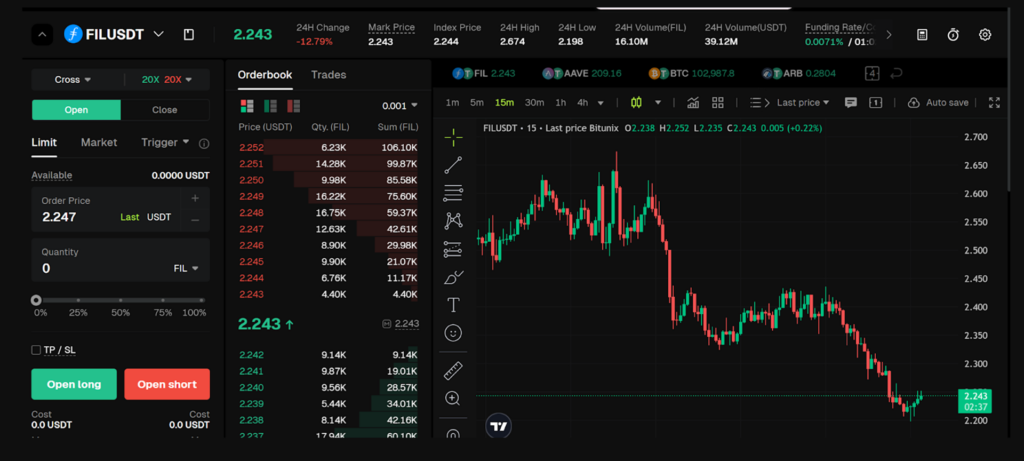
For direct spot exposure, buy and hold FIL on the FIL/USDT pair on a reliable crypto spot trading platform. Use the streamlined interface to create your account, deposit, and place limit or market orders with SL and TP in spot.
For directional trades or hedging, use the FILUSDT perpetual with leverage on the crypto futures trading platform up to 125x with TP and SL, and different margin modes. Verification is only required for fiat purchases, such as cards or bank transfers. Invest in the future of data. Trade Filecoin on Bitunix to gain exposure to the leader in decentralized storage. Sign up now.
To trade Filecoin efficiently and with confidence, Bitunix brings together what matters in practice. Account opening is fast, and verification is simple, which reduces friction when you start. For fiat purchases, basic KYC is requested. But fiat ramps remain simple. You can buy crypto with a debit card and then allocate it into FIL spot or perps.
On transparency and security, the exchange maintains a public, verifiable Proof-of-Reserves along with security documentation and support materials that reinforce governance and fund protection.
The trading experience is powered by the One Chart Platform that unifies analysis tools, advanced order types, and multi-window layouts in a single interface. The platform also offers deep liquidity and low slippage, which benefits traders in pairs like FIL/USDT.
If you choose to use leverage, Bitunix pairs global compliance with a protection fund and a user-first environment. Open your account and access professional features in minutes. Create your account and experience a transparent trading journey with ongoing support. Try trading FIL on Bitunix today.
The DePIN narrative has turned storage into one of the most compelling themes of this cycle: more data, more need for verifiable redundancy, and open governance. Filecoin sits at the center with adoption metrics that, even in 2025, point to active storage in the hundreds of PiB and a growing push from the Filecoin Virtual Machine for data dapps, data DAOs, and multi-chain integrations.
Looking ahead, the appreciation case ties to data onboarding via active deals, FVM network effects, and partnerships and integrations that anchor enterprise use cases. The upside is real, but there are counterweights, including competition from Arweave and Storj, and tokenomics with emissions and vesting schedules that require monitoring.
Data is the future, and decentralized storage is the key. Be part of the DePIN revolution and trade FIL on Bitunix today.
Can Filecoin (FIL) reach $100 again?
Possible in a bull case, but it would require strong acceleration in stored data, demand for verifiable storage, and meaningful traction for FVM. The historical ATH shows it is within the realm of potential.
Is Filecoin a good long-term investment?
For investors who believe in DePIN and want exposure to decentralized storage, FIL can fit a long-term thesis.
What is the Filecoin Virtual Machine (FVM)?
It is Filecoin’s smart contract layer, EVM compatible, enabling dapps, automated deals, data DAOs, and integrations with other chains.
How does Filecoin compare to Arweave?
Arweave pursues a pay-once store-forever permaweb model. Filecoin operates an open storage marketplace with time-bound contracts, verifiability, and crypto-economic incentives. The choice tends to depend on use case, cost, and retention requirements.
How much data is currently stored on the Filecoin network?
Reports in 2025 indicate average active storage around ~1.1 EiB (~1,100 PiB), with fluctuations through the year as deals and renewals roll.
Is Filecoin’s tokenomics inflationary?
There are block reward emissions, a finite 2 billion FIL allocation, and mechanisms that tune incentives relative to storage capacity. Net dynamics depend on usage, burn, and penalty mechanisms, and vesting.
How can I become a storage provider on Filecoin?
It requires economic planning, suitable hardware, and 24/7 operations.
What are the main risks of investing in Filecoin?
Crypto cycles, competitive pressure, weaker-than-expected onboarding, FVM execution risks, and supply overhang from unlock schedules and rewards.
Who are Filecoin’s biggest clients or partners?
Public cases include Starling Lab for data preservation, academic initiatives, and industrial pilots such as CERN via Seal Storage, along with organizations that weave IPFS and Filecoin into data pipelines.
Where is the best place to buy and trade FIL?
Bitunix is an excellent crypto exchange app where you can access FIL spot and perpetuals with professional tools, public Proof of Reserves, and ongoing support.
Bitunix is a global cryptocurrency derivatives exchange trusted by over 3 million users across more than 100 countries. The platform is committed to providing a transparent, compliant, and secure trading environment for every user. Bitunix offers a fast registration process and a user-friendly verification system supported by mandatory KYC to ensure safety and compliance. With global standards of protection through Proof of Reserves (POR) and the Bitunix Care Fund, Bitunix prioritizes user trust and fund security. The K-Line Ultra chart system delivers a seamless trading experience for both beginners and advanced traders, while leverage of up to 200x and deep liquidity make Bitunix one of the most dynamic platforms in the market.
Bitunix Global Accounts
X | Telegram Announcements | Telegram Global | CoinMarketCap | Instagram | Facebook | LinkedIn | Reddit | Medium
Disclaimer: Trading digital assets involves risk and may result in the loss of capital. Always do your own research. Terms, conditions, and regional restrictions may apply.