How AAPLUSDT Trading Works on Bitunix
Learn how to trade Apple stock on Bitunix with USDT, understand how AAPLUSDT works, and explore volatility, leverage, and risk management for beginners.

Apple is one of the most recognized companies in global markets. It is followed by long-term investors, short-term traders, technology watchers, and market analysts alike. Because of its size, brand strength, and role in the broader tech sector, Apple often becomes a key name whenever traders discuss market leadership, earnings momentum, consumer demand, and large-cap performance.
At Bitunix, Apple is part of the broader TradFi expansion that brings stock-linked markets into a familiar exchange environment. That matters because many traders no longer want to focus only on crypto. They want broader exposure across market categories, including major US stocks, commodities, and digital assets, all within one connected platform experience.
For users who already understand crypto trading but are new to stock-linked markets, Apple can be one of the easiest names to begin with. It is widely known, easier to follow than many niche stocks, and often seen as a benchmark for broader technology sentiment. At the same time, Apple should not be treated as a low-risk market simply because it is familiar. Like any stock-linked trading product, it still requires discipline, a clear setup, and proper risk control.
In this guide, we explain what it means to trade Apple stock on Bitunix, how AAPLUSDT works, why Apple remains important to traders, how to start trading it, and what beginners should understand before opening a position.
Trading Apple stock on Bitunix means trading a stock-linked market tied to Apple price movement rather than buying actual Apple shares through a traditional stockbroker.
This is the most important distinction to understand at the beginning. On Bitunix, users are not purchasing direct ownership in Apple as a company. Instead, they are trading a market product designed to reflect Apple’s price action in a futures-style environment. That makes the experience much more suitable for active trading than for traditional long-term stock ownership.
The Apple-linked pair shown on Bitunix is AAPLUSDT. This pair gives users exposure to Apple price movement through a USDT-based framework. For many users who already trade crypto or other market products on exchanges, this makes the process feel more natural and easier to navigate.
In simple terms, trading Apple on Bitunix is about gaining price exposure to Apple, not owning Apple shares directly.
Apple matters because it is one of the most influential companies in the world. It is not just a technology brand. In market terms, Apple is often treated as a signal for consumer strength, product demand, innovation stability, and large-cap tech performance.
That is a big reason traders keep watching it. Apple tends to matter not only on its own, but also as part of the broader market conversation. When Apple moves, many traders take notice because it can reflect larger sentiment around technology stocks, consumer spending, and market confidence.
Apple also appeals to a wide range of traders because it sits in a different category from more speculative names. It is still active and relevant, but it often feels more established than high-volatility growth stocks. That gives it a different kind of appeal. Some traders prefer names like Tesla for aggressive momentum, while others look to Apple for structure, familiarity, and consistent market relevance.
At Bitunix, adding Apple-linked trading makes sense because it gives users access to one of the most widely followed stocks in a format that fits the way modern exchange traders already operate.
At Bitunix, the expansion into stock-linked markets is part of a broader move toward a more complete TradFi offering. Traders no longer want to switch between separate financial worlds every time they want to explore a different asset class. They want one environment where crypto, commodities, and major stocks can all be accessed in a more unified way.
Apple fits naturally into that strategy. It is globally recognized, closely watched, and relevant across many market narratives. It gives Bitunix users access to a stock that is both familiar and important without forcing them to leave the broader exchange ecosystem.
This is especially useful for users who already manage capital in USDT and prefer a trading workflow built around charts, market movement, and active execution rather than traditional brokerage-style investing tools.
By including AAPLUSDT, Bitunix makes it easier for traders to engage with one of the biggest names in the market through a structure that feels consistent with the rest of the platform.
AAPLUSDT is the Apple-linked trading pair on Bitunix. In this structure, AAPL represents Apple-related price exposure, while USDT provides the stablecoin-based framework used for trading.
This setup matters because it makes Apple trading more accessible for users who already understand USDT-based markets. Instead of opening a separate stock account and learning a completely different system, users can stay within a framework that already feels familiar.
For beginners, AAPLUSDT is the main market to focus on when learning how Apple trading works on Bitunix. Once that pair makes sense, the rest of the process becomes easier to understand.
The key thing to remember is that AAPLUSDT is a stock-linked trading product. It is not the same as buying Apple shares directly through a conventional broker.
This comes down to trading goals.
Buying real Apple shares through a stockbroker is usually more aligned with long-term investing and direct ownership. Trading AAPLUSDT on Bitunix is more aligned with active market participation. The goal is not necessarily to build a traditional stock portfolio. The goal is to participate in price movement with more flexibility inside a trading-focused environment.
That can appeal to traders for a few clear reasons.
First, it supports a more active style of trading. Users can respond to Apple price movement rather than thinking only in terms of long-term holding.
Second, it works inside a USDT-based environment, which is already familiar to many Bitunix users.
Third, it places Apple into a workflow that feels consistent with other exchange-traded markets, making it easier for users to move between crypto, stock-linked pairs, and commodity-linked products.
This does not make one method automatically better than the other. It simply means they serve different purposes. AAPLUSDT is designed for active market exposure, not conventional stock accumulation.
Apple may come from traditional finance, but it still appeals to crypto-native traders for several reasons.
One reason is familiarity. Even traders who do not usually focus on equities understand what Apple represents. It is a globally known company with a strong brand, strong media visibility, and constant relevance in financial news.
Another reason is structure. Apple sits inside the technology sector, which is already a space many crypto traders follow naturally. Users interested in innovation, digital ecosystems, devices, and consumer tech may already keep an eye on Apple even if they primarily trade crypto.
There is also a practical reason. Apple offers a large-cap stock-linked market that feels more stable in identity than many speculative assets, while still providing opportunities for active trading. That can make it appealing to users who want to explore TradFi markets through Bitunix without jumping straight into the most extreme volatility names.
At Bitunix, AAPLUSDT gives these users a way to engage with Apple through a workflow that feels consistent with the rest of their trading activity.
The structure is straightforward. Users trade AAPLUSDT to gain exposure to Apple price movement. Instead of holding actual Apple shares, they open a position in a stock-linked market and participate in the changes in Apple’s trading value.
Because the pair is quoted against USDT, the overall workflow feels familiar for users who already trade stablecoin-based markets. They can review charts, watch daily movement, evaluate price behavior, and decide whether Apple fits their strategy.
This is one of the main benefits of Bitunix stock-linked markets. They place Apple into the same broader exchange environment as crypto and other TradFi products, which makes cross-market trading more practical.
At the same time, beginners should remember that AAPLUSDT is an active trading product. It should not be treated the same way as passive share ownership.
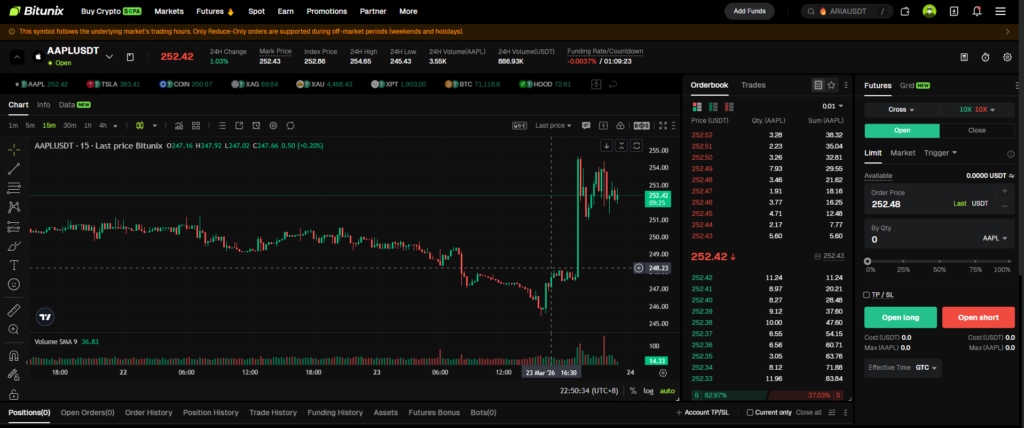
For beginners, the best approach is to keep the process simple and structured.
Start by locating AAPLUSDT in the Bitunix stock futures section. This is the Apple-linked market you need to understand first.
Study the current price, recent movement, daily range, and general market behavior. Apple may feel more established than some other names, but it still moves with market sentiment.
Before opening a trade, it helps to understand why Apple is moving. That could be due to earnings sentiment, product-related news, broader tech momentum, or wider market conditions.
Do not trade Apple just because it is familiar. Make sure the market conditions actually match your trading plan and risk tolerance.
Before entering any AAPLUSDT position, users should understand how leverage affects exposure and how margin shapes risk.
Apple is a major company, but that does not eliminate trading risk. Position sizing, discipline, and careful planning still matter.
Once a trade is open, active attention matters. Apple can react quickly when market sentiment changes.
A structured approach helps reduce emotional decisions and gives beginners a clearer way to manage risk.
Apple is influenced by several different types of market drivers.
Company-specific developments matter a lot. Traders may react to earnings expectations, product launches, sales performance, services growth, or broader business sentiment.
Sector trends also matter. Apple is part of the larger technology landscape, so broader movement in tech stocks can influence how traders approach it.
Macro conditions matter too. Interest-rate expectations, consumer sentiment, and overall market risk appetite can all affect Apple trading behavior.
Finally, market psychology plays a role. Because Apple is one of the most widely followed names in finance, shifts in sentiment around the company can influence trading activity quickly.
For beginners, this is useful to understand. Apple is not usually driven by one single factor. It often sits at the center of several overlapping narratives at once.
This distinction should stay clear throughout the article.
Buying Apple shares through a traditional stockbroker means owning actual equity in the company. That is more aligned with long-term investing and portfolio building.
Trading AAPLUSDT on Bitunix means participating in Apple price movement through a stock-linked trading product. That is more aligned with active trading and tactical positioning.
This difference affects how the product should be used. AAPLUSDT is designed for exposure to movement, not for traditional long-term share ownership. The better users understand this difference, the more realistic their expectations will be.
Leverage can make Apple trading more capital-efficient, but it also increases risk.
This matters because many beginners assume familiar large-cap stocks are automatically easy to trade. That assumption can be misleading. Apple may be more established than many speculative markets, but once leverage is involved, even moderate price movement can have a much larger impact on the position.
That is why leverage should always be treated carefully. It is a tool for exposure management, not a reason to take oversized positions.
A recognizable company name can create a false sense of confidence. Good trading discipline matters just as much in Apple-linked markets as it does anywhere else.
There are similarities between Apple trading and crypto futures on Bitunix, but there are also key differences.
The similarities are mostly structural. Both use a chart-based exchange environment, active position management, and trading-focused execution.
The differences come from market drivers. Crypto futures are usually shaped by token narratives, blockchain developments, regulation, and digital asset sentiment. Apple is more influenced by company performance, large-cap tech sentiment, macro conditions, and broader equity market behavior.
That means traders should not assume a crypto strategy transfers directly into AAPLUSDT without adjustment. Apple deserves its own market understanding, even if the trading interface feels familiar.
Apple is widely known, but that does not make it risk-free.
Apple can still move sharply, especially during earnings periods or broader market shifts.
Leverage magnifies both gains and losses, which means even moderate movement can matter much more than expected.
AAPLUSDT is an active trading product, not passive stock ownership.
Because Apple is so well known, some users may underestimate the need for careful planning.
Trading habits from crypto do not always translate directly into stock-linked markets.
At Bitunix, broader market access works best when users understand the product they are trading and the forces that move it.
Apple fits well into the Bitunix TradFi expansion because it gives users access to a major stock-market theme inside the same broader environment as crypto and commodities.
Modern traders do not think in narrow categories anymore. They may move between Bitcoin, Apple, gold, Nvidia, and Tesla depending on where the strongest market relevance appears. Apple helps make that kind of multi-market participation easier because it brings one of the most established names in global equities into a USDT-based exchange workflow.
For users who want to move across asset classes without switching platforms constantly, AAPLUSDT plays an important role in that larger Bitunix strategy.
Apple remains one of the most important companies in global markets, and that makes it a natural fit for the Bitunix stock-linked lineup. On Bitunix, AAPLUSDT gives users a practical way to access Apple price movement through a USDT-based trading structure that fits naturally within the broader platform environment.
For beginners, the most important thing to understand is that trading Apple on Bitunix is not the same as buying Apple shares directly. It is a stock-linked trading product designed for active market participation rather than long-term equity ownership.
That distinction matters. For users who want broader TradFi exposure, more active market access, and a more connected way to trade across categories, AAPLUSDT is a strong example of how Bitunix is bringing major stock themes into a crypto-native workflow.
AAPLUSDT is the Apple-linked trading pair on Bitunix that gives users exposure to Apple price movement through a USDT-based framework.
No. Trading Apple on Bitunix means using a stock-linked trading product, not directly purchasing Apple shares through a traditional broker.
Apple is widely followed because of its role in technology, consumer markets, large-cap equities, and overall market sentiment.
Many can, because Apple is a familiar company and its stock-linked market fits naturally into a chart-based trading workflow that resembles other exchange products.
Apple may be seen as more established than certain high-volatility stocks, but it still carries trading risk, especially when leverage is used.
It can be, as long as beginners understand that it is an active trading product rather than direct stock ownership and approach it with proper risk management.
Bitunix added Apple-linked trading as part of its broader TradFi expansion, giving users a more connected way to access major stock-market themes from one platform.
Bitunix is a global cryptocurrency derivatives exchange trusted by over 3 million users across more than 100 countries. The platform is committed to providing a transparent, compliant, and secure trading environment for every user. Bitunix offers a fast registration process and a user-friendly verification system supported by mandatory KYC to ensure safety and compliance. With global standards of protection through Proof of Reserves (POR) and the Bitunix Care Fund, Bitunix prioritizes user trust and fund security. The K-Line Ultra chart system delivers a seamless trading experience for both beginners and advanced traders, while leverage of up to 200x and deep liquidity make Bitunix one of the most dynamic platforms in the market.
Bitunix Global Accounts
X | Telegram Announcements | Telegram Global | CoinMarketCap | Instagram | Facebook | LinkedIn | Reddit | Medium
Disclaimer: Trading digital assets involves risk and may result in the loss of capital. Always do your own research. Terms, conditions, and regional restrictions may apply.