How AAPLUSDT Trading Works on Bitunix
Learn how to trade Apple stock on Bitunix with USDT, understand how AAPLUSDT works, and explore volatility, leverage, and risk management for beginners.


Silver has always held a unique place in financial markets. It is often grouped with gold because both are precious metals, but silver behaves differently enough to deserve its own trading approach. It can attract attention during periods of macro uncertainty, but it also reacts to industrial demand, which gives it a different market personality from gold. For traders, that combination is part of what makes silver interesting.
At Bitunix, silver is part of the broader TradFi expansion that brings commodity-linked markets into a familiar exchange environment. That matters because traders no longer look at crypto in isolation. They move across asset classes, compare narratives, and look for opportunities wherever volatility and momentum appear. Silver fits naturally into that picture because it sits at the intersection of defensive market interest and industrial relevance.
For users who already understand crypto trading but are new to commodities, silver futures may seem unfamiliar at first. In practice, the basic idea is straightforward. On Bitunix, silver exposure is available through XAG/USDT perpetual futures, which allow users to trade silver price movement without owning physical silver. In this version, the silver pair is positioned with up to 200x leverage, which gives traders flexibility while still making disciplined risk management essential.
In this guide, we explain what silver futures are, how XAG/USDT works on Bitunix, why traders pay attention to silver, how to start trading silver futures, and what beginners should understand before entering the market.
Silver futures on Bitunix are trading products linked to the price movement of silver. Instead of buying physical silver bars or coins, users trade a market that reflects silver price action inside the Bitunix futures environment.
On Bitunix, the silver pair traders need to know is XAG/USDT. It is offered as a perpetual futures market and gives users a way to access silver price exposure in a structure that feels closer to modern exchange trading than to traditional commodity ownership.
This distinction matters. Trading XAG/USDT is not the same as holding physical silver. It is about participating in silver price movement through a futures product. For active traders, that can be more practical because it removes the storage, settlement, and ownership concerns that come with physical metal.
For beginners, the simplest way to think about it is this: silver futures on Bitunix are designed for trading silver price action, not for holding silver itself.
Silver remains relevant because it carries two different identities at once. On one side, it is a precious metal and often enters market conversations alongside gold. On the other side, it has strong industrial uses, which means it can also react to manufacturing demand, economic expansion, and broader production trends.
That dual role makes silver different from many other assets. Gold is usually viewed more clearly through a macro or defensive lens. Silver can follow that same narrative, but it can also move because of industrial expectations. As a result, silver often feels more dynamic and sometimes more volatile. This is one reason many traders see silver as a more active commodity market than people expect at first glance.
At Bitunix, adding silver to the TradFi lineup reflects how traders actually think today. They want access to markets that are shaped by different forces, not only token narratives or crypto-specific momentum. Silver offers exposure to a traditional asset that can still produce sharp moves and meaningful opportunities.
At Bitunix, expanding into commodity-linked markets is part of a broader push toward multi-market access. Traders today may follow Bitcoin, large-cap stocks, gold, and silver in the same week. They want to compare price action across categories and respond without needing to jump between completely different platforms.
Silver futures fit that goal well. They give users access to a globally recognized commodity through a structure that feels familiar to Bitunix traders. Instead of treating silver as something separate from digital trading culture, Bitunix brings it into the same broader ecosystem as crypto and other TradFi-linked markets.
There is also a practical reason for silver’s addition. Not every market environment favors the same assets. In some phases, crypto dominates attention. In others, traders turn toward stocks or precious metals. Silver expands the range of markets Bitunix users can follow when conditions shift.
XAG/USDT is the Bitunix silver-linked perpetual futures pair. In market notation, XAG is commonly associated with silver, while USDT provides the stablecoin-based trading framework many Bitunix users already know.
This matters because it makes silver easier to approach for crypto-native traders. Users do not need to switch into an entirely different financial system just to follow silver. Instead, they can trade it in an environment that aligns with how they already manage charts, positions, and risk.
For beginners, XAG/USDT is the core market to understand first. Once that pair makes sense, the logic of Bitunix silver trading becomes much easier to follow.
Physical silver ownership and silver futures trading serve different purposes.
Physical silver is associated with direct possession, storage, and long-term holding. Silver futures are built for price exposure and active market participation. Traders choose futures because they want to respond to price movement rather than deal with the practical side of holding the metal itself.
This can be especially appealing for active users on Bitunix. If someone already understands charts, short-term volatility, and position management, then trading silver through XAG/USDT may feel much more natural than approaching silver through traditional physical ownership.
In other words, silver futures turn silver into a live trading market rather than a stored asset. That is a different mindset, and it is important for beginners to understand that difference early.
Silver attracts traders because it tends to move with a slightly different character than gold. It can benefit from similar macro narratives, especially during periods of uncertainty, but it is also more sensitive to industrial themes. That combination gives silver a more flexible identity in the market.
For some traders, silver is appealing because it can show stronger movement than gold. For others, it is appealing because it adds a different type of commodity exposure alongside crypto, stock-linked markets, and macro-driven positions.
Silver is also easier to understand conceptually than many niche commodities. Most users already know what silver is and why markets care about it. That familiarity helps reduce the learning curve, even though traders still need to respect the risks that come with futures trading.
The basic idea is simple. Users trade XAG/USDT to gain exposure to silver price movement. Instead of owning the metal directly, they participate in a perpetual futures market that tracks silver.
Because the market is structured against USDT, the overall experience is more familiar for users who already trade on crypto exchanges. They can review charts, watch 24-hour changes, compare market conditions, and make decisions through a workflow that feels consistent with the rest of the Bitunix environment.
XAG/USDT is a perpetual futures market with up to 200x leverage on Bitunix. That means leverage exists, but traders should still approach it carefully, especially if they are new to commodities.
The key thing to remember is that silver does not move for the same reasons as BTC or ETH. Its drivers are different, and that means strategy assumptions should also be different.
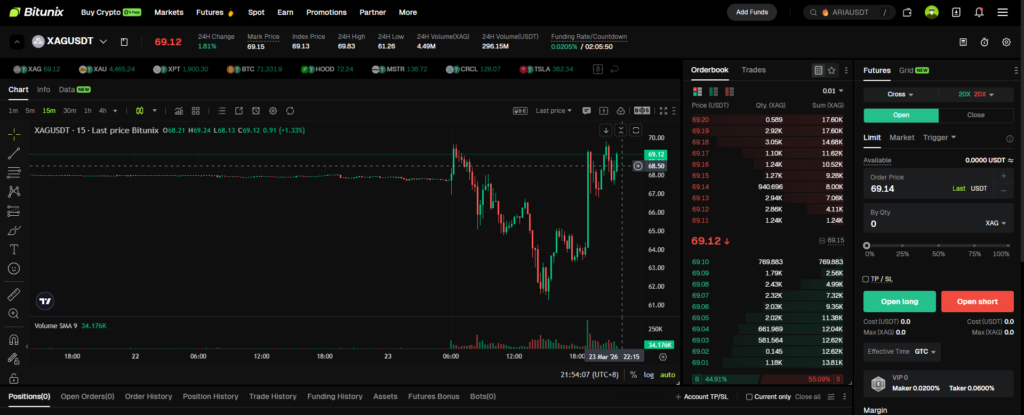
For beginners, the best way to approach silver is through a clear step-by-step process.
Start by locating XAG/USDT in the Bitunix TradFi or futures section. This is the silver-linked pair you need to understand first.
Look at price, daily movement, range, and overall activity. This helps you see whether silver is moving calmly or showing stronger volatility.
Silver can react to inflation expectations, broader macro sentiment, and industrial demand themes. You do not need to become a full macro analyst, but it helps to know what the market is responding to.
Once the market context is clearer, decide whether the current environment fits your strategy and risk tolerance.
Before trading, make sure you understand what up to 200x leverage means for exposure and liquidation risk.
Position sizing matters. Silver may be familiar, but it is still a live leveraged market.
Silver can react quickly when macro sentiment changes, so it is important to stay engaged once a position is open.
A structured approach is especially useful for beginners because it prevents silver from being treated as a passive asset when it is actually an active futures product.
Leverage makes silver trading more flexible, but it also makes risk more immediate.
That means traders can control a larger position with less capital, but it also means even moderate price movement can affect the position more strongly than many beginners expect.
This is where many new traders make mistakes. Because silver is a traditional asset, they may assume it is automatically safer or slower than crypto. In reality, leverage changes the experience. A move that looks manageable on a chart can become much more meaningful when the position is oversized.
That is why leverage should be treated as a tool, not a target. New users are usually better served by understanding the market first and keeping exposure disciplined rather than chasing the highest setting available.
Silver and gold are often mentioned together, but they do not trade the same way.
Gold is generally viewed as the more established defensive benchmark among precious metals. It tends to stay closely tied to macro themes such as inflation, risk aversion, and central bank expectations.
Silver shares some of those same drivers, but it also has a stronger industrial profile. That makes it more sensitive to manufacturing and growth-related themes. In practice, this often gives silver a different rhythm and sometimes sharper price movement than gold.
For Bitunix users, that means silver is not just a smaller version of gold. It is a distinct market with its own behavior.
Silver futures and crypto futures may look similar inside a trading interface, but the underlying markets respond to different forces.
Crypto futures are often shaped by token sentiment, blockchain adoption, ecosystem catalysts, and broader digital asset momentum. Silver futures are more closely tied to macro conditions, commodity sentiment, and industrial expectations.
That difference matters because it affects how traders should think. A setup that works in crypto is not automatically transferable to silver. At the same time, users who already understand active trading discipline may find silver easier to approach than expected, provided they respect the fact that the drivers are different.
Silver is familiar, but that should never be confused with low risk.
Silver can move sharply, especially when macro sentiment and commodity speculation become more active.
With up to 200x leverage in this version, gains and losses can both be magnified significantly if positions are not managed carefully.
Silver futures are active trading products. They are not the same as passive investing or physical silver ownership.
Because silver is a well-known metal, some users may underestimate its volatility or the effect of leverage.
Crypto habits do not always translate directly into commodity trading. Silver deserves its own market understanding.
At Bitunix, broader market access works best when users understand what they are trading and why the market moves the way it does.
Silver remains one of the most interesting commodity markets because it combines precious-metal status with industrial relevance. On Bitunix, XAG/USDT perpetual futures give users a practical way to access silver price movement through a USDT-based trading workflow that fits naturally within the broader platform environment.
For beginners, the most important point is that silver futures are about price exposure, not physical ownership. They are active trading products designed for users who want flexibility, broader TradFi access, and a way to explore silver in a familiar exchange setting.
XAG/USDT is positioned with up to 200x leverage, which gives traders useful flexibility while also making discipline and risk control essential. As more users move across crypto, stocks, and commodities, silver is likely to remain an important bridge market inside the broader TradFi category.
XAG/USDT is the Bitunix silver-linked perpetual futures pair that gives users exposure to silver price movement through a USDT-based trading structure.
XAG/USDT is positioned with up to 200x leverage.
No. Trading silver futures is not the same as directly owning physical silver. It is a way to gain price exposure through a futures product.
Silver is widely followed because it combines precious-metal status with industrial demand, giving it a different market character from gold and many other assets.
Silver often shows different and sometimes sharper price behavior because it is influenced by both macro and industrial drivers.
Yes. XAG/USDT is a USDT-based silver perpetual futures market on Bitunix.
It can be suitable for beginners who first understand how the market works, how leverage changes exposure, and why disciplined risk management matters.
Bitunix is a global cryptocurrency derivatives exchange trusted by over 3 million users across more than 100 countries. The platform is committed to providing a transparent, compliant, and secure trading environment for every user. Bitunix offers a fast registration process and a user-friendly verification system supported by mandatory KYC to ensure safety and compliance. With global standards of protection through Proof of Reserves (POR) and the Bitunix Care Fund, Bitunix prioritizes user trust and fund security. The K-Line Ultra chart system delivers a seamless trading experience for both beginners and advanced traders, while leverage of up to 200x and deep liquidity make Bitunix one of the most dynamic platforms in the market.
Bitunix Global Accounts
X | Telegram Announcements | Telegram Global | CoinMarketCap | Instagram | Facebook | LinkedIn | Reddit | Medium
Disclaimer: Trading digital assets involves risk and may result in the loss of capital. Always do your own research. Terms, conditions, and regional restrictions may apply.