How AAPLUSDT Trading Works on Bitunix
Learn how to trade Apple stock on Bitunix with USDT, understand how AAPLUSDT works, and explore volatility, leverage, and risk management for beginners.


Tesla is one of the most closely watched names in global markets. It attracts attention from traders who follow technology, electric vehicles, innovation, growth stocks, and high-volatility market themes. Even people who do not actively trade stocks usually know that Tesla often becomes a major talking point whenever market sentiment shifts.
At Bitunix, Tesla is part of the broader TradFi expansion that brings stock-linked markets into a familiar exchange environment. That matters because many traders no longer separate crypto and traditional markets the way they used to. They may watch Bitcoin and Ethereum one day, then shift to Tesla, Nvidia, Apple, or gold the next. Bitunix reflects that change by giving users access to stock-linked products alongside other market categories.
For users who already understand crypto trading but are new to stock-linked futures, Tesla can feel like a natural place to start. The company is widely recognized, the market narrative is easy to follow, and price action is often active enough to keep traders engaged. At the same time, Tesla is not a beginner market in the sense of being low risk. It is well known precisely because it can move sharply and attract strong speculation.
In this guide, we explain what it means to trade Tesla stock on Bitunix, how TSLAUSDT works, why Tesla remains such an important market, how to start trading it, and what beginners should understand before entering a Tesla-linked futures position.
Trading Tesla stock on Bitunix means trading a stock-linked market tied to Tesla price movement rather than buying actual Tesla shares through a traditional broker.
This is the first thing beginners need to understand clearly. On Bitunix, users are not purchasing direct equity ownership in Tesla. Instead, they are trading a product designed to reflect Tesla market movement in a futures-style environment. That makes the experience much closer to active exchange trading than to traditional long-term stock investing.
The Tesla-linked pair shown on Bitunix is TSLAUSDT. This pair gives users access to Tesla price exposure through a USDT-based structure. For many crypto-native traders, that makes the process easier to approach because it fits the same kind of workflow they already use in other leveraged or derivatives-based markets.
In simple terms, trading Tesla on Bitunix is about participating in Tesla price action, not owning Tesla shares directly.
Tesla matters because it is more than just another stock. In market terms, Tesla often acts like a narrative asset. It can represent growth, innovation, risk appetite, retail speculation, and tech-sector momentum all at once.
That is a big reason why Tesla is followed so closely across different trading communities. Equity traders watch it because of its role in large-cap growth. Tech-focused traders watch it because of its association with innovation and future-facing industries. Crypto traders often watch it because Tesla tends to fit the same fast-moving, sentiment-driven style of market attention that appears in digital asset markets.
Tesla also tends to react strongly to headlines, earnings expectations, product announcements, delivery numbers, leadership sentiment, and broader market mood. That combination gives it a different personality from many slower-moving stocks. It is one of the reasons active traders are often drawn to it.
At Bitunix, adding Tesla-linked trading makes sense because it aligns with how users already think. Many traders who are interested in crypto are also interested in high-profile, high-attention stocks like Tesla.
At Bitunix, the addition of Tesla-linked trading fits into a broader move toward multi-market access. Traders today want more flexibility. They do not only want crypto exposure. They also want access to stocks, commodities, and other traditional financial markets from one connected platform.
Tesla is one of the clearest examples of a stock that belongs in that lineup. It is globally recognized, highly liquid in market interest terms, and constantly relevant in both financial and media discussions. It also appeals to the kind of trader who values volatility, momentum, and widely followed narratives.
By including TSLAUSDT in the Bitunix stock futures lineup, the platform gives users a way to engage with one of the most watched names in the market without leaving the broader Bitunix ecosystem. That is especially useful for users who already manage capital in USDT and prefer exchange-based workflows over traditional brokerage structures.
TSLAUSDT is the Tesla-linked trading pair on Bitunix. In this structure, TSLA represents Tesla-related price exposure, while USDT provides the stablecoin-based framework used for trading.
This setup matters because it makes Tesla more accessible to users who already understand how to trade in a USDT environment. Instead of funding a separate stock account, switching into a completely different interface, and adapting to a traditional broker workflow, users can stay within a setup that already feels familiar.
For beginners, TSLAUSDT is the main market to focus on when learning how Tesla trading works on Bitunix. Once that pair makes sense, the rest of the process becomes much easier to understand.
The key point is that TSLAUSDT is a stock-linked trading product, not a direct Tesla share purchase.
This comes down to trading purpose.
Buying real Tesla shares through a broker is usually more aligned with long-term investing and direct equity ownership. Trading TSLAUSDT on Bitunix is more aligned with active market participation. The goal is not to build a traditional stock portfolio. The goal is to engage with price movement in a more flexible and tactical way.
That can appeal to traders for several reasons.
First, it fits a more active style. Users can focus on price movement rather than long-term share accumulation.
Second, it works within a USDT-based trading environment. That reduces friction for crypto-native users.
Third, it places Tesla into a futures-style workflow that many traders already understand from other markets.
This does not mean one approach is better than the other in every context. It simply means they serve different purposes. Bitunix Tesla trading is built for active exposure, not traditional ownership.
Tesla has always had a crossover appeal that extends beyond equity markets. It is one of the few large public companies that frequently draws attention from traders who do not consider themselves traditional stock investors.
Part of that comes from its volatility. Tesla often moves more dynamically than older, slower large-cap stocks. Part of it comes from narrative intensity. Tesla is constantly tied to future-focused themes such as EV growth, automation, energy, innovation, and broader tech disruption.
Crypto-native traders often respond well to markets that are fast-moving, widely discussed, and driven by strong sentiment. Tesla fits that description. It feels closer to a high-attention trading market than to a quiet long-term dividend stock.
That is one reason TSLAUSDT makes sense inside Bitunix. It connects a widely recognized stock with a trading format that feels natural to users who already trade crypto and other derivatives-based products.
The basic structure is straightforward. Users trade TSLAUSDT to gain exposure to Tesla price movement. Instead of owning a Tesla share directly, they open a position in a Tesla-linked market and participate in the rise or fall of that price.
Because the market is quoted against USDT, the workflow feels familiar to anyone who already trades stablecoin-based markets. Users can review the chart, watch daily movement, evaluate market momentum, and decide whether Tesla fits their current strategy.
This is one of the main benefits of the Bitunix setup. It brings Tesla into the same broader framework as crypto and other TradFi-linked products, which makes cross-market trading more practical.
Still, beginners should remember that TSLAUSDT is an active trading product. It is not meant to be treated like passive stock ownership.
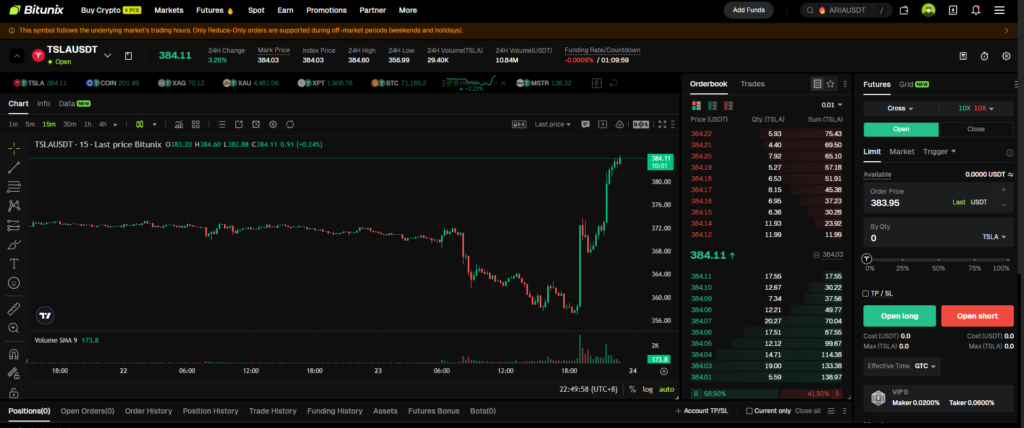
For beginners, the best approach is to keep the process simple and structured.
Start by locating TSLAUSDT in the Bitunix stock futures section. This is the Tesla-linked market you need to understand first.
Study the current price, 24-hour movement, range, and overall market behavior. Tesla can be volatile, so it is important to understand whether the market is trending, ranging, or reacting to fresh sentiment.
Before opening a trade, it helps to know why Tesla is moving. The catalyst may be broader tech momentum, company-specific news, earnings-related expectations, or wider market sentiment.
Do not trade Tesla just because it is popular. Make sure the market conditions align with your strategy and your risk tolerance.
Before entering any TSLAUSDT position, make sure you understand how leverage affects exposure and how margin can influence outcomes.
Tesla is widely known, but that does not make it low risk. Position sizing, discipline, and protective planning matter.
Tesla is a market that can shift quickly. Once a position is open, active attention matters.
A structured process reduces emotional decision-making and helps beginners approach Tesla more responsibly.
Tesla is one of those markets where several different drivers can matter at once.
Company-specific developments often play a major role. Traders may react to delivery numbers, earnings expectations, production updates, product-related news, or leadership sentiment.
Sector trends matter too. Tesla is often influenced by broader technology and growth-stock momentum.
Macro conditions can also play a role. Interest-rate expectations, market-wide risk appetite, and broad equity sentiment may all affect Tesla.
Finally, trader psychology matters. Tesla has a strong retail-following and often becomes a momentum market. That means price action can sometimes accelerate because of attention itself.
For beginners, this is important. Tesla is not usually a quiet or purely mechanical market. It is often a narrative-heavy market, which means understanding sentiment is part of understanding the trade.
This distinction should stay clear throughout the article.
Buying Tesla shares through a traditional broker means owning actual stock in the company. That is typically part of a longer-term investment framework.
Trading TSLAUSDT on Bitunix means participating in Tesla price movement through a stock-linked trading product. That is more suitable for active traders than for traditional investors.
This difference affects how the product should be used. TSLAUSDT is designed for market exposure, tactical positioning, and active trading decisions. It is not a substitute for building a conventional long-term equity portfolio.
The better users understand this difference, the more realistic their expectations will be.
Leverage can make Tesla trading more capital-efficient, but it also makes risk much more immediate.
This is especially important with Tesla because it already has a reputation for sharp price swings. When leverage is added, even a move that looks manageable on the chart can become much more significant in the position itself.
That is why leverage should never be treated casually. A familiar company name can create a false sense of confidence, especially for beginners. Tesla may be famous, but fame does not reduce market risk.
The more active and volatile the market, the more important discipline becomes. That means understanding position size, exposure, liquidation risk, and the need to trade within a plan rather than react impulsively.
There are similarities between Tesla trading and crypto futures on Bitunix, but there are also important differences.
The similarities are mostly structural. Both use an exchange-style workflow, chart-based trading, and active position management.
The differences come from market drivers. Crypto futures are often shaped by token narratives, blockchain news, regulation, ecosystem growth, and digital asset sentiment. Tesla is shaped more by company-specific developments, broader equity momentum, and macroeconomic conditions.
That means traders should not assume that a crypto strategy transfers directly into TSLAUSDT without adjustment. Tesla deserves its own market understanding, even if the interface feels familiar.
Tesla is popular, but popularity does not reduce risk.
Tesla can move sharply, especially when sentiment becomes aggressive.
Leverage increases both gains and losses, which becomes even more important in a volatile market like Tesla.
TSLAUSDT is an active trading product, not passive share ownership.
Because Tesla is widely known, some users may underestimate the need for careful planning.
Tesla is one of the markets most likely to trigger impulsive decisions because it is so heavily discussed and closely watched.
At Bitunix, broader market access works best when traders understand both the opportunity and the risk that come with the product.
Tesla fits well into the Bitunix TradFi expansion because it connects naturally with the kind of market behavior many users already have. Traders do not move in strict categories anymore. They shift between crypto, stocks, and commodities depending on where momentum and relevance appear.
Tesla is one of the clearest bridges between those worlds. It has the narrative power of a high-attention crypto asset, but it belongs to the stock market. That makes it especially suitable for a platform like Bitunix, where users want broader access without a fragmented workflow.
For users who want to move between Bitcoin, Nvidia, Tesla, gold, and other major market themes inside one ecosystem, TSLAUSDT helps make that possible.
Tesla remains one of the most important and most actively watched names in the market. On Bitunix, TSLAUSDT gives users a practical way to access Tesla price movement through a USDT-based trading structure that fits naturally within the broader platform environment.
For beginners, the most important thing to understand is that trading Tesla on Bitunix is not the same as buying Tesla shares directly. It is a stock-linked trading product designed for active market participation, not long-term equity ownership.
That distinction matters, especially in a market as high-profile and fast-moving as Tesla. For users who want broader TradFi exposure, active market access, and a more connected way to trade across categories, TSLAUSDT is one of the clearest examples of how Bitunix is bringing stock-linked markets into a crypto-native workflow.
TSLAUSDT is the Tesla-linked trading pair on Bitunix that gives users exposure to Tesla price movement through a USDT-based framework.
No. Trading Tesla on Bitunix means using a stock-linked trading product, not directly purchasing Tesla stock through a broker.
Tesla is widely followed because of its strong market narrative, high visibility, innovation-driven identity, and active price movement.
Many can, because Tesla is a highly discussed and fast-moving market that fits naturally with the style of active trading many crypto users already know.
Tesla often reacts strongly to sentiment, headlines, and broader growth-stock momentum, which can create sharper volatility.
It can be, but beginners should first understand that it is an active trading product, not long-term stock ownership, and they should approach leverage and risk control carefully.
Bitunix added Tesla-linked trading as part of its broader TradFi expansion, giving users a more connected way to access major market themes from one platform.
Bitunix is a global cryptocurrency derivatives exchange trusted by over 3 million users across more than 100 countries. The platform is committed to providing a transparent, compliant, and secure trading environment for every user. Bitunix offers a fast registration process and a user-friendly verification system supported by mandatory KYC to ensure safety and compliance. With global standards of protection through Proof of Reserves (POR) and the Bitunix Care Fund, Bitunix prioritizes user trust and fund security. The K-Line Ultra chart system delivers a seamless trading experience for both beginners and advanced traders, while leverage of up to 200x and deep liquidity make Bitunix one of the most dynamic platforms in the market.
Bitunix Global Accounts
X | Telegram Announcements | Telegram Global | CoinMarketCap | Instagram | Facebook | LinkedIn | Reddit | Medium
Disclaimer: Trading digital assets involves risk and may result in the loss of capital. Always do your own research. Terms, conditions, and regional restrictions may apply.