How AAPLUSDT Trading Works on Bitunix
Learn how to trade Apple stock on Bitunix with USDT, understand how AAPLUSDT works, and explore volatility, leverage, and risk management for beginners.

As more traders move beyond crypto-only strategies, interest in stock-linked markets continues to grow. Many users already follow names like Tesla, Apple, Nvidia, Amazon, Circle, MicroStrategy, Intel, and HOOD alongside Bitcoin and Ethereum. That shift is easy to understand. Modern traders are no longer focused on just one market category. They want flexibility, broader exposure, and the ability to act on opportunities across different sectors from one platform.
At Bitunix, that is where US stock futures become relevant. Instead of limiting the trading environment to crypto pairs alone, Bitunix also gives users access to stock-linked markets in a USDT-based setup. For traders who are already comfortable with exchange-style interfaces, charts, order books, and futures products, this creates a much smoother way to explore stock-related price action without moving into a completely separate workflow.
This matters because traditional stocks remain some of the most closely watched assets in the world. Tesla often leads conversations around innovation and volatility. Apple is one of the biggest names in global equities. Nvidia has become central to AI and semiconductor narratives. Amazon continues to represent scale, ecommerce, and cloud infrastructure. At the same time, names like MicroStrategy, Coinbase, Circle, Intel, and HOOD also attract significant market attention for their connection to technology, finance, and digital asset narratives.
In this guide, we explain what US stock futures on Bitunix are, how trading stocks with USDT works, why these markets matter, how to start trading them, and what beginners should understand before entering stock-linked futures markets.
US stock futures on Bitunix are trading products linked to the price movement of major US-listed companies. Instead of buying actual shares through a traditional broker, users access stock price exposure through futures-style markets on Bitunix.
This distinction is important. Trading a stock-linked market on Bitunix is not the same as directly owning the stock itself. It is about trading the price movement of a market tied to that company. For active traders, this can be much more practical because it fits the same type of fast-moving, chart-based, execution-focused workflow they already use in crypto futures.
On Bitunix, the stock-linked markets include:
These markets allow users to follow some of the most recognized names in US equities while staying inside a USDT-based trading environment.
For beginners, the core idea is simple. US stock futures on Bitunix are designed for trading stock price movement, not for long-term stock ownership.
Stock-linked markets matter because many of the biggest global market narratives are still shaped by public companies. Even traders who focus heavily on crypto often watch large US equities because those companies influence broader risk sentiment, technology momentum, retail trading interest, and capital flows.
Tesla is a good example. It is not just a car company in market discussions. It is often treated as a volatility asset, a growth story, and a risk appetite indicator. Nvidia plays a similar role in AI-related market narratives. Apple is tied to large-cap stability and consumer tech leadership. Amazon remains important because of ecommerce and cloud infrastructure. MicroStrategy, Coinbase, and Circle matter for a different reason. They sit closer to digital asset and fintech conversations, which makes them especially interesting for crypto-native traders.
At Bitunix, adding stock futures reflects the fact that users increasingly want more than one type of market exposure. A trader may watch Bitcoin in the morning, Nvidia in the afternoon, and gold later in the week. That is no longer unusual. It is how many active traders already behave.
At Bitunix, expanding into stock-linked futures is part of a broader move toward a more complete TradFi offering. Traders today do not think in strict categories. They want a platform that helps them move between crypto, commodities, and stock-related opportunities without having to constantly rebuild their workflow.
US stock futures support that goal. They bring familiar equity market names into an exchange environment that many crypto traders already understand. Instead of asking users to open a separate stock brokerage account, learn a different system, and move capital into a different infrastructure, Bitunix gives them a more streamlined way to access stock-linked price action through USDT.
This also helps users diversify their attention. There will be market phases where crypto leads. There will also be periods where stocks dominate the conversation. By offering both, Bitunix creates a more flexible environment that better reflects how real-world traders adapt when market leadership changes.
Trading stocks with USDT on Bitunix means users access stock-linked futures markets through a stablecoin-based framework instead of using fiat settlement through a traditional broker.
That makes a real difference for crypto-native users. USDT is already central to how many traders manage capital, calculate position sizes, and move between markets. Extending that same workflow into stock-linked pairs removes friction and makes the experience more intuitive.
It also creates a stronger bridge between crypto and traditional market themes. Instead of treating stocks as something that belongs outside the exchange ecosystem, Bitunix integrates them into a format that feels familiar. Users can monitor stock-linked pairs in a layout similar to other futures markets, compare volatility across categories, and think about exposure in a more unified way.
For beginners, this is one of the biggest benefits. Trading stock-linked markets through USDT often feels more accessible than starting from scratch in a traditional equities environment.
The stock-linked pairs shown on Bitunix cover a useful range of sectors and narratives.
Tesla remains one of the most followed stocks in the world. It attracts attention because of innovation, volatility, and strong retail trader interest.
Circle-linked market exposure is especially relevant to users who already understand stablecoin and digital finance narratives.
MicroStrategy stands out because of its strong association with Bitcoin and digital asset exposure.
Coinbase is a major name in crypto-financial infrastructure and tends to attract interest from traders who watch both equities and digital assets.
Nvidia is central to AI, chips, and high-growth technology conversations.
Apple remains one of the most recognized large-cap companies in global finance and often represents broader stability in the technology sector.
Amazon continues to matter because of ecommerce, cloud services, and overall market weight.
HOOD is closely tied to retail trading culture and app-based finance.
Intel remains a significant semiconductor name and can matter during chip-sector rotations or manufacturing-related narratives.
Together, these pairs offer users more than just basic stock exposure. They provide access to several of the most visible themes in modern equities.
There is a natural connection between crypto traders and stock-linked markets on Bitunix. Many of the companies listed above are already familiar to users who spend time in digital markets. MicroStrategy, Coinbase, and Circle have obvious relevance. Tesla and Nvidia are often part of the same high-volatility, innovation-driven market culture that attracts active traders in crypto. Even Amazon, Apple, Intel, and HOOD fit into broader conversations around technology, consumer behavior, and financial infrastructure.
This overlap matters because it reduces the learning curve. Crypto-native users are not stepping into completely unfamiliar territory. They are exploring stock-linked markets tied to companies they likely already follow in headlines, on social media, or through general market commentary.
At the same time, these markets bring a different type of structure. Stock-linked futures are influenced by equity sentiment, sector trends, corporate narratives, and macro conditions. That gives traders a chance to broaden their thinking without leaving a familiar platform environment.
The basic structure is straightforward. Users trade a pair such as TSLAUSDT or AAPLUSDT to gain exposure to the price movement of that stock-linked market. Rather than buying real company shares, they participate in a futures-style product that tracks price action.
Because the pair is quoted against USDT, the experience feels more natural for exchange users who already manage other positions in stablecoin terms. Users can review prices, daily changes, ranges, volume, and chart behavior in a workflow that aligns with other Bitunix markets.
This is one of the main advantages of the Bitunix approach. It removes the feeling that stocks and crypto belong in completely separate worlds. Instead, both can be viewed through a connected multi-market framework.
Still, beginners should remember that stock-linked futures are not identical to direct stock ownership. They are active trading products, which means they are generally better suited to users who want to manage positions actively rather than passively hold shares over time.
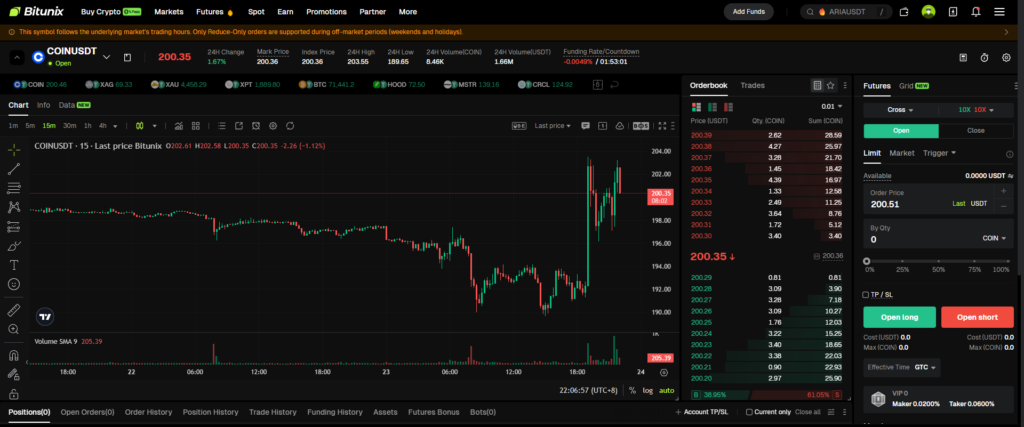
For beginners, the best approach is to keep the process structured.
Start by choosing one market, such as TSLAUSDT, AAPLUSDT, or NVDAUSDT, instead of jumping into all pairs at once.
Look at the current price, 24-hour move, daily range, and trading volume. This helps build a basic sense of the pair’s activity level.
A trader does not need to become an equity analyst, but it helps to know why a stock is widely watched. Nvidia may be driven by AI sentiment. Tesla may react to growth expectations and broader risk appetite. Coinbase may follow crypto-related sentiment more closely.
Once the market context is clear, decide whether the pair fits your strategy, risk tolerance, and timing.
Before entering any stock-linked futures trade, users should understand how leverage affects exposure and how margin requirements can shape outcomes.
Position sizing and discipline matter. A recognizable stock name does not automatically mean lower risk.
These are not passive investments. Stock-linked futures need active attention, especially during periods of strong market momentum or broader macro changes.
A clear process helps reduce beginner mistakes and makes stock futures easier to approach responsibly.
This is one of the most important distinctions in the entire topic.
Owning real US stocks means purchasing actual company shares through a traditional brokerage account. That type of ownership is typically associated with longer-term investing, direct exposure to the company, and traditional portfolio building.
Stock futures on Bitunix work differently. They provide price exposure through a trading product rather than direct share ownership. This makes them more suitable for active traders than for users whose main goal is long-term share accumulation.
That difference should shape expectations. Bitunix stock futures are designed for traders who want access to movement, timing, and short-term market opportunities. They are not the same thing as building a conventional long-term stock portfolio through direct share purchases.
Leverage can make stock-linked futures more flexible, but it also increases risk quickly.
When leverage is used, a trader controls a larger position with a smaller amount of capital. That can improve efficiency, but it also means even moderate moves in a stock-linked pair can have a much bigger effect on the position than expected.
This matters because many beginners assume familiar company names are automatically safer to trade. That assumption can be dangerous. A company like Tesla or Nvidia may be widely recognized, but it can still experience sharp price swings. When leverage is added, the risk becomes even more immediate.
That is why leverage should always be approached with care. It is a tool for managing exposure, not a reason to trade too aggressively.
Stock futures and crypto futures can look similar inside the platform, but the underlying market drivers are different.
Crypto futures are often shaped by token narratives, blockchain adoption, ecosystem developments, regulation, and broad digital asset sentiment. Stock futures are more connected to company-specific expectations, equity sector sentiment, earnings outlook, market rotation, and overall macroeconomic conditions.
That difference matters because it affects strategy. A setup that works well in crypto does not automatically translate to stocks. Traders need to understand what actually moves the market they are trading.
At the same time, there is useful overlap. Anyone who already understands chart reading, position sizing, and active futures discipline may find stock-linked markets easier to learn than expected, as long as they respect the fact that the market logic is different.
Stock-linked futures can be useful, but they come with real risks.
Large-cap names can still move sharply, especially when sentiment changes quickly.
Leverage magnifies both gains and losses. This becomes especially important when trading volatile names.
Stock futures are active trading products, not passive stock ownership.
Because many users know the company names, they may underestimate the need for discipline.
Crypto habits do not always transfer neatly into stock-linked futures markets.
At Bitunix, broader market access works best when users understand the product they are trading and the forces that move it.
US stock futures help complete the broader TradFi picture on Bitunix. Alongside crypto and commodity-linked products, they give users another major category of market exposure in one connected environment.
This matters because traders increasingly move across sectors. They may follow Bitcoin when digital assets lead, shift to Nvidia when AI drives the market, watch Tesla during volatility spikes, and turn to gold when macro stress rises. That cross-market behavior is now a normal part of active trading.
By bringing stock-linked futures into a USDT-based workflow, Bitunix creates a more flexible system for users who want to engage with the markets they already watch, without unnecessary complexity.
US stock futures on Bitunix give users a practical way to explore major equity market themes through a familiar USDT-based trading environment. Pairs such as TSLAUSDT, AAPLUSDT, NVDAUSDT, AMZNUSDT, MSTRUSDT, COINUSDT, CRCLUSDT, HOODUSDT, and INTCUSDT allow traders to follow some of the most recognized companies in the market without leaving the broader Bitunix ecosystem.
For beginners, the most important point is that these are stock-linked futures markets, not direct stock ownership. They are designed for active traders who want exposure to price movement, broader market access, and a platform structure that fits naturally with how crypto-native users already trade.
As more users look beyond crypto-only strategies, US stock futures are likely to become an increasingly important part of the Bitunix TradFi offering. They help connect traditional market themes with a more modern exchange workflow, giving users more flexibility to follow where attention, volatility, and opportunity move next.
It means users trade stock-linked futures pairs through a USDT-based framework instead of buying actual company shares through a traditional broker.
No. Stock futures on Bitunix are price-linked trading products, not direct stock ownership.
Based on the Bitunix stock market lineup shown, available pairs include TSLAUSDT, CRCLUSDT, MSTRUSDT, COINUSDT, NVDAUSDT, AAPLUSDT, AMZNUSDT, HOODUSDT, and INTCUSDT.
Many of these companies are already relevant to technology, AI, fintech, retail trading, and digital asset narratives, which makes them a natural extension for crypto-native traders.
Yes. These markets are structured in a USDT-based format, which helps create a more familiar workflow for Bitunix users.
They can be, as long as beginners first understand that these are active trading products, not direct stock ownership, and learn how leverage, volatility, and risk management apply.
Bitunix added US stock futures to give users broader market access and a more connected way to trade across crypto, commodities, and stock-linked markets from one platform.
Bitunix is a global cryptocurrency derivatives exchange trusted by over 3 million users across more than 100 countries. The platform is committed to providing a transparent, compliant, and secure trading environment for every user. Bitunix offers a fast registration process and a user-friendly verification system supported by mandatory KYC to ensure safety and compliance. With global standards of protection through Proof of Reserves (POR) and the Bitunix Care Fund, Bitunix prioritizes user trust and fund security. The K-Line Ultra chart system delivers a seamless trading experience for both beginners and advanced traders, while leverage of up to 200x and deep liquidity make Bitunix one of the most dynamic platforms in the market.
Bitunix Global Accounts
X | Telegram Announcements | Telegram Global | CoinMarketCap | Instagram | Facebook | LinkedIn | Reddit | Medium
Disclaimer: Trading digital assets involves risk and may result in the loss of capital. Always do your own research. Terms, conditions, and regional restrictions may apply.