How AAPLUSDT Trading Works on Bitunix
Learn how to trade Apple stock on Bitunix with USDT, understand how AAPLUSDT works, and explore volatility, leverage, and risk management for beginners.

Harmony (ONE) is a blockchain platform designed to enhance the creation and use of decentralized applications (DApps). With a strong emphasis on scalability, speed, and security, Harmony employs innovative technologies like random state sharding and Fast Byzantine Fault Tolerance (FBFT) consensus to process transactions efficiently while maintaining decentralization.
Since its launch in June 2019, Harmony has gained significant traction due to its ability to provide high-speed transactions, low fees, and interoperability with other blockchains. The native Harmony $ONE token plays a crucial role in the network, enabling staking, governance, and participation in the platform’s growing ecosystem of DeFi, NFTs, and cross-chain applications.
In this article we will explain what makes Harmony coin unique and how you can trade in Harmony spot and future contracts.
Unlike traditional blockchains that struggle with scalability and high transaction costs, Harmony offers a revolutionary approach to blockchain architecture through its innovative use of sharding and an advanced consensus mechanism. Lets break down Harmony’s core features that make it stand apart.
Traditional blockchain consensus mechanisms often face latency and communication inefficiencies. Harmony’s Fast Byzantine Fault Tolerance (FBFT) improves upon the widely used Practical Byzantine Fault Tolerance (PBFT) by:
This combination allows Harmony to process transactions faster and at a lower cost than many other blockchains, including Ethereum.
Harmony is designed to work seamlessly with multiple blockchain networks, enabling smooth cross-chain transfers and interoperability. The platform supports:
These features position Harmony as a key player in the multi-chain future.
Harmony offers keyless smart wallets, providing users with a more secure and convenient way to manage their digital assets. These wallets:
This makes Harmony wallets more resilient against hacks, thefts, and lost access compared to traditional wallets.
The Harmony ONE token has multiple utility functions that underpin its significance in the network’s ecosystem. First, it is used to pay transaction fees, covering the cost of smart contract execution and token transfers, which helps maintain a secure and efficient blockchain.
Second, ONE holders can stake their tokens to become validators or delegate them to existing validators, earning rewards while also contributing to the network’s overall security and performance. Third, the token serves a governance function, allowing holders to propose and vote on protocol upgrades, parameter changes, and other key decisions that shape the platform’s future.
Finally, Harmony ONE is widely used across the network’s DeFi and NFT ecosystems, powering lending, borrowing, yield farming applications, and NFT marketplaces, further driving demand and expanding its real-world utility.
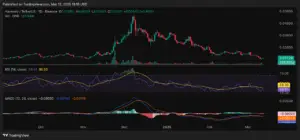
Harmony (ONE) is trading near $0.011 and appears to have been in a steady downtrend since its peak in late 2021. The RSI (14) hovers around the mid- to high-30s, suggesting mild oversold conditions but not an extreme level that would typically precede a major reversal. Meanwhile, the MACD remains in negative territory, though the histogram’s gradual shift could indicate that selling momentum is weakening.
Price action is consolidating at a critical support zone just above $0.010, an area that has acted as a floor in recent weeks. A decisive break below this level could lead to further downsides, while a strong bounce—accompanied by rising volume—might signal a potential trend reversal.
While exact forecasts are speculative, many observers anticipate that Harmony could reclaim higher levels if broader market conditions improve and development milestones are met. A conservative projection might see ONE trading in the $0.05–$0.08 range by 2025, assuming gradual market recovery and steady adoption.
By 2026, if the crypto sector enters another strong bullish phase and Harmony continues to innovate, it could potentially test $0.10–$0.12 or higher. As always, these targets are highly dependent on market sentiment, overall crypto trends, and the project’s ability to execute on its roadmap.
Harmony was founded by Stephen Tse, who serves as the company’s CEO. Dr. Tse holds a Ph.D. from the University of Pennsylvania, where he focused on cryptographic protocols and type theory.
During his time in academia, he took on a research internship at Microsoft. By 2006, he was a senior engineer at Google, dedicating four years to the tech giant. In 2011, he launched Spotsetter, a search engine that gained enough traction to catch Apple’s eye, leading to its acquisition. Following this, Dr. Tse became a principal engineer at Apple in 2014.
In 2017, Dr. Tse established Harmony. The founding team of Harmony consists of twelve individuals, including seven former employees from major tech companies such as Google, Apple, Microsoft, and Amazon.
To buy $ONE, you need to create an account on Bitunix. If you are already a registered user, you can skip this step.
Next, you need to deposit USDT in your Bitunix account. Simply head to your profile and click on the wallet icon. Next, click on deposit and follow the steps to deposit crypto in your account.
To trade in ONE/USDT, navigate to the main menu and click on the Markets tab and select ‘Marketplace’.

Next, click on the search icon and look for ONE.
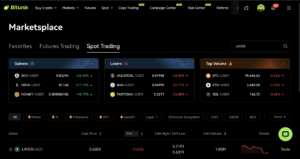
Next, click on Trade to open the trading window for ONE/USDT
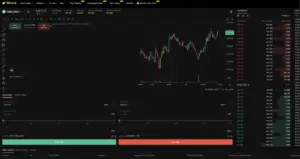
You can choose to place a limit or a market order for buying and selling $ONE tokens.
Watch our detailed tutorial on How to use Crypto Limit and Market Orders on Bitunix Futures?
To trade in ONE/USDT on Bitunix, head over to the Markets Tab and click on Marketplace from the drop down menu.
Next, click on trade to open the ONE/USDT futures pair trading panel.
Now, you can place a long or short order on ONE/IUSDT futures.
You can buy USDT through our on ramp crypto partners like Moonpay, AlchemyPay and Volet. Bitunix also offers p2p crypto trading. Following are the steps to buy USDT through a third party provider.
Navigate to Buy Crypto in the main navigation menu. Click on Buy Crypto tab and choose Third Party from the drop down menu.
Next, choose your currency, crypto and the amount you wish to spend. Now, choose your preferred payment method and click on Buy. Next, verify the payment with your bank or payment gateway (Bank or payment gateway like Apple Pay) Once done, the crypto will be reflected in your Bitunix account.
Bitunix has recently added P2P trading to make your crypto investing journey a breeze. Follow the following steps to place a P2P USDT order.
First, head over to the Buy Crypto tab in the main menu. Now, click on P2P Trading from the drop down menu.
Next, choose the amount you wish to spend and the preferred method of payment. Once done, the system matches your order requirements with the verified merchants. Now, you can choose the merchant you wish to buy your USDT from.
Next, click on Buy and make the payment. Once done, share a screenshot of the payment and click on I have Paid. Once the seller has received the amount, he/she will release the funds.
If you already own crypto and wish to deposit in your Bitunix account simply follow the steps below
First, navigate to the main menu and click on the wallet icon. Now, choose spot account from the drop down menu.
Next, click on Deposit from the menu to your left.
Next, choose crypto and network you wish to deposit through. This will generate your deposit address that you need to send your crypto to. Double, triple check the details before you send your crypto to the deposit address. Make sure to never manually copy the address as it might lead you to miss out any characters.