Injective is one of the most innovative Layer-1 blockchains, offering developers what they crave most: lightning-fast transactions. The platform also caters to traders with its on-chain order book and minimal transaction fees. Its focus on high-performance operations, coupled with seamless cross-chain interoperability, positions Injective as a strong contender in the on-chain derivatives race.
Injective was designed for building DeFi applications, particularly decentralized exchanges (DEXs) for spot and derivatives trading. Its modular architecture enables teams to build sophisticated financial products, including perpetuals and futures, while keeping execution fast and costs low.
The INJ token powers the Injective ecosystem and supports permissionless, transparent, and efficient trading infrastructure. Token holders can use INJ in governance, staking, and other on-chain functions that sustain the network’s security and growth.
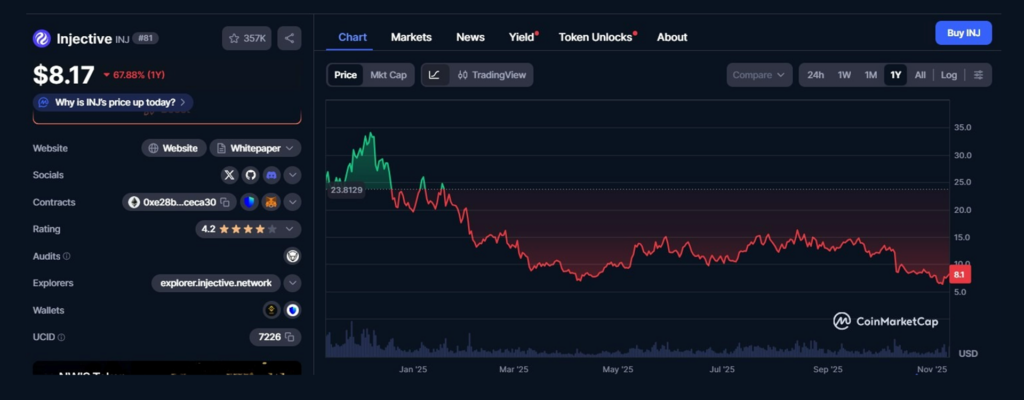
INJ reached an all-time high of about $52.75 in 2024, then fell sharply and has traded far below peak levels since. As DeFi expands and on-chain trading infrastructure matures, the question is whether Injective’s technology and ecosystem can translate into renewed demand and a stronger price cycle.
This article provides a comprehensive INJ price prediction for 2026–2030, analyzing Injective’s core technology, the growth of its dApp ecosystem, and its positioning in the broader shift toward on-chain finance. It also explains where you can trade INJ if you are looking to buy crypto online.
What Is Injective (INJ)?
Injective launched mainnet in November 2021, but development began years earlier. The project was built to support open, global financial markets by enabling fast and composable DeFi applications, especially order-book-based trading.
Injective is built using Cosmos SDK, which supports application-specific blockchains and native interoperability through the Cosmos ecosystem. This design supports cross-chain workflows and helps Injective connect liquidity and assets across networks.
From early development, Injective differentiated itself by focusing on trading infrastructure rather than general-purpose apps. Its architecture was optimized for financial products, including spot markets, futures, and perpetual swaps. Over time, that focus helped it build a reputation as a chain built for finance.
One of Injective’s defining features is its on-chain order book system. Developers can build decentralized exchanges that match bids and asks in a way that resembles centralized exchange execution, while keeping settlement on-chain. This is a key part of Injective’s appeal to traders who prefer order-book liquidity and clearer execution mechanics.
Notable Injective ecosystem projects include Helix (perpetuals), derivatives-focused protocols, DEX infrastructure, NFT marketplaces, and asset management tools.
The INJ Token
INJ is central to Injective’s security model and governance framework. It is used for staking and validator incentives, governance participation, and fee-related mechanisms across the ecosystem.
Injective also uses a fee-based mechanism where part of protocol fees can be used for buybacks and burns, contributing to a deflationary narrative tied to activity. The practical impact depends on sustained ecosystem volume and how fees scale through different market regimes.
INJ Price History and Key Context
INJ launched in 2020 and traded through multiple market cycles before reaching its 2024 peak near $52.75. Since then, it has experienced significant drawdowns consistent with broader altcoin cycles and shifting liquidity conditions.
Injective’s long-term price potential depends less on a single catalyst and more on whether it becomes a primary venue for meaningful on-chain spot and derivatives activity, plus whether developers continue to choose Injective for financial applications relative to other ecosystems.
INJ Price Prediction 2026–2030
Below is a scenario-based outlook for 2026–2030. These ranges are not guarantees and are best treated as conditional frameworks based on adoption, market cycles, and ecosystem execution.
INJ Price Prediction 2026: Rebuilding Momentum
By 2026, the key question is whether Injective converts its technical strengths into consistent growth in active traders, applications, and on-chain volumes.
A constructive 2026 scenario assumes:
- More traders adopting on-chain order-book execution for perpetuals and advanced markets
- Better cross-chain asset support and improved user experience
- Continued ecosystem expansion with higher-quality dApps
2026 outlook (scenario range): $10 to $25, depending on broader market conditions and whether Injective meaningfully grows its derivatives footprint.
INJ Price Prediction 2027: Interoperability and Institutional Attention
In 2027, the strongest upside case is driven by deeper liquidity and broader interoperability, especially if on-chain derivatives become more mainstream and market structure improves across DeFi.
A bullish 2027 scenario typically requires:
- Higher daily on-chain volumes across key Injective venues
- More market makers and deeper books supporting tighter spreads
- Stronger cross-chain bridging, asset listings, and institutional-grade integrations
2027 outlook (scenario range): $18 to $40, with the high end requiring a strong market cycle and clear ecosystem traction.
INJ Price Prediction 2028–2030: Can Injective Become a Major Trading Hub?
The 2028–2030 thesis is about whether Injective becomes one of the default rails for on-chain trading, especially derivatives.
2028
If Injective strengthens its ecosystem and retains developer interest while on-chain derivatives expand, a higher valuation range becomes plausible.
2028 outlook (scenario range): $25 to $60
2029
A more mature on-chain derivatives market could reward networks that provide reliable execution, liquid order books, and strong product breadth.
2029 outlook (scenario range): $35 to $85
2030
A high-conviction bull case assumes Injective is a top-tier on-chain venue for derivatives and spot markets, with sustained volumes and stronger institutional participation.
2030 outlook (scenario range): $50 to $120
Key Factors Influencing INJ’s Price
On-Chain Derivatives Adoption
Injective’s identity is closely tied to trading infrastructure. If more volume migrates to on-chain derivatives, Injective’s order-book model can benefit.
Liquidity and Market Maker Depth
Order books are only as strong as their liquidity. Sustained depth and tight spreads are essential for long-term relevance.
Developer Ecosystem Growth
More high-quality dApps, better tooling, and stronger product variety increase stickiness and user retention.
Interoperability and Asset Breadth
A broader set of tradeable assets across chains can support higher volumes and make Injective more competitive.
Token Mechanics and Activity-Linked Burns
If usage grows and fee-linked mechanisms scale, that can strengthen the long-run supply narrative. The impact depends on real, sustained activity, not marketing alone.
How to Trade Injective (INJ) on Bitunix
Getting started with INJ trading on Bitunix is straightforward:
- Sign up on Bitunix using your email or mobile number.
- Deposit crypto or link a fiat method (KYC is required only for fiat operations).
- Open the Spot Market and search for the INJ pair to buy or sell.
- If you want advanced strategies, you can use perpetual futures to trade volatility and manage directional exposure.
Why Trade INJ on Bitunix?
Bitunix supports both beginner and advanced workflows with practical features designed for execution and risk control.
Key advantages include:
- Fast registration and smooth onboarding
- KYC required only for fiat operations
- Deep liquidity across popular markets
- Risk tools such as TP/SL and structured order types
- Leverage up to 200x in select markets (availability varies by pair and region)
Conclusion: Can Injective Capture the On-Chain Trading Crown?
Injective’s ambition to become a leading chain for on-chain trading is credible because its architecture is purpose-built for financial applications. Its strengths include fast execution, an on-chain order book model, and interoperability that supports multi-asset participation.
The challenge is competition. Other ecosystems also push aggressively into DeFi and derivatives, and liquidity often clusters where traders already are. Injective’s long-term success depends on whether it can consistently grow real activity, deepen liquidity, and keep developers building.
If it does, INJ can participate meaningfully in the next wave of on-chain finance. If it fails to attract sustained liquidity and users, upside scenarios become harder to justify.
If you want exposure to the Injective ecosystem, you can trade INJ on Bitunix and participate in the on-chain trading narrative as it evolves.
FAQ
1. Can Injective (INJ) reach $500 or $1,000?
Most analysts consider that unlikely within the next five years under current growth assumptions. Reaching those levels would require extraordinary adoption, sustained volume growth, and a dramatic expansion in the overall on-chain derivatives market.
2. What is the Injective token burn auction, and how does it work?
Injective has used fee-related mechanisms that can buy back and burn INJ, linking supply reduction to activity. Specific implementation details can evolve over time, so it is best to verify the current mechanism through official Injective documentation before relying on it.
3. How does Injective achieve fast transaction speeds?
Injective is built with Cosmos SDK and uses a Tendermint-based Proof-of-Stake consensus model designed for fast block times and efficient finality.
4. What is the relationship between Injective and Cosmos?
Injective is built on Cosmos SDK and is part of the broader Cosmos ecosystem, which supports interoperability across compatible chains.
5. Is the INJ token inflationary or deflationary?
INJ can exhibit deflationary dynamics through activity-linked burn mechanisms, but net supply behavior depends on protocol-level issuance, staking rewards, and how burn policies scale with usage.
6. Where is the best place to buy and trade INJ?
If you want spot and derivatives access in one place, Bitunix offers INJ spot markets and perpetual contracts with execution tools and risk controls.
Glossary
- Altcoin: Any crypto asset that is not Bitcoin.
- DeFi: Decentralized finance applications on public blockchains.
- Gas: Network fee for processing a transaction.
- Layer 1: Base blockchain that verifies and records transactions.
- Layer 2: Scaling solution that processes transactions off-chain and posts proofs to Layer 1.
- Volatility: Degree of price fluctuation for an asset over time.
- Proof of Stake (PoS): Consensus where validators lock native tokens to secure the network and earn rewards.
- Validator: Operator that proposes or attests blocks in PoS and shares rewards with delegators.
- Incentive Program: Extra token rewards used to direct liquidity or participation.
- Governance: Process for changing protocol parameters or logic, often token-based with timelocks.
- Stable Pair: A pair of assets that track similar values, such as two stablecoins.
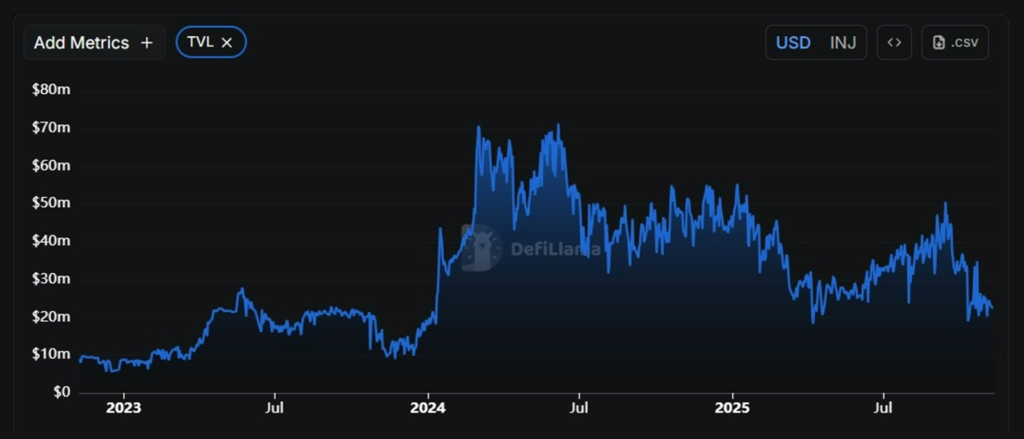
- TVL: Total value locked in a protocol, a rough usage proxy.
About Bitunix
Bitunix is a global cryptocurrency derivatives exchange trusted by over 3 million users across more than 100 countries. The platform is committed to providing a transparent, compliant, and secure trading environment for every user. Bitunix offers a fast registration process and a user-friendly verification system supported by mandatory KYC to ensure safety and compliance. With global standards of protection through Proof of Reserves (POR) and the Bitunix Care Fund, Bitunix prioritizes user trust and fund security. The K-Line Ultra chart system delivers a seamless trading experience for both beginners and advanced traders, while leverage of up to 200x and deep liquidity make Bitunix one of the most dynamic platforms in the market.
Bitunix Global Accounts
X | Telegram Announcements | Telegram Global | CoinMarketCap | Instagram | Facebook | LinkedIn | Reddit | Medium
Leave a Reply