The AI crypto revolution is taking shape, but it runs on one scarce resource: high-quality compute. A potential solution comes from the Render Network, a decentralized GPU marketplace that lets users monetize idle GPU power while giving creators and developers access to high-performance compute without owning expensive hardware.
Think of it as an “Airbnb for GPUs,” built for rendering, graphics pipelines, and increasingly, AI workloads.
The RENDER token powers the Render Network by supporting payments, incentives, and governance. At the time of writing, RENDER is trading far below its 2024 peak, which keeps the long-term debate active: is this a temporary drawdown inside a growing narrative, or a sign that the market is not pricing Render’s utility as highly as expected?
This article provides a comprehensive RNDR price prediction for 2025-2030, analyzing its first-mover advantage, the explosive growth of the AI industry, and its fundamental role in powering the next generation of digital content and AI models. Our analysis should help you determine whether this is the right time to buy crypto online.
What Is Render (RENDER)?
Render Network is a peer-to-peer GPU compute marketplace designed to help developers create high-performance, power-hungry digital content renditions. The platform was built on Ethereum.
Render’s model connects three core participants:
- Creators and developers who need compute for graphics or AI tasks
- Node operators who provide GPU power
- The protocol that coordinates job matching, verification, and settlement
Over time, Render expanded beyond a pure graphics-rendering narrative toward broader GPU compute, including AI-adjacent workloads. The network’s governance and product roadmap also evolved, including community proposals focused on compute specialization.
In 2023, Render migrated to Solana, and the token branding shifted from RNDR to RENDER. The move was positioned around scalability, throughput, and lower transaction costs, with the goal of improving user experience for high-frequency job settlement and marketplace activity.
In April 2025, the Render community passed the RNP-019 proposal to create a new Render Compute Network optimized explicitly for AI workloads. This is important context for 2026 onward because AI compute demand is one of the key narratives that can drive utilization.
Render also uses blockchain mechanics to coordinate payments and, depending on workflow, provide auditability around job settlement. The value proposition is not “blockchain for its own sake,” but coordination and marketplace incentives for distributed compute.
The RENDER Token
RENDER is the native token of the Render Network. It is used to pay node operators for compute work and supports governance participation.
A commonly referenced mechanic in the Render ecosystem is that users acquire network credits for jobs using tokens (often described as burning RENDER in exchange for credits). The practical takeaway is that token utility is tied to network usage: more marketplace demand can translate into more token-driven settlement activity.
Token holders can also participate in governance, including voting on proposals related to network design, economics, and roadmap priorities.
RENDER Price History and Market Behavior
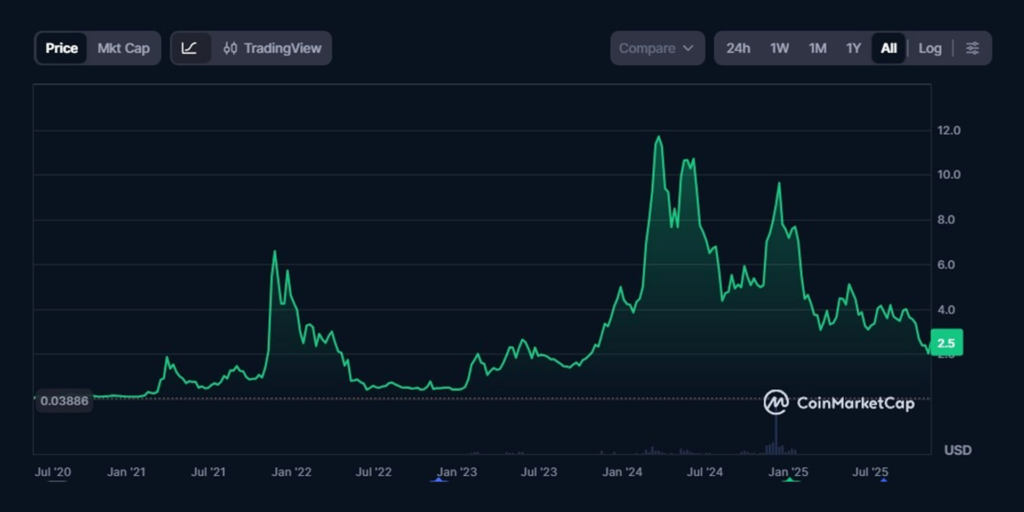
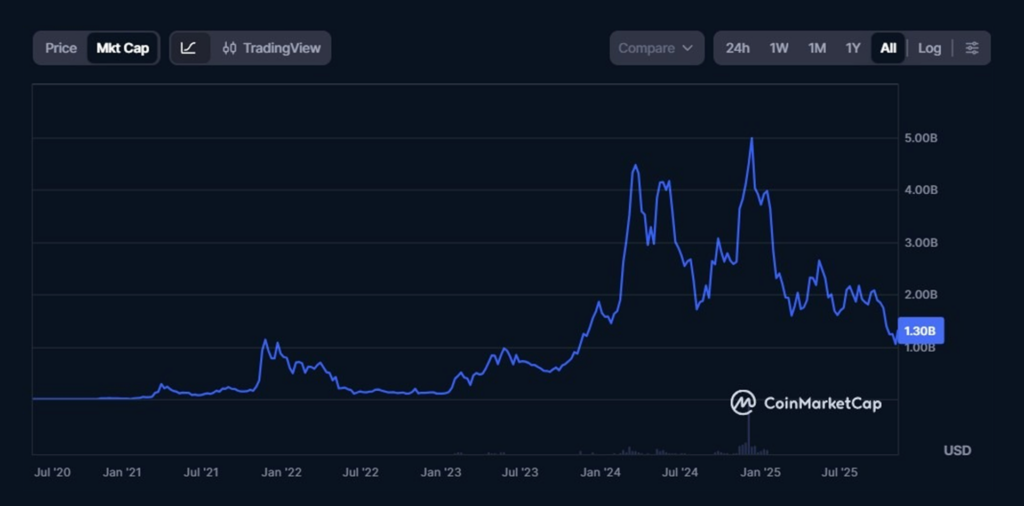
RENDER (formerly RNDR) has experienced multiple cycles, including an all-time low early in its history and a major run-up that culminated in a 2024 high near $13.60.
Since that peak, the token has traded significantly lower. In practice, RENDER tends to be sensitive to AI sentiment, GPU compute narratives, and broader risk-on or risk-off market regimes.
It is also common for AI-themed crypto assets to react to major developments in the AI hardware and compute market, including high-profile GPU industry announcements. That does not mean the token tracks any single company, but narrative flows can influence demand in the short term.
RENDER Price Prediction 2026–2030
The ranges below are scenario-based and conditional. They reflect how the market could price RENDER if network usage grows, if AI compute demand continues expanding, and if Render stays relevant versus centralized cloud providers and other decentralized compute networks.
RENDER Price Prediction 2026: AI Compute Narrative Meets Real Usage
In 2026, the most important question is simple: does marketplace usage rise in a measurable way?
A constructive 2026 scenario typically requires:
- Higher volume of completed jobs and recurring buyers of compute
- A clearer product identity for AI workloads, not only graphics rendering
- Stronger reliability signals for creators and studios that need predictable execution
If those conditions improve alongside a favorable market cycle, RENDER can re-rate from “narrative token” toward “infrastructure token.”
2026 outlook (scenario range): $2.50 to $6.50
The low end reflects weak adoption or choppy markets. The high end assumes stronger AI demand and visible network traction.
RENDER Price Prediction 2027: Metaverse, Gaming, and High-Fidelity Content Pipelines
By 2027, Render’s upside case expands if high-fidelity content production increases demand for distributed GPU compute.
Potential tailwinds include:
- Next-generation gaming workflows and heavier real-time graphics needs
- AR and VR content pipelines that require frequent rendering workloads
- Continued growth of AI-assisted video and 3D content generation
If Render becomes a dependable option for studios and production pipelines, demand can shift from speculative interest toward recurring marketplace usage.
2027 outlook (scenario range): $4.00 to $10.00
Sustained upside depends on adoption quality, not only sector hype.
RENDER Price Prediction 2028–2030: The Backbone of Decentralized AI?
The 2028–2030 thesis is ambitious: Render becomes a meaningful decentralized compute layer in a world where AI workloads and digital content production demand massive GPU capacity.
2028: Scaling the Supply Side
To grow meaningfully, Render must attract more GPU providers while maintaining performance and reliability for buyers.
2028 outlook (scenario range): $6.00 to $14.00
2029: Credibility as Infrastructure
If Render demonstrates enterprise-grade reliability and consistent throughput, the market may price it closer to infrastructure peers rather than small-cap narrative plays.
2029 outlook (scenario range): $8.00 to $20.00
2030: Winning a Seat at the Compute Table
A high-end 2030 scenario assumes Render captures a durable niche inside GPU compute demand, even while competing with major centralized cloud providers.
2030 outlook (scenario range): $10.00 to $30.00
These ranges assume the AI compute market continues to expand strongly and that Render’s marketplace usage increases in a visible, durable way. If adoption stalls or competitors dominate, the high-end scenarios become much less likely.
Key Factors Influencing RENDER’s Price
Network Utilization and Job Volume
Token narratives matter less over time than real usage. Sustained completed-job volume and repeat demand are the most important drivers.
Supply of Reliable GPU Providers
Render must grow the supply side without sacrificing reliability. A marketplace with inconsistent providers struggles to retain serious buyers.
AI Compute Demand and Content Production Growth
The broader AI market can lift interest, but the key is whether Render captures meaningful demand from actual compute users.
Competition From Centralized Cloud Providers
Centralized platforms have scale, distribution, and enterprise relationships. Render’s opportunity is cost efficiency, flexibility, and marketplace openness, but it must execute fast.
Token Utility and Governance Execution
If token usage remains tied to job settlement and the protocol executes well, the market may assign a higher “utility premium” over time.
How to Trade Render (RNDR) on Bitunix
Getting started with RNDR trading on Bitunix is quick and simple. Follow these steps:
- Sign up on Bitunix using your email or mobile number.
- Deposit crypto or link a fiat method (KYC required only for fiat operations).
- Go to the Spot Market to buy RENDER or sell instantly.
- For advanced traders who are margin trading crypto, open a RENDER perpetual futures position to trade with leverage and capitalize on market swings.
Why Trade RENDER on Bitunix?
Trading a narrative-driven token like RENDER benefits from fast execution, liquidity, and clear risk tooling.
Bitunix supports both spot and derivatives workflows with features such as:
- Fast registration and simple onboarding
- KYC required only for fiat operations
- Deep liquidity in popular markets to reduce slippage risk
- Risk-management tools such as TP/SL
- Leverage up to 200x in select markets (availability varies by pair and region)
Conclusion: Is RENDER the “NVIDIA of Crypto”?
Render is not a hardware company, so it is not a like-for-like comparison. What Render can be, however, is a marketplace layer that helps route compute to where it is needed, especially as AI and content workloads grow.
The core bull case is straightforward: GPU demand keeps rising, centralized compute remains expensive for many users, and Render becomes a credible decentralized alternative for certain workflows. If network usage rises materially, RENDER can benefit from a stronger utility narrative.
The bear case is also clear: centralized providers keep dominating, decentralized compute remains niche, and marketplace demand does not scale meaningfully.
If you want exposure to the AI compute narrative through a token tied to a GPU marketplace concept, you can trade RENDER on Bitunix and participate in the trend as it develops.
FAQ
1. Can Render reach $100?
It is possible in theory, but it would require extraordinary adoption and a major market-wide repricing of decentralized compute networks. Under realistic assumptions, $100 is not a base-case target for 2026–2030.
2. How does Render work?
Render Network connects creators who need GPU compute with node operators who provide GPU power. The protocol coordinates job matching and settlement so buyers can pay for compute without owning the hardware.
3. Who are Render’s main competitors?
Render competes with centralized cloud providers and also faces competition from other decentralized compute and GPU marketplace projects. The competitive landscape evolves quickly as AI compute demand grows.
4. How is the RENDER token used on the network?
RENDER is used for payments and settlement related to compute jobs and supports governance participation. Practical usage depends on how job credits and settlement are structured within the network at a given time.
5. Is Render built on Solana or Ethereum?
Render originated on Ethereum and later migrated to Solana. The token is now branded as RENDER after the migration.
6. Where is the best place to buy and trade RENDER?
Bitunix offers spot markets and perpetual futures for traders who want to buy, sell, or hedge RENDER positions using professional order tools and risk controls.
Glossary
- Altcoin: Any crypto asset that is not Bitcoin.
- DeFi: Decentralized finance applications on public blockchains.
- Gas: A network fee paid to process a transaction.
- Layer 1: A base blockchain that verifies and records transactions.
- Layer 2: A scaling system that processes transactions off the main chain and posts proofs or data back to Layer 1.
- Volatility: The degree of price fluctuation for an asset over time.
- Modular Architecture: A design approach that separates parts of a blockchain system (for example, execution and data availability) to improve scalability and flexibility.
- Incentive Program: Token-based rewards used to attract users, liquidity, or activity.
- Governance: The process of proposing, voting on, and implementing protocol changes, often through token-holder voting and timelocks.
- Stable Pair: A pair of assets that track similar values, such as two stablecoins.
About Bitunix
Bitunix is a global cryptocurrency derivatives exchange trusted by over 3 million users across more than 100 countries. The platform is committed to providing a transparent, compliant, and secure trading environment for every user. Bitunix offers a fast registration process and a user-friendly verification system supported by mandatory KYC to ensure safety and compliance. With global standards of protection through Proof of Reserves (POR) and the Bitunix Care Fund, Bitunix prioritizes user trust and fund security. The K-Line Ultra chart system delivers a seamless trading experience for both beginners and advanced traders, while leverage of up to 200x and deep liquidity make Bitunix one of the most dynamic platforms in the market.
Bitunix Global Accounts
X | Telegram Announcements | Telegram Global | CoinMarketCap | Instagram | Facebook | LinkedIn | Reddit | Medium
Leave a Reply