Known for its charismatic leader and a bold push to decentralize the web, TRON has carved out a significant place in the crypto ecosystem. The network became especially strong in stablecoin processing, particularly for USDT on TRC-20, attracting millions of daily users with low costs and fast settlement.
In 2025, independent reports place TRON among the chains with the largest base of active addresses and a usage profile centered on wallet-to-wallet payments, reinforcing its role as a retail settlement rail.
That position was boosted by a year in which stablecoins hit record transaction volumes, increasing demand for cheap and reliable rails for transfers, exactly the niche where TRON operates. At the same time, the growth of USDT issued and running on TRON cemented the network as a preferred route for remittances and wallet payments.
This analysis presents a TRX price prediction for 2026-2030, guided by data such as on-chain metrics, ecosystem progress, and competitive comparisons. The goal is to assess whether the focus on content and stablecoin payments can sustain long-term strength and under what conditions that translates into price.
What Is TRON (TRX)?
Quick view. TRON is a high-throughput blockchain designed to host a global system for digital entertainment and content, with an emphasis on low-cost transfers and media distribution. The ecosystem includes integrations with BitTorrent (acquired in 2018) and broad support for TRC-20 tokens, which helped the network scale transactional use cases.
Security and block production run on DPoS, where TRX holders vote for Super Representatives who validate transactions and propose blocks. The resource model combines Bandwidth for transaction size and Energy for contract computation to keep fees very low. Users can obtain resources by freezing TRX.
Beyond the base layer, the network hosts USDD, a stablecoin maintained by the TRON DAO Reserve, and concentrates USDT on TRC-20 at a large scale. The BitTorrent integration supports the content-distribution narrative. The practical focus remains on cheap transfers and fast settlement, which are now pillars of the network’s everyday usage.
TRON (TRX) Price History & Key Events
The BitTorrent acquisition in 2018 cemented the content and distribution narrative, connecting the network to a massive file-sharing user base. In 2022, TRON launched USDD, the stablecoin of the TRON DAO Reserve. After criticism of algorithmic models, it was re-architected toward an over-collateralized design. In 2025, USDD advanced to version 2.0 with multichain expansion.
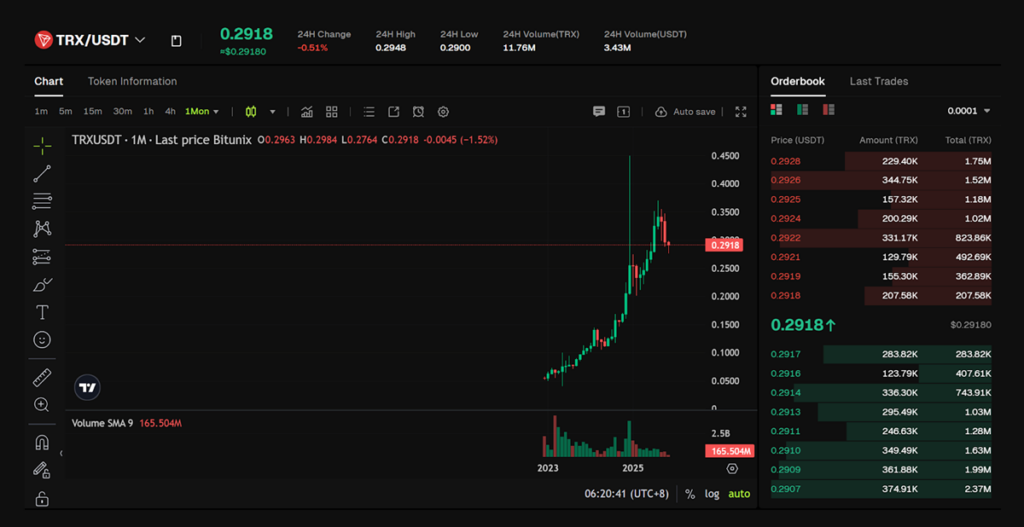
TRX set its last all-time high on December 3, 2024, at $0.4407. In 2025, the asset traded mostly in the $0.28-$0.34 range, with short-term swings tied to the altcoin cycle and stablecoin flows on the network. This behavior reflects fewer idiosyncratic pumps and more of TRON’s function as a payments rail, where low fees and fast settlement matter more than momentary hype.
Throughout 2025, the network consolidated leadership in USDT in circulation and transfers, with estimates around $79-$81 billion of USDT issued on TRON by mid-year and growth in daily usage following a community-approved reduction in Energy fees in the third quarter. In the short term, the BTC/USDT price remains a good indicator of risk appetite.
TRON (TRX) Price Prediction 2026-2030
These TRX price predictions for 2026-2030 are conditional (annual averages and ranges) based on USDT dominance on TRON and low transaction costs, on-chain activity metrics, regulatory risk, and technical execution, including the evolution of USDD.
TRX Price Prediction 2026: The Stablecoin Engine
In trending markets, perpetual crypto futures allow for hedging and directional exposure without leaving the ecosystem. TRON leads stablecoin transfers, especially USDT on TRC-20, concentrating tens of billions in circulation and high daily volumes. This retail-driven use favors low fees and fast settlement. In August 2025, the community reduced Energy costs by about 60%, making transactions cheaper and pushing DAUs to record levels.
That tends to attract more transactional flow and, in turn, more demand for TRX as gas (Bandwidth and Energy resources). In a bull market, users and market makers migrate to cheaper rails. The combination of dominant USDT on TRON and lower fees creates a natural route for on-ramps, remittances, and P2P.
If the network keeps access affordable and maintains leadership in stablecoin rails, TRX beta should track the cycle with lower volatility than more speculative L1s. The projected range of $0.20-$0.35 accounts for regulatory risk and payment competition.
TRX Price Prediction 2026-2027: The dApp and GameFi Push
The strategic challenge is to diversify beyond stablecoin rails. Expanding dApps (DEXs, lending, payments) and GameFi helps retain users and developers against competing L1s and L2s. TRON shows high user activity but volatile TVL. The fee roadmap aims for minimal barriers to entry for apps and on-chain games. Real adoption will depend on new contracts and retention in verticals beyond payments.
On TRON, Energy and Bandwidth consumption not covered by frozen resources results in TRX being burned (fee burn). Rotation between crypto futures trending coins could expand the user base and volumes of TRX. With higher activity, burn tends to rise, creating net deflationary pressure, partially offset by issuance and base inflation. The 2025 cost reduction was calibrated to scale usage.
The 2026 range of $0.22-$0.60 has upside tied to dApp and GameFi launches with real traction, broad wallet integrations, and sustained low costs. The downside appears if TVL and retention lag behind BNB, Solana, and new competitors. For 2027, $0.28-$0.75 reflects a constructive scenario that requires a pipeline of games and finance with real DAU, mature tooling, and sustained fee burn with network security.
TRX Price Prediction 2028-2030: A Mass Adoption Platform?
If ultra-low fees and fast finality remain a structural edge, TRON could serve as an everyday payments rail in emerging markets, especially where wallet-to-wallet and P2P transfers reduce friction and banking costs. The network already handles a large share of small-value USDT transfers, pointing to usage that is more retail than speculative.
The founder remains central to the project’s storytelling and strategic deals, such as the 2018 acquisition of BitTorrent that anchored its content and distribution narrative. At the same time, ongoing investigations and regulatory actions in the United States remain a first-order risk that can influence the asset’s risk premium.
The balance between the ability to close partnerships and regulatory liabilities will shape the multiple the market is willing to assign to TRX. For 2028, a constructive view with a high of $0.95 assumes USDT remains dominant on TRON, UX keeps improving, and the network expands regional on-ramps.
The downside near $0.35 focuses on competition from low-cost L1s and L2s and any regulatory pressure on stablecoins. For 2029, the projected range is $0.45-$1.20. The upper band assumes growth in payments and remittances across emerging markets with TRX as gas and USDT as the transfer medium. The lower band accounts for regulatory shocks or a slowdown in the stablecoin growth driver.
For 2030, the range remains $0.55-$1.60. To sustain values near the top end, the network would need to keep its lead in USDT on TRON, diversify use cases beyond payments, and navigate the period without major adverse legal events. Any reversal in these pillars would compress the price multiple.
Key Factors Influencing TRX’s Price
TRON’s primary use case today is stablecoin rails. The network hosts the largest share of USDT in circulation and concentrates small-value transfer volume, which anchors demand for TRX as the resource to move tokens. If USDT on TRON keeps expanding, it tends to support TRX’s floor.
To raise the ceiling, TRON needs to attract developers and users beyond payments, avoiding dependence on simple dApps. TVL (total value locked), user retention, and stronger developer tools for DeFi and GameFi will be decisive for earning more fee revenue from each transaction. Low-fee L1 and L2 competitors are actively contesting this space.
SEC actions against Justin Sun and associated entities in 2023 and issuer decisions such as Circle discontinuing USDC on TRON in 2024-2025 form a risk backdrop. Any regulatory escalation can pressure multiples and liquidity. Conversely, settlements or legal stability improve perceived risk.
There is also the deflationary tokenomics angle. The resource model lets users freeze TRX to obtain Energy and Bandwidth. When resources do not cover activity, fees are paid and burned, introducing deflationary pressure proportional to usage. Activity spikes can increase net burn and help support price over time.
How to Trade TRON (TRX) on Bitunix
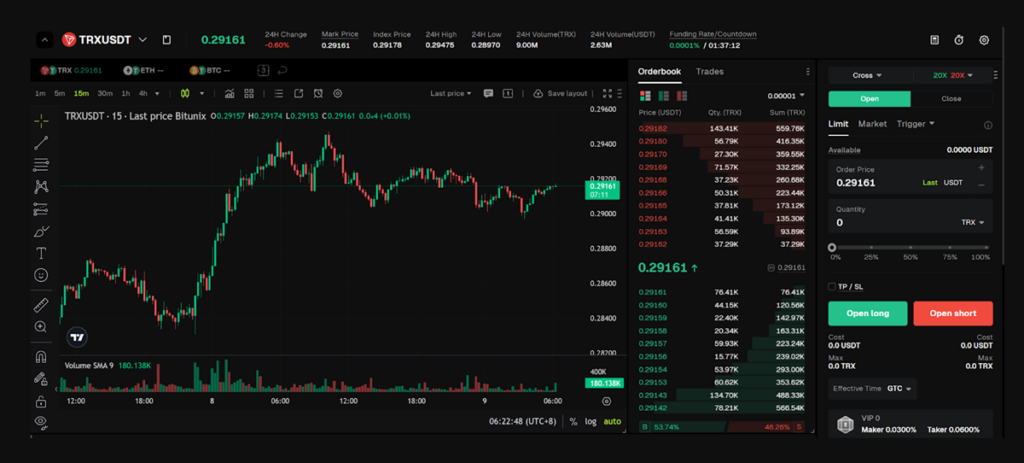
To buy crypto online and trade TRX on spot, go to Bitunix, open the TRX/USDT pair, and use the order box (Limit, Market, TP-SL). With Market, you buy or sell crypto instantly at the current price. With Limit, you set a target price. Keep an eye on the order book, recent trades, and the One Chart view to read market flow. If you prefer mobile, the Bitunix app offers the same layout with a full TradingView interface.
For traders looking for crypto futures with hedging and directional exposure, the perpetual TRXUSDT contract is available on the crypto derivatives exchange, offering variable leverage up to 200x and both isolated and cross-margin modes. Adjust size, leverage, and TP/SL and track real-time P&L. KYC is required only for fiat; for crypto-to-crypto you can trade normally.
Harness the power of the TRON network. Trade TRX on Bitunix with competitive fees and a reliable platform. Sign up today.
Why Trade with Leverage on Bitunix?
- Open positions efficiently and with control.
- Take advantage of KYC being required only for fiat.
- The platform operates under Global Compliance with a Protection Fund and proof-of-reserves for ongoing trust.
- The best liquidity in the market improves execution quality and fills.
Try responsible leverage trading in TRX perpetuals and other pairs. Create your account and start testing now.
Conclusion: Can TRON Outlast Its Critics?
Our TRX price prediction 2026-2030 outlined conditional ranges driven by stablecoin dominance (USDT) as the core engine of usage and gas demand, plus ecosystem growth in dApps and GameFi to lift the value ceiling, and tokenomics with fee burn that strengthens when activity rises.
The most optimistic scenarios require low fees, real user growth beyond payments, and legal stability. TRON remains a target of criticism and controversy, yet the network effect of cheap transfers and its large active user base are measurable realities.
If the network expands use cases without losing its cost advantage, TRX can maintain its floor and pursue upside as the cycle unfolds. If not, low-cost competitors and regulatory noise may compress multiples and cap its potential.
Whether you’re a believer in Justin Sun’s vision or a trader playing the trends, Bitunix is your go-to platform for trading TRX. Get started now!
The content published on the Bitunix Exchange Blog is provided for informational purposes only and does not constitute financial, investment, or trading advice. Cryptocurrency markets are highly volatile and can fluctuate rapidly. Always do your own research and consider your individual financial situation before making any investment decisions. Bitunix does not guarantee the accuracy or completeness of any predictions or analysis shared on this blog and is not liable for any losses incurred as a result of relying on this information.
FAQ Section
Is TRON (TRX) a Good Investment?
It depends on your risk profile. TRON has real usage for wallet-to-wallet payments with stablecoins, especially USDT, with very low fees. That supports demand for TRX as gas. On the other hand, there are risks, including regulatory pressure, reliance on the stablecoin use case, and competition from low-cost L1s and L2s.
Can TRX Reach $1?
Technically it’s possible, but it would require a very high market cap given the circulating supply in the tens of billions of TRX. To reach and sustain $1, the network would need to keep its lead in stablecoin transactions, diversify into dApps with real traction, and navigate the regulatory cycle without major shocks.
Why Is TRON So Popular for USDT Transactions?
It combines low fees, fast settlement, and wide availability of USDT on TRC-20. For people sending small amounts frequently, like remittances, P2P transfers, and regional on/off-ramps, cost and speed are decisive.
What Is the Relationship Between TRON and Justin Sun?
Justin Sun is the founder and a central figure in the ecosystem’s strategy and narrative.
Is TRON a Centralized Blockchain?
TRON uses Delegated Proof-of-Stake (DPoS) with 27 Super Representatives elected by TRX holders. It is efficient and fast, but often viewed as more concentrated than networks with thousands of permissionless validators.
How Do TRON’s Transaction Fees Compare to Ethereum?
On layer 1, TRON fees are usually fractions of a cent, while Ethereum mainnet can get expensive during congestion. However, Ethereum L2s have cut costs significantly. In many cases, L2s offer competitive fees, but TRON remains simple and cheap on-chain.
What Is the USDD Stablecoin?
It is the stablecoin associated with the TRON ecosystem through the TRON DAO Reserve. Launched in 2022, it has undergone design adjustments and aims to hold parity near $1 with collateral mechanisms and reserve governance.
What Are the Main Risks of Investing in TRON?
The biggest is regulatory risk, including actions or decisions involving the founder or stablecoin issuers. There is also concentration in the stablecoin rails use case, competition from low-cost L1s and L2s, and execution risk around attracting and retaining dApps with real TVL and DAU.
How Can I Stake TRX to Earn Rewards?
You can freeze or stake TRX to gain Energy and Bandwidth, and vote for Super Representatives, receiving rewards according to each validator’s policy. You can do this through compatible wallets or platforms that offer delegated staking.
Where Is the Best Place to Trade TRX?
If you want spot and leveraged perpetuals, Bitunix offers One Chart for beginners and advanced users in one panel, deep liquidity, and competitive fees. KYC is required only for fiat.
Glossary
- TRON (Network): A high-throughput blockchain optimized for low-cost transfers and media/content distribution, using Delegated Proof of Stake (DPoS) for block production.
- TRX (Asset): TRON’s native token. It powers transactions and smart-contract execution via the network’s resource model and is used to vote for Super Representatives.
- DPoS (Delegated Proof of Stake): A consensus model where token holders vote for a small set of block producers. On TRON these are called Super Representatives.
- Super Representatives (SRs): The elected validators (27 active at any time) who produce blocks and maintain the network. Voters can delegate TRX and share in rewards per SR policy.
- TRC-20: TRON’s fungible token standard (analogous to ERC-20 on Ethereum). Most stablecoins on TRON, including USDT, use TRC-20.
- USDT (TRC-20): Tether’s dollar-pegged stablecoin issued on TRON. It dominates stablecoin transfers on the network due to low fees and fast settlement.
- USDD: A dollar-pegged stablecoin associated with the TRON ecosystem and governed by the TRON DAO Reserve. Its design targets over-collateralization and peg stability.
- TRON DAO Reserve (TDR): The entity that oversees USDD policy, collateral, and peg defense mechanisms, publishing reserve transparency and governance updates.
- Resource Model: TRON uses two metered resources, Bandwidth for transaction size and Energy for smart-contract computation, to keep end-user fees near zero for routine activity.
- Freezing / Staking TRX: Locking TRX to obtain Bandwidth and Energy and to gain voting power for SRs. Frozen TRX can later be unfrozen after a protocol-defined period.
- Bandwidth: A per-account quota that covers the byte size of transactions. Sufficient Bandwidth lets users send transfers without paying TRX at the time of use.
- Energy: A compute budget consumed by smart-contract execution. Users secure Energy by freezing TRX; if insufficient, Energy is purchased implicitly via fees.
- Fee Burn: When Bandwidth and Energy are insufficient, fees paid in TRX are deducted and a portion is burned, creating usage-linked deflationary pressure.
- Gas (on TRON): Informal term for the TRX cost of computation when Bandwidth and Energy do not fully cover the transaction.
- Account Resources Delegation: Users or dApps can delegate Bandwidth and Energy to other addresses to sponsor activity (e.g., onboarding flows).
- TRON Virtual Machine (TVM): The smart-contract runtime (EVM-compatible at the bytecode level with TRON-specific opcodes and resource accounting).
- BitTorrent Integration: TRON’s 2018 acquisition of BitTorrent added a massive content-distribution user base and introduced products like BTFS.
- BTFS (BitTorrent File System): A decentralized storage layer integrated with the BitTorrent ecosystem for hosting and retrieving content on peer-to-peer networks.
- Stablecoin Rails: The combination of infrastructure, liquidity, and wallets that make TRON a popular network for everyday USDT transfers, remittances, and P2P payments.
- Remittances / P2P Transfers: Cross-border or wallet-to-wallet payments, often small-value and fee-sensitive, an area where TRON’s low costs are a structural advantage.
- On-Ramps / Off-Ramps: Services that convert between fiat and crypto. Regional ramps that support TRC-20 USDT can amplify TRON’s usage as a payments rail.
- TVL (Total Value Locked): The value of assets deposited in TRON-based DeFi protocols. A proxy for liquidity depth and application traction.
- Active Addresses / DAU: Usage metrics that track unique sending and receiving wallets and daily active users, important signals for payments-centric networks.
- Perpetual Futures (Perps): Derivatives without expiry used to hedge or take directional exposure to TRX. Perp prices are kept near spot via the funding rate.
- Funding Rate: Periodic payments between long and short perp traders that help align perp prices with spot. Positive funding pays longs; negative funding pays shorts.
- Open Interest (OI): The total number of open derivative contracts. Rising OI with price can signal stronger trend participation; falling OI can indicate unwinds.
- Isolated vs. Cross Margin: In isolated mode, risk is confined to a single position’s margin. In cross mode, all collateral in the account can be used to back any position.
- Order Book vs. AMM: Order-book DEXs match bids and asks directly; AMMs quote prices from liquidity pools. TRON hosts both models across its DeFi stack.
- Regulatory Risk: Legal actions or policy changes (e.g., regarding stablecoins, exchanges, or specific individuals) that can affect liquidity, multiples, and market access.
- Token Burn (Supply Reduction): Permanent removal of tokens from circulation. On TRON, fee burn links network activity to net supply dynamics over time.
- Bridges / Multichain: Mechanisms to move assets to and from TRON (and within USDD’s multichain design). Bridge trust assumptions and custody models matter for risk.
- Explorers & Tooling: TRONSCAN (block explorer), TRONLink (wallet), developer portals, and analytics dashboards that surface resource usage, fees, and contract data.
About Bitunix
Bitunix is a global cryptocurrency derivatives exchange trusted by over 3 million users across more than 100 countries. The platform is committed to providing a transparent, compliant, and secure trading environment for every user. Bitunix offers a fast registration process and a user-friendly verification system supported by mandatory KYC to ensure safety and compliance. With global standards of protection through Proof of Reserves (POR) and the Bitunix Care Fund, Bitunix prioritizes user trust and fund security. The K-Line Ultra chart system delivers a seamless trading experience for both beginners and advanced traders, while leverage of up to 200x and deep liquidity make Bitunix one of the most dynamic platforms in the market.
Bitunix Global Accounts
X | Telegram Announcements | Telegram Global | CoinMarketCap | Instagram | Facebook | LinkedIn | Reddit | Medium
Leave a Reply