Published on April 18, 2025 by AG - Content Manager • 16 min read
Crypto charts help traders understand price movement instead of guessing where the market may go next. Whether you are watching Bitcoin, Ethereum, Solana, or a new altcoin, a chart shows how price has moved over time and where buyers and sellers may be active.
For beginners, crypto charts can look confusing at first. Candlesticks, timeframes, support, resistance, volume, and indicators may seem like too much information. However, once you understand the basic structure, charts become much easier to read.
A cryptocurrency chart does not predict the future with certainty. Instead, it helps traders study price action, identify trends, plan entries and exits, and manage risk. This guide explains how to read crypto charts step by step, including candlestick charts, chart patterns, volume, indicators, and common beginner mistakes.
What Are Crypto Charts?
Crypto charts are visual tools that show the price movement of a cryptocurrency over time. They help traders see whether a coin is rising, falling, consolidating, or reacting to important price levels.
A crypto chart can show price movement over different timeframes, such as:
1 minute
5 minutes
15 minutes
1 hour
4 hours
1 day
1 week
Short timeframes are often used by day traders and scalpers. Longer timeframes are usually used by swing traders and investors who want to understand the bigger market trend.
Main Parts of a Crypto Chart
Most crypto charts include four main parts.
Chart Elements and Their Meanings:
X-Axis — Shows time
Y-Axis — Shows price
Candles or Line — Shows price movement
Volume Bars — Shows trading activity
Indicators — Shows extra technical signals
The goal is to understand what the chart is telling you about market behavior. Are buyers in control? Are sellers pushing price lower? Is price stuck in a range? Is volume supporting the move?
Types of Crypto Charts
There are several chart types, but beginners usually start with line charts and candlestick charts.
Line Chart
A line chart connects closing prices over time. It is simple and useful for seeing the overall trend.
Line charts are best for:
Beginners
Long-term trend viewing
Simple price direction
Removing short-term noise
However, line charts do not show as much detail as candlestick charts.
Bar Chart
A bar chart shows open, high, low, and close prices for each time period. This is also called OHLC data.
Bar charts are more detailed than line charts, but many traders prefer candlesticks because they are easier to read visually.
Candlestick Chart
A candlestick chart is the most popular chart type in crypto trading. Each candle shows the open, high, low, and close price for a selected time period.
Candlestick charts are useful because they show:
Price direction
Market strength
Buying pressure
Selling pressure
Volatility
Reversal signals
Most crypto traders use candlestick charts because they provide a clear and detailed view of price action.
How to Read Candlestick Charts
A candlestick has two main parts: the body and the wick.
The body shows the difference between the open and close price. The wick shows the highest and lowest price reached during that time period.
Candle Part
Meaning
Open
Price at the start of the candle
Close
Price at the end of the candle
High
Highest price during the candle
Low
Lowest price during the candle
Body
Difference between open and close
Wick
Price range outside the body
A green candle usually means the closing price is higher than the opening price. A red candle usually means the closing price is lower than the opening price.
Green Candle vs Red Candle
A green candle shows that price moved up during the selected time period.
Example:
Open: $60,000
Close: $61,000
A red candle shows that price moved down during the selected time period.
Example:
Open: $60,000
Close: $59,000
A long green candle can show strong buying pressure. A long red candle can show strong selling pressure. However, traders should always check volume and the broader trend before making decisions.
What Timeframes Mean on Crypto Charts
A timeframe controls how much time each candle represents.
For example:
On a 1-minute chart, each candle shows 1 minute of price movement.
On a 1-hour chart, each candle shows 1 hour of price movement.
On a 1-day chart, each candle shows 1 day of price movement.
Choosing the right timeframe depends on your trading style.
Trading Style
Common Timeframes
Scalping
1-minute, 3-minute, 5-minute
Day Trading
5-minute, 15-minute, 1-hour
Swing Trading
4-hour, daily
Long-Term Investing
Daily, weekly, monthly
Beginners should avoid relying only on very short timeframes because they can be noisy and stressful.
How to Identify Trends on Crypto Charts
A trend shows the general direction of price.
There are three main types of trends:
Uptrend
Downtrend
Sideways trend
Uptrend
An uptrend forms when price creates higher highs and higher lows.
This means buyers are generally stronger than sellers. Traders often look for buying opportunities during pullbacks in an uptrend.
Downtrend
A downtrend forms when price creates lower highs and lower lows.
This means sellers are generally stronger than buyers. Traders may avoid long positions or look for short opportunities, depending on their strategy and platform access.
Sideways Trend
A sideways trend happens when price moves within a range instead of clearly rising or falling.
This is also called consolidation. During sideways markets, traders often watch support and resistance levels closely.
Support and Resistance Explained
Support and resistance are two of the most important concepts in chart reading.
Support
Support is a price area where buying interest may appear. It is where price has previously stopped falling or bounced higher.
Traders often use support to plan:
Potential entries
Stop loss placement
Bounce trades
Trend continuation setups
Resistance
Resistance is a price area where selling pressure may appear. It is where price has previously stopped rising or moved lower.
Traders often use resistance to plan:
Take profit levels
Short entries
Breakout confirmation
Risk management
Support and resistance are not exact lines. They are better understood as zones.
What Is Volume in Crypto Charts?
Volume shows how much of a cryptocurrency was traded during a specific period.
High volume means more market participation. Low volume means less market participation.
Volume is important because it helps confirm price movement.
For example:
Price breaks above resistance with high volume: stronger breakout signal
Price breaks above resistance with low volume: possible fakeout risk
Price falls with rising volume: selling pressure may be increasing
Price rises with falling volume: momentum may be weakening
Volume should not be ignored because price movement without participation can be unreliable.
Common Crypto Chart Patterns
Chart patterns are shapes that form on price charts. They help traders understand possible continuation or reversal setups.
Patterns do not always work, so traders should use them with volume, trend, and risk management.
Double Bottom
A double bottom forms when price tests a support area twice and fails to break lower. It can signal a possible bullish reversal.
Double Top
A double top forms when price tests a resistance area twice and fails to break higher. It can signal a possible bearish reversal.
Head and Shoulders
A head and shoulders pattern can signal a possible trend reversal from bullish to bearish.
The inverse head and shoulders pattern can signal a possible reversal from bearish to bullish.
Ascending Triangle
An ascending triangle forms when price creates higher lows while resistance remains near the same level. It is often watched for bullish breakout potential.
Descending Triangle
A descending triangle forms when price creates lower highs while support remains near the same level. It is often watched for bearish breakdown potential.
Bull Flag
A bull flag forms after a strong upward move followed by a small pullback or consolidation. Traders watch it for possible continuation.
Bear Flag
A bear flag forms after a strong downward move followed by a small bounce or consolidation. Traders watch it for possible continuation lower.
Common Candlestick Patterns
Candlestick patterns can help traders understand short-term market psychology.
Doji
A doji candle forms when the open and close are close together. It may show indecision in the market.
Hammer
A hammer has a small body and a long lower wick. It may show that sellers pushed price lower, but buyers recovered before the candle closed.
Shooting Star
A shooting star has a small body and a long upper wick. It may show that buyers pushed price higher, but sellers rejected the move.
Bullish Engulfing
A bullish engulfing pattern happens when a strong green candle fully covers the body of the previous red candle. It may suggest stronger buying pressure.
Bearish Engulfing
A bearish engulfing pattern happens when a strong red candle fully covers the body of the previous green candle. It may suggest stronger selling pressure.
Candlestick patterns are stronger when they appear near support, resistance, or trend reversal zones.
Best Indicators for Reading Crypto Charts
Indicators are tools that use price, volume, or momentum data to help traders analyze the market.
Beginners should not use too many indicators at once. Two or three well-understood indicators are usually better than a crowded chart.
Moving Averages
Moving averages smooth price data to show trend direction.
Common moving averages include:
9 EMA
20 EMA
50 EMA
200 EMA
If price stays above a moving average, the market may be in an uptrend. If price stays below it, the market may be in a downtrend.
RSI
RSI stands for Relative Strength Index. It measures momentum and is often used to identify overbought or oversold conditions.
Common RSI readings:
Above 70: potentially overbought
Below 30: potentially oversold
However, RSI can remain high during strong uptrends and low during strong downtrends, so it should not be used alone.
MACD
MACD stands for Moving Average Convergence Divergence. It helps traders identify momentum shifts and trend changes.
Traders often watch MACD crossovers and histogram changes for potential signals.
Bollinger Bands
Bollinger Bands show volatility around price. When the bands expand, volatility is increasing. When the bands contract, volatility is decreasing.
A tight Bollinger Band squeeze may suggest that a larger move could happen soon, but it does not predict the direction by itself.
How to Read Crypto Charts for Day Trading
Day traders use charts to make decisions within the same trading day. They usually focus on shorter timeframes and fast price movement.
For day trading, traders often watch:
5-minute chart for short-term movement
15-minute chart for intraday structure
1-hour chart for trend direction
Volume for confirmation
Support and resistance for entries and exits
RSI or MACD for momentum
A simple day trading process may look like this:
Check the 1-hour trend.
Mark support and resistance.
Move to the 15-minute chart.
Wait for a pullback, breakout, or confirmation.
Check volume.
Set stop loss and take profit before entering.
Day trading can be risky because crypto markets move quickly. Beginners should practice carefully and avoid using high leverage without experience.
How to Analyze Crypto Charts Step by Step
Here is a simple chart reading process for beginners.
Step 1: Choose the Right Timeframe
Start with a higher timeframe, such as the 4-hour or daily chart, to understand the main trend. Then move to a lower timeframe if you are looking for an entry.
Step 2: Identify the Trend
Ask whether price is making higher highs, lower lows, or moving sideways.
Step 3: Mark Support and Resistance
Identify price areas where the market has reacted before.
Step 4: Check Volume
See whether volume supports the current move. A breakout with strong volume is usually more reliable than a breakout with weak volume.
Step 5: Add Indicators
Use one or two indicators to support your analysis. For example, a trader may combine moving averages with RSI.
Step 6: Plan Entry and Exit
Before entering, decide:
Entry price
Stop loss
Take profit
Risk-reward ratio
Position size
Step 7: Review the Trade
After the trade closes, review whether the setup followed your plan. This helps improve your chart reading over time.
Example: Reading a Bitcoin Chart
Assume BTC is trading near $65,000.
A beginner chart analysis may look like this:
Daily trend: BTC is above the 50-day moving average.
Support: $62,000 area.
Resistance: $68,000 area.
Volume: Rising volume during upward candles.
RSI: Near 60, showing positive momentum but not extreme.
Plan: Watch for a pullback near support or a breakout above resistance.
This does not mean BTC must rise. It simply shows how a trader can organize chart information into a plan instead of guessing.
Common Mistakes When Reading Crypto Charts
Using Too Many Indicators
Too many indicators can make the chart confusing. Beginners should keep charts simple and learn each tool properly.
Ignoring Volume
Volume helps confirm whether a move has real participation. A breakout without volume can fail quickly.
Chasing Green Candles
Buying after a large price move can be risky because the market may pull back. Beginners should wait for structure and confirmation.
Forgetting the Bigger Trend
A bullish setup on a 5-minute chart may fail if the daily trend is strongly bearish. Always check higher timeframes.
Drawing Random Support and Resistance
Support and resistance should be based on areas where price has reacted clearly, not random levels.
Trading Without Stop Loss
Even good chart setups can fail. A stop loss helps protect capital when the market moves against the trade.
Treating Patterns as Guarantees
Patterns are possibilities, not certainties. A chart pattern should always be combined with risk management.
How to Use Crypto Charts on Bitunix
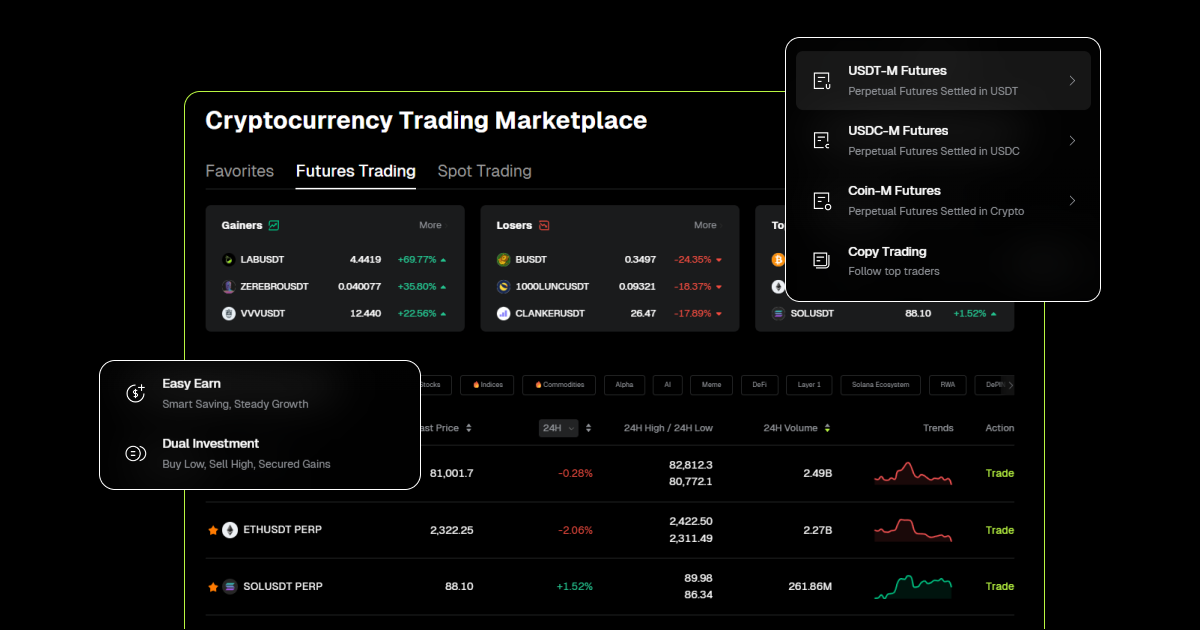
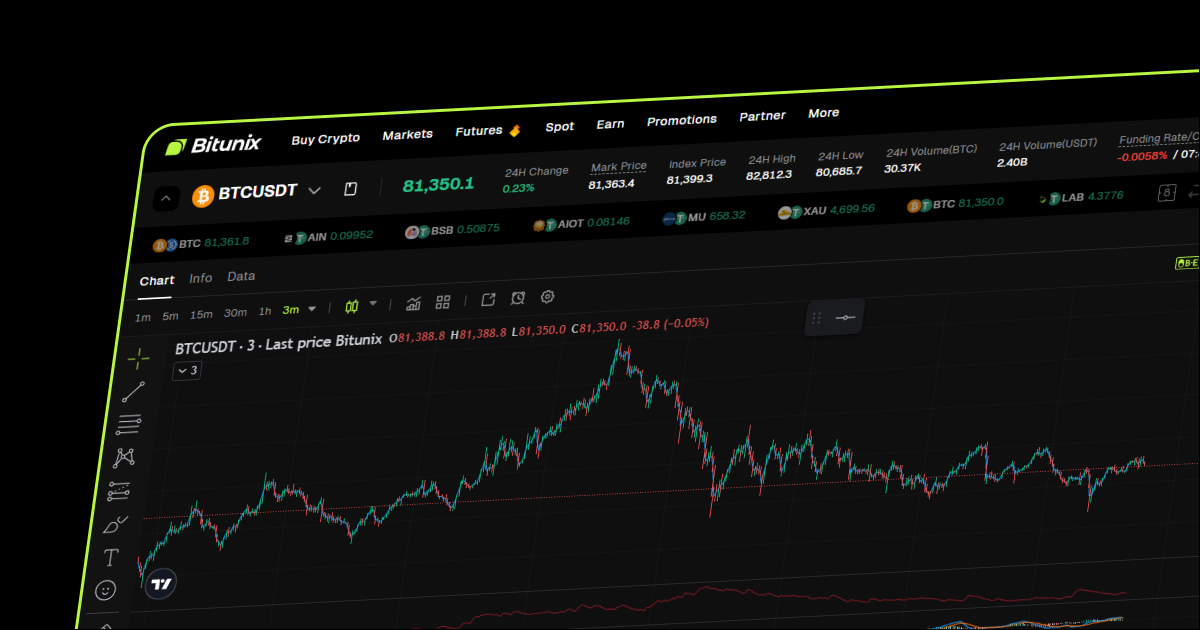
Bitunix provides real-time charts for spot and futures markets. Bitunix Pro also supports TradingView charts, alerts, and secure account tools on mobile.
On Bitunix, traders can use charts to:
Monitor BTC, ETH, SOL, and altcoin price movements
Track spot and futures markets
Use candlestick charts
Apply technical indicators
Watch volume
Plan entries and exits
Set alerts where available
Manage trades with order tools
A strong charting setup helps traders move from emotional decisions to structured analysis.
Conclusion
Crypto charts are one of the most important tools for traders. They show price movement, market structure, volume, trends, support, resistance, and potential trading setups.
Beginners should start with the basics: candlestick charts, timeframes, trends, support and resistance, volume, and a few simple indicators such as moving averages, RSI, and MACD. Once these tools are understood, traders can begin building more structured strategies for spot or futures trading.
Charts do not guarantee profit, but they help traders make better decisions. On Bitunix, users can access real-time spot and futures charts, technical tools, and mobile charting features to analyze crypto markets more confidently.
FAQs
What are crypto charts?
Crypto charts are visual tools that show the price movement of a cryptocurrency over time. They help traders analyze trends, support, resistance, volume, and market behavior.
What is the best crypto chart for beginners?
Candlestick charts are usually the best choice for beginners because they show open, high, low, and close prices in a clear visual format.
How do you read candlestick charts?
Each candlestick shows the open, close, high, and low price for a selected timeframe. A green candle usually means price closed higher, while a red candle usually means price closed lower.
What is support in crypto charts?
Support is a price area where buying interest may appear and price may stop falling or bounce higher.
What is resistance in crypto charts?
Resistance is a price area where selling pressure may appear and price may stop rising or move lower.
Which indicators are best for crypto charts?
Popular beginner indicators include moving averages, RSI, MACD, and Bollinger Bands. Traders should use indicators with price action and volume instead of relying on one signal.
How do I read crypto charts for day trading?
Start by checking the larger trend, then mark support and resistance, review volume, use a lower timeframe for entries, and set stop loss and take profit levels before trading.
Are chart patterns reliable?
Chart patterns can be useful, but they are not guaranteed. They work best when combined with volume, trend analysis, and risk management.
Can I trade only using crypto charts?
Some traders use technical analysis as their main method, but charts should still be combined with risk management, market news awareness, and proper position sizing.
Does Bitunix have crypto charts?
Yes. Bitunix provides real-time charts for spot and futures markets. Bitunix Pro also supports TradingView charts and mobile charting tools.
Glossary
Crypto Chart: A visual display of cryptocurrency price movement over time.
Candlestick: A chart element that shows open, high, low, and close prices for a selected time period.
Open Price: The price at the start of a candle.
Close Price: The price at the end of a candle.
High Price: The highest price reached during a candle.
Low Price: The lowest price reached during a candle.
Wick: The thin line above or below a candle body showing the highest and lowest price.
Timeframe: The period represented by each candle, such as 5 minutes, 1 hour, or 1 day.
Support: A price area where buying interest may appear.
Resistance: A price area where selling pressure may appear.
Trend: The general direction of price movement.
Uptrend: A market condition where price forms higher highs and higher lows.
Downtrend: A market condition where price forms lower highs and lower lows.
Sideways Market: A market condition where price moves within a range.
Volume: The amount of an asset traded during a specific period.
Breakout: A move above resistance or below support.
Fakeout: A false breakout that quickly reverses.
Moving Average: An indicator that smooths price data to show trend direction.
RSI: Relative Strength Index, a momentum indicator used to identify overbought or oversold conditions.
MACD: Moving Average Convergence Divergence, an indicator used to study momentum shifts.
Bollinger Bands: A volatility indicator that shows price movement around a moving average.
Stop Loss: An exit level used to limit losses.
Take Profit: An exit level used to secure gains.
Risk-Reward Ratio: A comparison between the planned risk and planned reward of a trade.
About Bitunix
Bitunix is a global cryptocurrency derivatives exchange trusted by over 5 million users across more than 100 countries. The platform is committed to providing a transparent, compliant, and secure trading environment for every user. Bitunix offers a fast registration process and a user-friendly verification system supported by mandatory KYC to ensure safety and compliance. With global standards of protection through Proof of Reserves (POR) and the Bitunix Care Fund, Bitunix prioritizes user trust and fund security. The K-Line Ultra chart system delivers a seamless trading experience for both beginners and advanced traders, while leverage of up to 200x and deep liquidity make Bitunix one of the most dynamic platforms in the market.
Disclaimer: Trading digital assets involves risk and may result in the loss of capital. Always do your own research. Terms, conditions, and regional restrictions may apply.
Table Of Contents
Ready To Place Your Next Trade?
Choose a market, set your order, and manage risk in one place.
AG | Content Manager | Bitunix
May 18, 2026 No Comments
Explore how top traders balance crypto volatility and TradFi macro trends in 2026. Join the Bitunix Showdown Tournament and compete for 630,000 USDT in prizes.
AG | Content Manager | Bitunix
May 12, 2026 No Comments
Compare Bitunix, BingX and BloFin for fiat-to-crypto buying in 2026, including local currency options, payment methods, fees, safety and trading access.
AG | Content Manager | Bitunix
May 12, 2026 No Comments
Compare Coinbase and Kraken in 2026, including US availability, restricted regions, fees, security tools, mobile access, trading services and user eligibility.
AG | Content Manager | Bitunix
May 12, 2026 No Comments
Compare Bitunix, KuCoin and BingX across security, fees, futures trading, mobile access, trading tools and user experience to choose the best crypto exchange in 2026.